

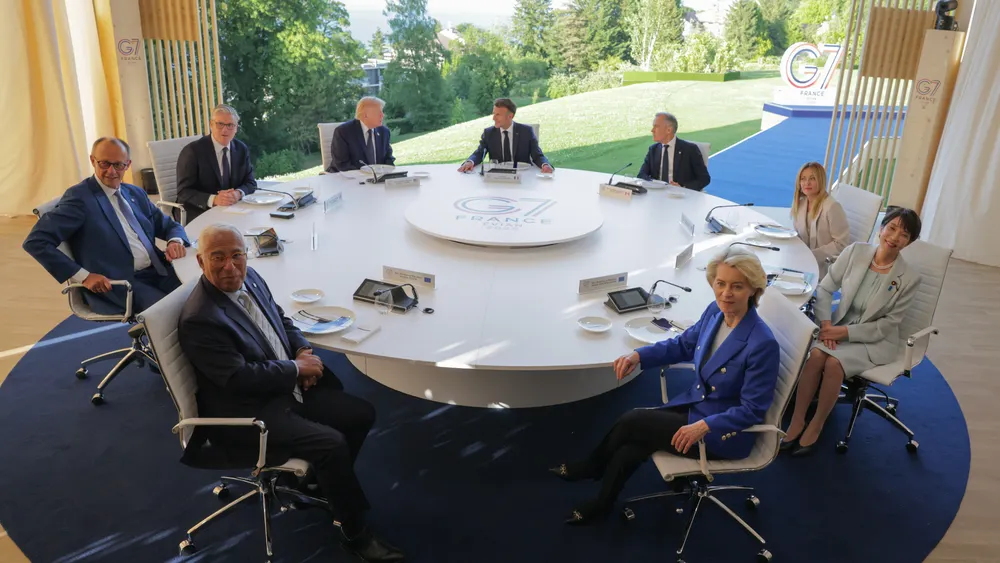
'The Deal with the Islamic Republic of Iran is now complete. Congratulations to all!' Trump wrote on Truth Social on Sunday evening. Then he boarded Air Force One and flew to the G7 summit in Évian-les-Bains, France, to inform the world's most powerful diplomatic club of what had been decided without it.
The G7 — Canada, France, Germany, Italy, Japan, the United Kingdom and the United States — convened at a lakeside resort in the French Alps on Monday morning. The terms of a ceasefire agreement covering a three-and-a-half-month war had already been posted on social media. The deal had been negotiated between Washington, Tehran and Oman. G7 allies spent Tuesday scrambling to restore Ukraine to an agenda the Iran deal had consumed entirely. French officials dropped plans for a sweeping final statement, settling instead for narrower joint statements on critical minerals and drug trafficking. There was no joint G7 position on Iran. There was none to record.
This is what the G7 has become. Not a coordinating forum but a venue where one member announces decisions and the others adjust. The club that once set the terms of the global economic order now receives briefings about wars it did not authorise, ceasefires it did not negotiate and agreements it did not sign. The other six leaders sat in Évian while Trump told reporters the deal was 'very powerful,' that Iran 'will not' be allowed to obtain a nuclear weapon and that Netanyahu needed to be 'more responsible with respect to Lebanon.' They nodded and asked about Ukraine.
The deal itself deserves scrutiny that its celebratory announcement did not invite. The memorandum of understanding, due for formal signing in Geneva on Friday, ends the US blockade of Iranian ports, reopens the Strait of Hormuz and begins 60 days of nuclear negotiations. The full text has not been released. What it confirms, on Trump's own authority in a New York Times interview, is that Iran will be permitted low-level enrichment.
That sentence has a history. In 2018, Trump withdrew from the JCPOA, the 2015 nuclear agreement negotiated under Obama, calling it the worst deal ever. His objections were specific: it permitted enrichment, failed to address ballistic missiles and did not curb Iran's regional activities. The MOU he signed on Sunday permits enrichment. It allows IAEA inspectors back in. It offers sanctions relief. These are the three pillars of what he condemned in 2015. Obama told ABC News before the announcement: 'It is doubtful that any agreement that arises is going to be significantly different from the deal that we had in the first place.' Trump flew to France to prove him right.
This war began on February 28, 2026. On that same morning, a Tomahawk missile struck the Shajareh Tayyebeh Primary School in Minab, a girls' school in southern Iran's Hormozgan province, during class hours. At least 165 people were killed, most of them schoolgirls aged between seven and 12. The United States has not accepted responsibility. The Truth Social post announcing the deal's completion did not mention them. Congratulations to all.
The G7 will issue its narrower statements on critical minerals, drug trafficking and supply chains. Nobody who was not in the room where the deal was made will have written a word of it.


