

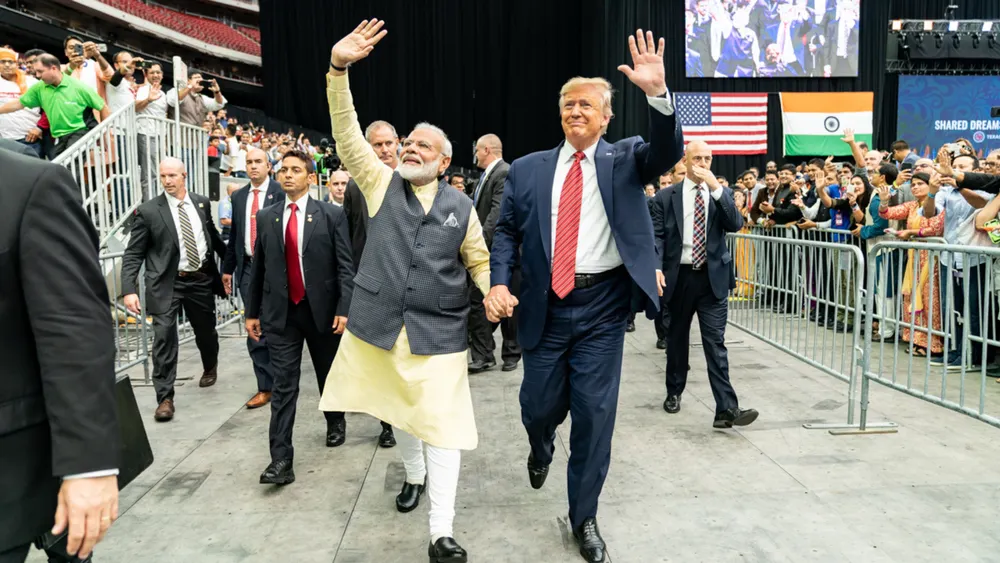
Modi's bilateral with Trump, confirmed for June 17 on the sidelines of the G7 in Évian-les-Bains, covers trade tariffs, defence cooperation and the Indo-Pacific partnership. It does not mention Patnala Suresh, Aditya Sharma or Shivanand Chaurasia.
It should.
Those are the names of the three Indian sailors killed on June 10 in what the vessel's operator called an unprovoked military action against a civilian commercial vessel in international waters. Dubai-based IOS Marine, which manages the MT Settebello, says no warning was given before American forces struck, directly contradicting the US military's account. The International Maritime Organization's Secretary-General condemned the attack as simply unacceptable. Legal analysts note the strike raises serious questions about the protection of civilian merchant shipping under the UN Convention on the Law of the Sea.
The Settebello was not an isolated incident. Three separate vessels carrying Indian crew have been struck by US forces in the Gulf of Oman since June 8: the MT Marivex on June 8, the MT Settebello on June 10 and the MT Jalveer on June 11, whose engine room was struck by two Hellfire missiles. India has over 300,000 sailors in global shipping fleets. Manoj Yadav, General Secretary of the Forward Seamen's Union of India, has stated publicly that he refuses to believe the US did not know the nationalities of those on board. 'I absolutely refuse to believe that the US lacked information regarding the nationalities of the people on board those ships,' he said. His union has called for full accountability.
India protested. Twice it summoned the US chargé d'affaires. Jaishankar called the actions 'not justified'. The State Department's readout of the same call did not use the words India, Indian, mariners or killed. It discussed compliance. It instructed a sovereign state that its vessels must obey American military orders in international waters. A country whose citizens were illegally killed was told, in return, to fall in line.
What followed has been more troubling still. The Indian government's own statements have at points described the struck vessels as 'sanctioned ships', adopting elements of Washington's framing rather than contesting it. Aditya Sharma's father has one demand. 'I have only one demand,' Rajesh Sharma told an Indian news agency, 'that my son's remains be brought back.'
Modi arrives in Évian carrying a particular self-description. In February he declared that India had evolved into a confident voice of the Global South, shaping global conversations and contributing to a more balanced world order. He will repeat those words at Évian as a guest at the table of seven wealthy nations, invited as an outreach partner rather than a member.
The test of those words is not rhetorical. It is whether he uses them in the room.
If the bilateral produces anything on this question, the minimum standard is clear: a public acknowledgement from Washington that Indian citizens were killed, a commitment to an independent investigation and a stated assurance that vessels carrying Indian crew will not be targeted as long as India is not a party to the conflict. Anything short of that is a communiqué, not accountability. A joint statement that mentions cooperation and shared values without naming the dead is not a resolution. It is a burial.
Every time a government of India absorbs an illegal act against its citizens in the interest of bilateral warmth, it confirms what that warmth is worth. India is a partner whose losses are manageable and whose protests are filed, not answered. A strategic partnership worth the name cannot silence India on the illegal killing of its own citizens. What exists instead is a hierarchy with better branding.
Modi has built his political identity on the proposition that India has arrived. That the era of being lectured is over. On June 17 he will sit across from the man whose government struck civilian vessels carrying Indian workers without warning, whose military described those workers as participants in illegal activity and whose State Department told India to comply when India called to protest. The proposition will be tested in that room, not in the statement issued afterwards.
The families of Patnala Suresh, Aditya Sharma and Shivanand Chaurasia are not in Évian. Their prime minister is.


