

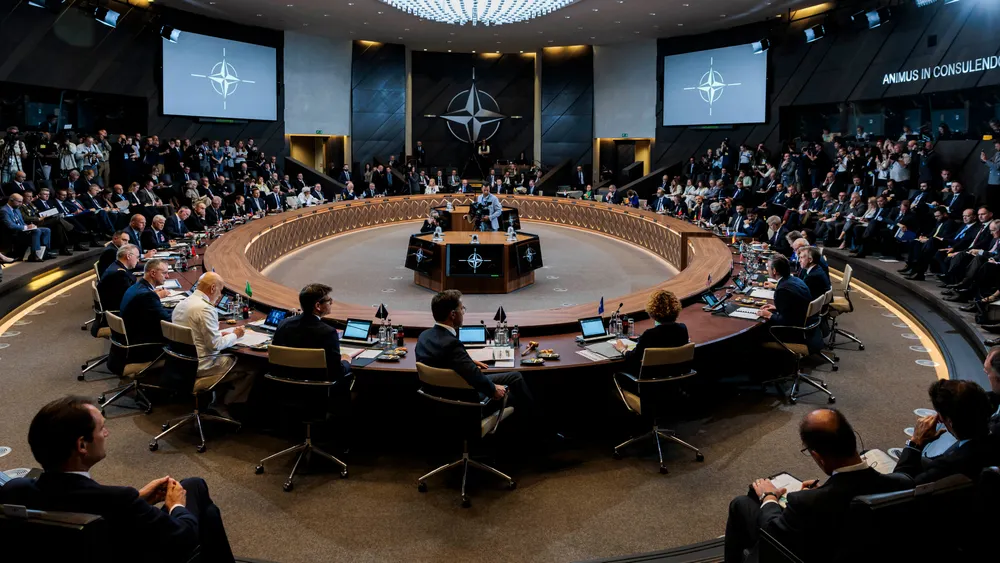
That is the word Pete Hegseth used in Brussels on Thursday to describe what America's NATO allies did during the Iran war. European countries, 'too many of them,' he said, refused US forces access to their bases and airspace when Washington asked. For this, Hegseth called them shameful. He announced a six-month Pentagon review of all 80,000 US troops stationed across Europe. He said some countries would 'fail' the review and others would 'pass with flying colors.' He called the whole thing NATO 3.0. He said it without apparent embarrassment, in the building where the alliance has met since 1967, to the ministers of the countries that helped build it.
Let us be precise about what the Europeans actually did and why they did it.
The United States and Israel launched Operation Epic Fury on February 28 without consulting NATO. The operation had no UN Security Council authorisation. It had no Article 5 basis; Iran had not attacked a NATO member. Several European governments concluded, independently and publicly, that the operation was illegal under international law. Spain's Prime Minister Pedro Sánchez said precisely that: 'We are a sovereign country that does not want to participate in illegal wars.' Spain's government rejected every flight plan connected to the operation, including refuelling aircraft. The bilateral defence agreement governing US access to Spanish bases requires mutual consent for offensive operations. Spain was not consulted before February 28. Its legal case for refusal is, by any reading of the treaty, coherent.
Rota is not a peripheral installation. It is home to several Aegis ballistic missile defence destroyers, central to NATO's missile shield across the Mediterranean, the Black Sea and the North Atlantic. The base has been expanding its destroyer fleet for years under an agreement reached with Washington. If the review produces a withdrawal from Rota, the gaps in European air defence will not be filled by America's willingness to bomb its enemies. They will simply be gaps. The missile shield Hegseth is punishing Spain for hosting will be the one that no longer functions.
The Europeans were not freeloading. NATO Secretary-General Mark Rutte noted on Thursday, in the same meeting where Hegseth was lecturing, that European allies spent $90 billion more on defence last year, a 20 per cent increase over 2024. They have pledged to reach five per cent of GDP on defence by 2035, more than double the previous target. This is the fastest expansion of European defence spending since the Cold War. They did not refuse to defend themselves. They refused to bomb Iran. Those are not the same thing. Hegseth is treating them as identical.
The review Hegseth announced is not a security policy. It is a punishment structured as a bureaucratic process. Some countries will pass. Germany will pass; it gave access to its bases for Iran operations and has spent twelve years rebuilding its military. Romania will pass. Greece will pass. Poland will almost certainly gain troops. Spain will fail. Possibly France. The countries being penalised are those that exercised the sovereign right, enshrined in their bilateral agreements, consistent with international law, supported by their publics, to decline participation in a war they were not consulted about and did not believe was legal.
NPR reported that Hegseth also used the meeting to lecture European allies about gender equity and climate change consuming their defence budgets, precisely the rhetoric that has defined Washington's contempt for European governance since January 2025. 'Instead of tanks and fighters and air defenses, the focus has been on gender equity and climate change and defense austerity,' he said. NATO's own figures show this is false. European defence budgets have risen sharply for three consecutive years. The facts did not interrupt the speech.
NATO has survived 77 years because its members accepted that collective security meant shared decisions. The war on Iran was not a shared decision. It was announced. The Europeans were informed, not consulted. When they declined to support it, they were called shameful. When they spent more on their own defence than ever before, they were called freeloaders. When they exercised their treaty rights, they were told their troops would be reviewed.
Spain said it was a sovereign country that did not wish to take part in illegal wars. For this, its naval base is now under threat. The alliance Washington built is being dismantled not by its enemies but by the country that built it, because its partners had the consistency to mean what they signed.


