Rahul Gandhi was asked about the Iran war at the University of Chicago on 18 November. The session was a fireside conversation moderated by Professor Robert Pape, and the expectation was that the leader of India's principal opposition would have something specific to say about one of the most consequential conflicts in India's immediate strategic neighbourhood. What Gandhi said was that he was 'pretty shocked' — the phrase he used, with the precise emphasis of someone who has had time to absorb a fact and has not quite finished being surprised by it — that Pakistan is negotiating between the United States and Iran while India is 'just looking.'
The remark landed as an indictment. Gandhi was not complaining about Pakistan's diplomatic success. He was describing India's absence from a conversation that, by any measure of regional weight, India should be part of. Pakistan — smaller in every economic dimension, governed by a military-civilian arrangement that has never resolved its own internal contradictions, managing a relationship with the United States that oscillates between client and liability — is at the table in the Iran war's diplomatic back-channels. India is watching.
The following day, the argument acquired new evidence. Trump, Putin and Xi emerged from their trilateral summit in Shenzhen on 19 November — the first time the three leaders had gathered together — and Gandhi posted about the meeting on social media, saying that a Congress-led government would have ensured India was at that table. He alleged that Modi was 'compromised.' The BJP's response accused Gandhi of harming India's standing abroad and pointed to Modi's global recognition as evidence of strength rather than the dependence Gandhi was implying. What it did not do, across either the Chicago speech or the Shenzhen social media post, is dispute the specific observations Gandhi had made: that Pakistan is talking to both Washington and Tehran, and that India was absent from the room when the three most powerful leaders in the system met in Shenzhen.
The Friendship Theory
The more significant thing Gandhi said at Chicago was not the diagnosis. It was the argument about why.
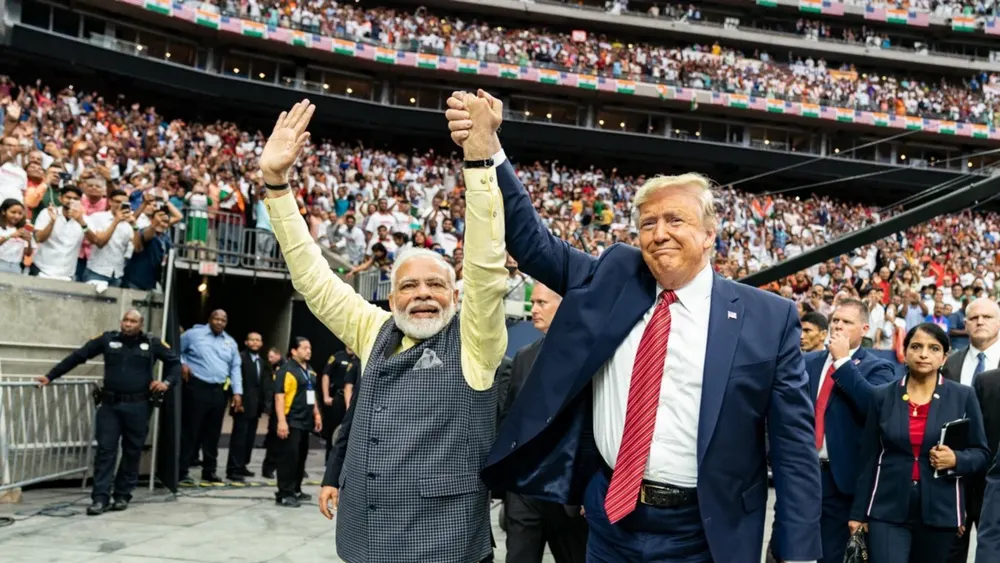
Modi has built his foreign policy presentation — and, to a large degree, his domestic political brand — around the proposition that personal relationships with world leaders translate into strategic outcomes. The 'Modi-Trump friendship,' the 'Modi-Putin personal chemistry,' the 'Modi-MBS rapport' — each has been offered as evidence of India's growing global stature, as proof that India's prime minister operates at the highest table of world affairs. The images are carefully curated: the bear hug at the airport, the joint press conference, the first-name warmth. The implication, sustained over a decade of foreign policy communication, is that India's interests are served because important men like India's prime minister.
Gandhi's critique at Chicago went directly to the architecture of that claim. 'Friendship is not the point,' he said. 'Who gives a damn about friendship? Do you really think that geopolitics is going to work because the guy is your friend? He's leading a structure. He's got a whole economic system under him. He's not going to make decisions based on whether he likes you or doesn't like you.'
The argument is not partisan in its logic, whatever its political context. It is the standard account of how international relations actually work — the account that professional diplomats have believed since the collapse of the Congress of Vienna's monarchical personal diplomacy in the nineteenth century. Leaders represent systems of interest. Bilateral relationships are the product of those interests, not their cause. A prime minister who has genuine personal warmth with Donald Trump will find that warmth suspended the moment American interests and Indian interests diverge — because Trump, like any leader, operates within a structure that his personal preferences cannot override. The hug at the airport did not prevent the tariff dispute. The personal chemistry did not prevent American pressure on India's oil purchases from Russia. The 'friendship' was a marketing category; the strategic relationship was something else entirely, operating on its own logic.
What Gandhi is describing, in the compressed vocabulary of a university lecture, is a distinction between relationship and leverage. Leverage is what determines whether a country's voice is heard in a crisis. It comes from economic weight, from the credibility of independent judgment, from the institutional depth of diplomatic engagement, from the ability to offer something — a mediating position, a supply chain, a market, a legitimating narrative — that the parties to a conflict actually need. Friendship is what leaders perform for cameras. The two are not the same thing, and conflating them has been the central confusion of Modi's foreign policy presentation.
What Leverage Looks Like
Pakistan is negotiating with the United States and Iran because Pakistan has leverage. Not despite its dysfunction, but, in a specific and uncomfortable sense, partly because of the specific position that dysfunction occupies. Pakistan's ability to influence Taliban-controlled territory on Iran's eastern flank, its intelligence networks across the region, its role as a geographic pivot between South and West Asia, and the American need for a channel into Tehran that bypasses the formal hostility of the blockade: these are the components of a leverage package that Islamabad can offer. They are not products of Pakistan's economic weight or democratic legitimacy. They are products of Pakistan's specific position in the regional geography of a specific conflict.
India's leverage package is objectively larger. The world's fifth-largest economy. The largest democracy. A population of 1.4 billion that is simultaneously a supply chain partner, a consumer market and a remittance-sending diaspora at every significant node of the global economy. A country that has historically maintained relationships with Iran, the United States, Russia and Israel simultaneously — the kind of multi-directional engagement that makes India a natural interlocutor in a conflict that touches all four. India imports Iranian oil through alternative payment arrangements; Indian companies operate in Iranian ports; the Indian diaspora spans both sides of every Western-Iranian diplomatic rupture. In its basic strategic position, India has what is needed to be relevant.
What it has not done, under Modi, is convert that position into the institutional diplomatic engagement that relevance requires. The personal relationship with Trump did not build American respect for Indian strategic independence; it built Indian participation in the American strategic communications operation — the Quad, the I2U2, the technology partnership frameworks that are genuinely valuable but that also anchor India's diplomatic positioning closer to Washington than India's traditional autonomy would have required. When the Iran war began, India's established posture — aligned with the United States on technology and security architecture, managing its Russian energy dependence quietly, maintaining its Iranian port investments in the background — was too complicated to translate into a clear diplomatic contribution. India could not offer to be Washington's surrogate in Tehran, because it does not play that role. It could not offer to be an independent mediator, because a decade of personal-relationship diplomacy had not built the institutional credibility that independent mediation requires. It was, in the precise sense Gandhi used at Chicago, watching.
What He Didn't Say
Gandhi said at Chicago that India once led the Non-Aligned Movement and that he would like to see New Delhi regain that standing. He said no country — the United States, Israel, Russia or China — should hold India back from playing its rightful role on the global stage. During the same US tour he said that India is sitting on an 'economic disaster,' that its manufacturing base is broken, that the economic model stopped producing results almost a decade ago.
These are propositions, not policies. They describe an aspiration and a disposition, not the specific diplomatic work — the relationship-building with Tehran that is distinct from alignment, the credibility with Washington that is distinct from dependence, the institutional investment in diplomatic capacity — that recovering India's strategic autonomy would require. Gandhi is correct that India should be in the room. He is less specific about how India gets back in, and that omission is worth sitting with.
It is not, in fairness, an unreasonable omission from a university lecture. Opposition leaders do not write foreign policy from the Chicago lecture circuit. But the gap between the critique, which is structurally sound, and the alternative, which remains at the level of instinct, is real. 'India has a mind of its own' is a better starting premise than 'Trump is my friend.' It is not, by itself, a doctrine.
The Non-Aligned Movement, at its peak under Nehru and Nasser and Tito, was not simply an aspiration toward independence. It was a carefully constructed institutional architecture — a set of principles, a conference infrastructure, a diplomatic network — that gave small and medium powers a collective voice in the Cold War's binary logic. What it required, to work, was sustained diplomatic investment: the building of relationships with governments across the ideological divide, the cultivation of credibility with both superpowers as a genuinely independent actor, the willingness to take positions that annoyed both sides when Indian interests required it. That is not personal diplomacy in the Modi sense. It is institutional diplomacy, slow and expensive and not easily photographable.
The Question He Left Open
The BJP's response to Gandhi's November critique operated on two registers, and both are worth examining. The 'global consensus builder' claim — offered against the Chicago speech — is a claim about India's centrality in multilateral processes that does not address the specific fact Gandhi cited: that Pakistan is at the table in the most consequential regional conflict of the moment, and India is not. The charge that Gandhi was damaging India's image abroad — offered against the Shenzhen social media post — is a charge about where Gandhi was saying it, not about whether the observation is accurate. India was not in the room when Trump, Putin and Xi met in Shenzhen. Neither BJP response disputes that.
Gandhi was 'pretty shocked.' The shock, sustained across two days and two specific absences, points to something beyond a debating point. It is not about India's general weight in the world, which remains substantial. It is about India's specific position in the moment — absent from a war in its own neighbourhood being managed in part by a country weaker than India by most measures, and absent from a great-power gathering to which it was not invited and apparently did not expect to be. These two absences are related. A foreign policy organised around personal warmth with individual leaders, rather than around the institutional diplomatic work that positions a country to be useful in crises it did not choose, produced them both.
Gandhi's argument at Chicago — that friendship is not the point, that leaders act on structures and interests, that 'who gives a damn about friendship' — is correct as a theory of how international relations work. Whether the Congress party, in government, would have made the specific investments in diplomatic independence that the theory requires is a different question, and an unanswerable one. What can be said is this: the theory is right. The evidence is Pakistan at the Iran table and India absent from Shenzhen. And a foreign policy built on photographs of hugs has not changed either.
This Analysis piece is free to read. Future Analysis pieces will be available to registered DiploPolis members first. Free registration takes 30 seconds. No credit card required.
Find this piece interesting?
Dispatches by DiploPolis delivers sharp analysis and pointed commentary on power, politics, diplomacy, and world affairs — directly to your inbox.
No neutrality. No noise. Just argument.