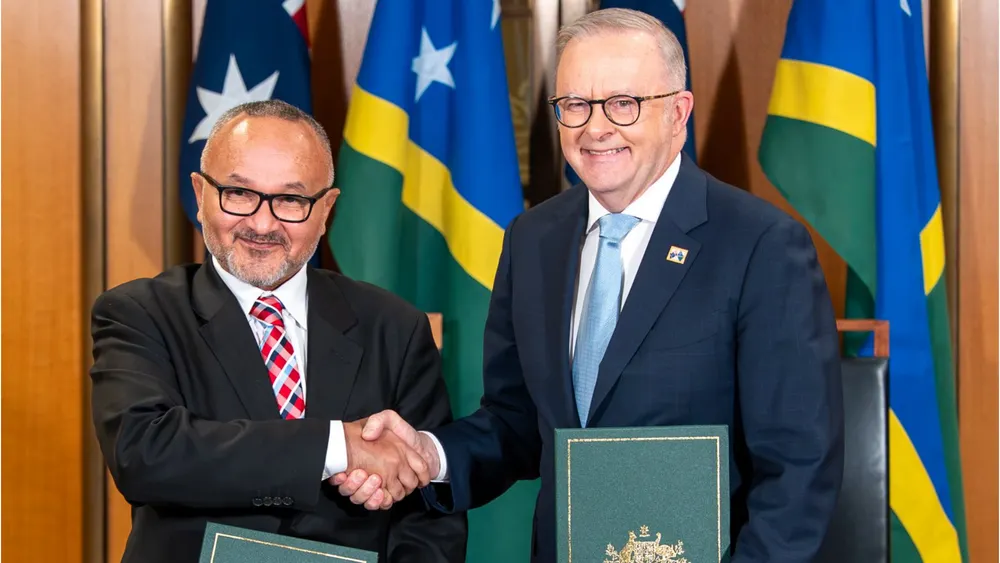
On 25 November, Solomon Islands Prime Minister Matthew Wale signed a security treaty with Australia in Canberra. The China-Solomon Islands security pact signed under former Prime Minister Manasseh Sogavare in 2022 was not renewed. In its place: an Australian security partnership worth AU$740 million over a decade, with a clause requiring Honiara to consult Canberra before entering security or infrastructure agreements with countries outside the Pacific Islands Forum.
That consultation clause is the core of the deal. It is not a request. It is a structural constraint, written into the treaty, limiting Solomon Islands' sovereign capacity to enter agreements with any external actor — read: China — without Australian foreknowledge and, implicitly, Australian approval. Honiara has agreed to that constraint. Beijing has lost its Pacific foothold.
The 2022 security pact gave China something no Pacific power had allowed since the end of the Cold War: a formal legal basis for a military presence in the South Pacific. The agreement's terms, leaked and later confirmed, allowed China to deploy naval vessels and personnel to Solomon Islands, potentially giving the PLA Navy a base within striking distance of Australia's north-east coast, PNG, and the critical shipping lanes between Asia and North America. Canberra's alarm was genuine. The pact represented not a diplomatic setback but a strategic shift — a potential alteration to the geographic buffer that Australia has treated as the first line of its defence since the Second World War.
Matthew Wale came to power on a different platform from Sogavare. He was elected as a sceptic of the China alignment, with a base of support in communities that had felt the economic promises of the 2022 pact go unfulfilled. The AU$740 million Australian package — in development finance, infrastructure, and security support — gave Wale something to show for the pivot: concrete money, not geopolitical abstraction.
The timing also reflects Beijing's broader position in the Pacific, which has weakened since 2022. Nauru re-established ties with Taiwan. Kiribati's enthusiasm for the Chinese relationship has cooled. The Pacific Islands Forum has held its centre. Solomon Islands is not alone in its recalibration.
The requirement to consult Australia before signing security or infrastructure agreements with non-PIF countries is unprecedented in Australian treaty practice. It is a form of pre-clearance. It signals that Canberra has concluded that formal partnership is not sufficient and that structural constraint is necessary. That judgment has two edges. It reflects Australian confidence that the deal is durable. It also reflects Canberra's view that Solomon Islands sovereignty, exercised fully, represents a risk. That is a colonial logic, however well-intentioned, and it will be used against Australia by Beijing and by critics within the Pacific.
China has lost the Solomon Islands — for now. 'For now' matters: the consultation clause is as durable as the government that signed it, and Pacific politics are volatile. The 2022 pact itself was the product of a single political cycle. So is this. What Australia has won is time and geography. What it has not resolved is the underlying dynamic: small Pacific states will continue to use great-power competition to extract resources and leverage, and they will continue to find willing partners as long as Beijing and Washington see the Pacific as strategically essential. The pivot is real. So is its fragility.