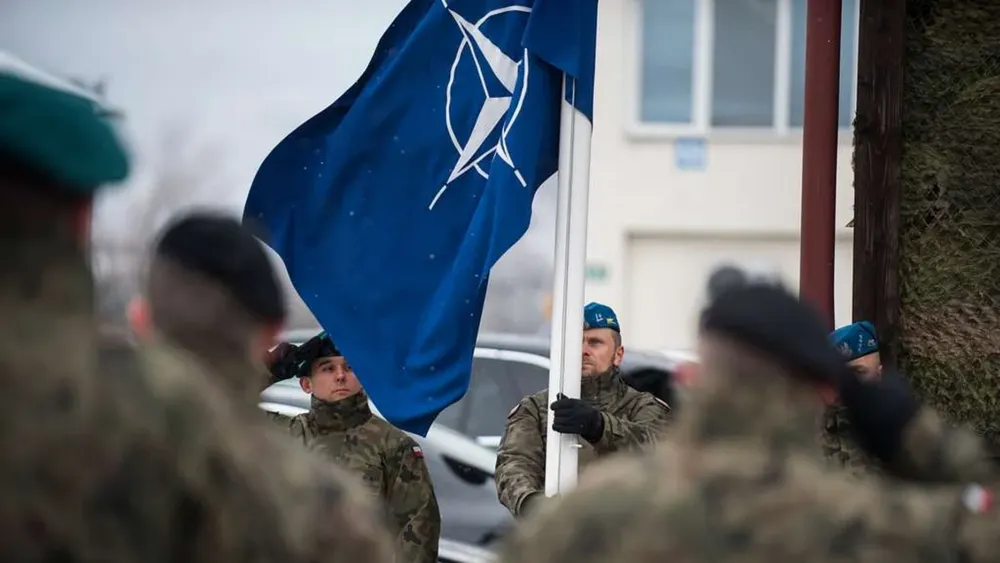
On 20 November, two Russian Kh-101 cruise missiles and a drone struck Polish territory near Nowa Deba, in south-eastern Poland, during active NATO military exercises in the region. NATO's Secretary-General called it a 'grave violation' of Polish sovereignty. Poland raised its alert level under Operation Eastern Sentry. No Article 4 consultation was formally invoked. No collective defence mechanism was triggered.
That sequence — a confirmed violation, a strongly worded statement, and no formal procedure — is the story. Not what happened in the skies over Nowa Deba. What NATO did not do.
Article 4 of the North Atlantic Treaty allows any member to call for consultations when it believes its territorial integrity, political independence, or security is threatened. It is not a trigger for military action. It is a right to convene. Poland did not exercise it.
The distinction matters. Article 4 would have placed the incident formally on the alliance's agenda, required a collective response — even if that response was deliberative — and created a documented record of a member's territorial violation by a belligerent power. Warsaw chose not to do that. The question is why.
In November 2022, a missile struck Polish territory near Przewodów, killing two. That incident was eventually attributed to Ukrainian air defence. But at the moment of impact, NATO scrambled jets, convened emergency sessions, and treated it as a potential Article 4 or 5 event until attribution was confirmed. The seriousness of the procedural response was proportionate to the ambiguity of the moment.
This time, there was no such ambiguity. Russian-manufactured weapons struck Polish soil during Russian operations against Ukraine. Attribution was immediate. The response was procedurally weaker.
The practical effect is a signal, however unintentional. NATO's threshold for formal collective procedures — even the lowest-level consultation mechanism — was not met by a confirmed missile strike on a member state's territory during a live conflict. That is information Russia will use.
It tells Moscow that short of a mass-casualty, unambiguous, sustained attack, the alliance's formal machinery can be held in abeyance. That there is space between a 'grave violation' and a procedural response. That the word 'grave' does not, by itself, activate anything.
Poland is not naive. It operates one of the most capable and best-funded military establishments on NATO's eastern flank. The decision not to invoke Article 4 was a political choice, not a failure of capacity.
The likely calculation: invoking Article 4 risks escalation at a moment when alliance unity is already under strain, when Washington's commitment is uncertain, and when Warsaw has strong bilateral security arrangements it prefers to exercise rather than test collective mechanisms. It is a rational choice. It is also a choice that narrows the alliance's credibility over time.
NATO works when its procedures are used. A mechanism that exists only in theory — invoked when the case is overwhelming and withheld when the case is merely clear — is not a deterrent. It is a decoration.
Russia struck Poland and the alliance responded with a press statement. That is the record. Whatever the internal deliberations, whatever the bilateral communications, the external signal is one of procedural restraint in the face of a confirmed violation. Restraint has its uses. It also has its costs. The cost here is paid in deterrence.