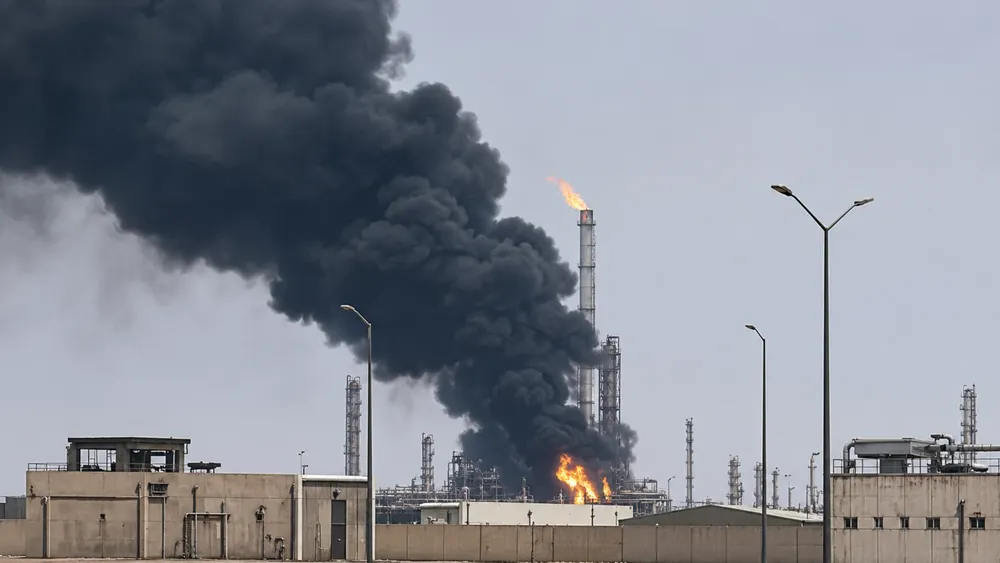
On Wednesday 25 November, the Houthis struck the Ras Tanura refinery, the world's largest oil processing facility, handling 550,000 barrels per day. The fire burned long enough and hot enough to generate a smoke cloud covering 600 square kilometres — visible from space, confirmed by NASA and Planet Labs imagery. Saudi air defences intercepted four drones. The refinery caught fire.
The strike follows the Houthi attack on 19 November that hit the PIF tower in Riyadh — the headquarters of Saudi Arabia's sovereign wealth fund, the tallest skyscraper in the kingdom. These are not random targets. They are the two most symbolically and economically significant nodes in Saudi Arabia's financial and energy architecture.
Ras Tanura is not merely a refinery. It is the fulcrum of Saudi Arabia's energy export capacity. Located on the Gulf coast in the Eastern Province, it processes crude from the Ghawar field — the world's largest conventional oil reserve — and feeds the pipeline and tanker infrastructure that makes Saudi Arabia the world's swing producer. A sustained disruption at Ras Tanura would move global oil markets immediately and structurally.
The Houthis know this. The strike was not an accident of range or targeting. It was a deliberate strike on the facility most likely to generate maximum economic pressure on Riyadh with minimum force.
The 19 November PIF tower strike hit the headquarters of the Public Investment Fund, the vehicle through which Mohammed bin Salman is pursuing Vision 2030. The building — Riyadh's tallest — was struck twice that day. Reports from regional media and Saudi news outlets confirmed damage to the structure. The pattern is deliberate: first the financial symbol of Saudi modernisation, then the energy infrastructure on which that modernisation depends. The Houthis are not striking randomly. They are constructing a campaign.
Riyadh has three problems it cannot solve simultaneously. It cannot achieve a military victory against the Houthis — years of coalition operations have demonstrated that. It cannot negotiate from a position of strength while its critical infrastructure is being struck. And it cannot rely on US protection to the degree it once could — Washington's attention and commitment have shifted, and the Houthis have learned to operate in the gaps.
The ceasefire that Saudi Arabia and the Houthis reached in April 2022, and the normalisation process that followed, have clearly not held as a constraint on Houthi military operations. What it held was Saudi restraint. That dynamic is now under pressure.
A refinery the size of a city, struck and burning. A sovereign wealth fund headquarters, struck twice. Saudi Arabia absorbing attacks on its core economic assets without a corresponding military response. The Houthis have found the ceiling of Riyadh's tolerance and are testing it. The smoke visible from space is not a metaphor. It is a measure of how much Saudi Arabia is absorbing and how little the absorption is costing the Houthis. That ratio will not hold indefinitely.