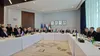
The Mecca Joint Deterrence Agreement, signed by Turkish President Recep Tayyip Erdogan, Saudi Crown Prince Mohammed bin Salman and Pakistani Prime Minister Shehbaz Sharif on 7 August, cleared its final legal hurdle on Friday when Turkey's ratification law took effect after publication in the Official Gazette. The same day, Ankara and Doha signed a separate bilateral defence pact at the twelfth Turkey-Qatar High Strategic Committee in Istanbul. Two agreements on one day: the architecture of a new alignment is being assembled in full view, and the international media is not quite sure what to do with it.
The Mecca Agreement's formal terms are modest in one reading. A Turkish official told Reuters it was defensive, not aimed at any specific actor, and open to other regional countries. Analysts describe it as "a framework for closer strategic, military, and defence-industrial coordination," not a NATO-style mutual defence pact. But the analogy to NATO is the wrong comparison. The right comparison is not to what already exists in the architecture of Western alliances but to what the three countries have been building toward since October 2023. The agreement's mutual attack clause, that an armed attack on any one of the three would be regarded as an attack on all, is the same language as Article 5. The diplomatic hedging around it is not.
The pact brings together a specific combination of capabilities that has not previously been formalised. Turkey has the most capable defence industry in the Muslim world outside Israel, producing drones that have proven themselves in Ukraine, Libya and the South Caucasus. Saudi Arabia has the finance and the regional influence, and sits at the centre of the conflict with Iran that has reshaped the entire region since February. Pakistan has military experience, a large standing army and a nuclear deterrent. The three countries hold different positions on most global questions. What they share, increasingly, is a view that neither Washington nor Beijing can be relied upon as the sole guarantor of their security.
The timing is not incidental. The pact was signed in August, two weeks after Iran and the United States declared a formal state of war. Saudi Arabia has been struck repeatedly by Iran and its proxies since then. The kingdom hosts US military assets, which makes it both a target and an American liability in the same breath. Pakistan has officially stayed out of the conflict while training Saudi personnel and reportedly allowing its airspace and territory to be used for equipment transit. Turkey has criticised US military posture in the region and offered its own mediation channels. The pact formalises a triangular relationship that was already functioning; it also signals that the three countries are thinking beyond the current conflict toward what regional security arrangements look like when this war eventually ends.
Iran's parliamentary response was dismissive. A lawmaker said a paper agreement would not bring Saudi Arabia security. That is probably right as a narrow point. What it misses is the signal the agreement sends about the direction of travel. The Gulf security architecture has been a US-led arrangement since the 1991 war. The Mecca Agreement is the first formal multilateral defence pact in the region that excludes the United States. That is a significant shift, whatever its current legal weight.
The Turkey-Qatar bilateral adds a second dimension. Qatar mediates between Washington and Tehran, houses the largest US air base in the Middle East and has been one of the few channels through which the Iran war has not escalated further. Ankara's tightening of its defence relationship with Doha while simultaneously ratifying the Mecca Agreement suggests Turkey is positioning itself at the intersection of every significant diplomatic and military channel in the region. Whether that makes Turkey a stabilising force or an opportunistic one depends on what Erdogan decides to do with the position.
The United States has not responded publicly to the ratification. The alliance management challenge for Washington is real: Saudi Arabia is a defence partner, Qatar hosts its largest regional air base, Turkey is a NATO member, Pakistan is a nuclear power with a complicated bilateral history. The Mecca Agreement does not dissolve any of those relationships. What it does is make them conditional, in a region where conditionality has rarely been acknowledged this openly before. The question is not whether this alignment constitutes a bloc in the formal sense. The question is what Washington does when it needs something from Riyadh, Ankara or Islamabad and finds that all three are now answering from the same room.