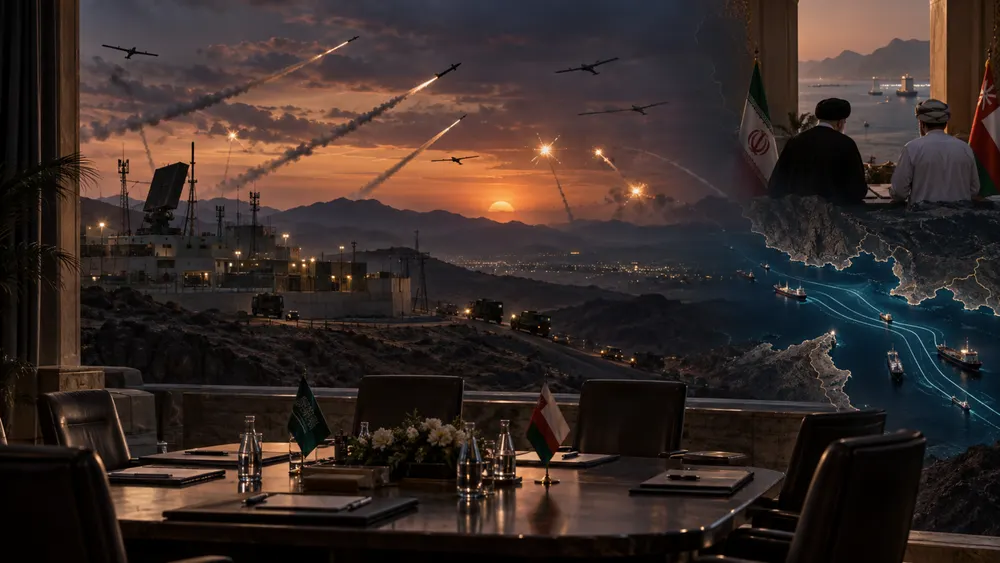
Yemen's Houthi movement fired dozens of missiles and drones at a Saudi military base in Khamis Mushait on Monday September 14. The Saudi-led coalition confirmed 13 civilians were injured in the strike. The Houthis have been targeting Saudi infrastructure since 2015. The difference in September 2026 is that the Houthis are operating under explicit Iranian coordination, that the US interceptor stockpiles that would normally provide a safety net for Saudi Arabia are depleted, and that Saudi Arabia is simultaneously trying to broker an end to the war that is producing these strikes.
Iran's Foreign Ministry confirmed that Saudi Arabia had demanded a scheduled meeting between Iran and Gulf nations be postponed 'for the time being.' The meeting — part of the broader de-escalation diplomacy running alongside the bombing — was the mechanism through which the Gulf states hoped to formalise a regional settlement. Saudi Arabia has been its primary advocate: the kingdom that told Trump to call off the biggest attack since WWII, that signed the Mecca Joint Defence Agreement with Turkey and Pakistan and that has repeatedly told Washington it wants de-escalation. Now the same Saudi Arabia has demanded the de-escalation meeting be postponed because Iran's proxy struck Khamis Mushait.
Oman had been due to host the meeting but announced overnight that it was postponed. Iran said the postponement was at Saudi Arabia's request. Trump repeated his frequent claim that Iran was eager to make a deal quickly. Iran's Mohsen Rezaei, secretary of the Supreme National Security Council, responded on X: 'No talks until Iran's conditions are met.' Iran also confirmed separately that an agreement between Iran and Oman on the Strait of Hormuz had been finalised and would be announced later. The Strait of Hormuz has a bilateral deal. Oman mediated it. Iran finalised it. The country Trump threatened to blow up in May for trying to mediate has produced the most significant Hormuz framework of the war.
The three developments on September 14 produce a single picture. Iran's proxy strikes Saudi Arabia. Saudi Arabia demands the Iran-Gulf reconciliation meeting be postponed because Iran struck it. Iran simultaneously finalises a Hormuz deal with Oman through the mediation of the country the US threatened to destroy. All three are happening within the same US-Iran war framework and none of them point in the same direction. The Mecca Joint Defence Agreement that Saudi Arabia signed to protect itself from Iranian attacks is running alongside the Saudi demand to postpone the talks that would end those attacks. The Hormuz deal is being finalised outside the US bilateral framework by a country the US threatened to bomb for trying to do exactly what it just succeeded in doing.
Saudi Arabia is running low on its own missile interceptors and has turned to France, the United Kingdom, Pakistan and Egypt for air-defence support against Houthi strikes. The US interceptors that were supposed to backstop Gulf air defence are depleted. The Gulf is now asking the UK — whose government just banned settlement goods and had its consulate closed by Israel — and Pakistan — which DiploPolis called the Indispensable Bad Actor in March — to fill the gap. The war's consequences are redistributing across the alliance system in real time.
The talks were postponed for the time being. The missiles landed in Khamis Mushait. The Hormuz deal was finalised. All on the same Monday. The de-escalation that Saudi Arabia wants and the escalation that the Houthis are providing are running simultaneously in the same region, under the same war, on the same day.