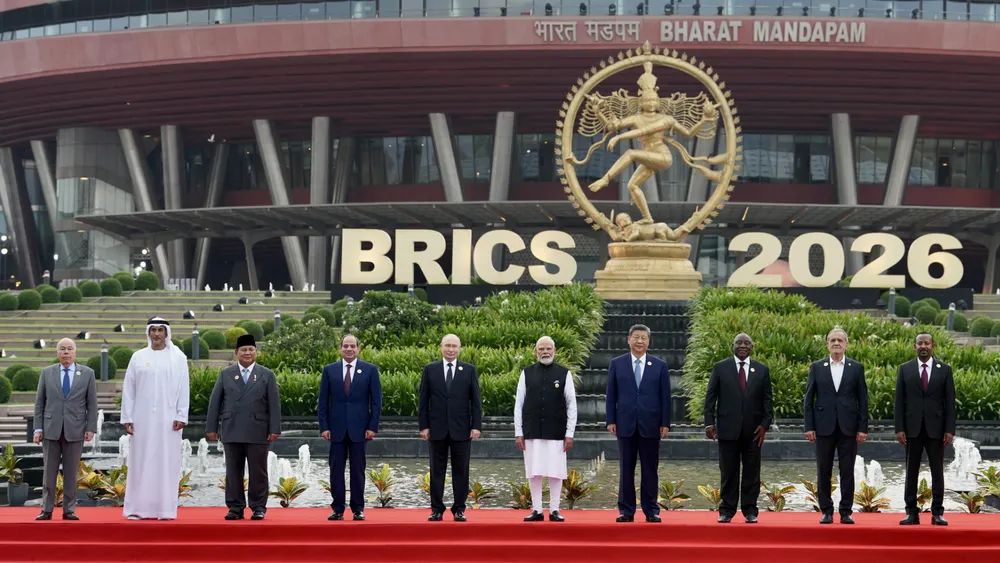
Negotiations at Bharat Mandapam in New Delhi ran until four in the morning on September 12. The text that emerged, the New Delhi Declaration of the 18th BRICS Summit, was unanimously adopted by ten member states covering 41 per cent of global GDP. It was, as the Indian government described it, a significant diplomatic breakthrough.
The breakthrough's language on the West Asia conflict reads as follows: 'We express deep concern over the continued escalation of tensions in the Middle East/West Asia and, recalling our respective national positions, call for exercising maximum restraint. We encourage increasing efforts, through dialogue and diplomacy, towards a long-term understanding that will contribute to lasting peace, security and stability in the region.'
That sentence, which took four months of diplomatic preparation, a failed foreign ministers' meeting in May and a final night of negotiations to produce, does not name the United States, Israel, or Iran. It does not describe the conflict as a war. It does not note that one of the ten signatories has been under US bombardment since February 28. It does not name the Strait of Hormuz, the closing of which has altered global energy markets for six months. The phrase 'recalling our respective national positions' is the diplomatic language for 'we cannot agree, so we are noting that we disagree.' The sentence before it expresses deep concern. Deep concern is the international community's grammatical form for inaction. It is what the Security Council expresses when a veto prevents it from acting. It is what BRICS expressed on September 12 when its internal divisions prevented it from saying what two of its members wanted said and what two others could not accept.
India authored this language. It is the most significant document India's chairship produced, and its most significant quality is what it chose not to say.
What the Chair Could Not Write
The room India was chairing contains a specific contradiction that the New Delhi Declaration was constructed to paper over. Iran is a BRICS member. It has been under US-Israeli bombardment since February 28. The United Arab Emirates is also a BRICS member. Iranian missiles and drones have struck UAE territory and targeted its infrastructure since the war began. Saudi Arabia, an observer in the BRICS Plus format, has watched its oil pipeline attacked by Iraq-based Iranian drones. The 2025 BRICS summit in Rio de Janeiro had produced language that said specifically: 'we condemn the military strikes against the Islamic Republic of Iran since 13 June 2025, which constitute a violation of international law and the Charter of the United Nations.'
That language was produced when Brazil chaired BRICS and when the Iran war had not yet escalated to include the UAE as a combatant. By New Delhi in September 2026, the war had pulled more BRICS members into its direct consequences. India's challenge as chair was not simply to produce a statement that Iran could sign. It was to produce a statement that Iran and the UAE could both sign — that a country being bombed and a country being struck in retaliation for supporting those bombings could both approve. The price of that achievement was a sentence so carefully emptied of content that it satisfied everyone's minimum condition: the absence of any specific accusation.
India also made a separate choice. The New Delhi Declaration drops all references to the Ukraine conflict — the first time since Russia invaded in 2022 that a BRICS declaration has omitted Ukraine. Previous declarations, including Brazil's 2025 text, had included Ukraine language. The omission serves Russia's interests and contributes to the diplomatic cover that the DiploPolis Distraction War piece identified in June: the Iran war's most convenient consequence for Moscow is the reduction of international attention to Ukraine. The BRICS chair in 2026 has produced a declaration that omits Ukraine and offers Iran nothing stronger than deep concern. Both omissions serve the same strategic function: normalising the current state of violence without naming it.
What India Signed Eleven Days Earlier
On September 1, India signed the Shanghai Cooperation Organisation declaration in Kyrgyzstan. That declaration condemned US-Israeli military action against Iran as a violation of the principles and norms of international law. The SCO statement was specific, attributed and critical of the US-Israeli operation in precise legal language.
Eleven days later, India authored a BRICS declaration that says 'deep concern' and 'maximum restraint.'
The difference is not between two organisations with different political orientations. It is between a document India signed when others controlled the language and a document India wrote when India controlled the pen. The BRICS chair can produce whatever language will achieve consensus, within the constraint that consensus requires. At the SCO, India signed a condemnation. At BRICS, India authored an erasure. Both documents carry India's name. The documents say different things because in one case India was a signatory and in the other India was the author. What an author chooses not to write is as deliberate as what it writes.
The explanation for this gap is not difficult to find. BRICS includes the UAE and, in the Plus format, Saudi Arabia — both aligned with the US-led coalition against Iran. The SCO includes Russia and China but not the UAE. India's studied bilateral absence from the Iran war throughout 2026, documented across multiple DiploPolis India Examined pieces, has now produced its most multilateral expression: a document carefully emptied of anything that would require India to take a position in its own name.
Kapil Komireddi, writing in UnHerd, described India's position across the war's first six months with specific bluntness: 'Every other founding member — Russia, China and Brazil — quickly denounced the war. India alone seemed to be condoning it with silence.' He added that Modi's 'New India proved too inconsequential to influence the warmakers — and too weak, craven, and self-woundingly stupid to be spared its effects.' That is a harsher verdict than DiploPolis would deliver, but its factual premise — that India has not taken a position while its own economy suffers from the war's energy consequences — is accurate.
What the Achievement Actually Is
Responsible Statecraft described the New Delhi Declaration as 'more a relief than a victory for BRICS as a whole.' That is the most precise external assessment. A relief rather than a victory is what you produce when the alternative — a failed summit with no declaration — would have been a worse outcome. India avoided the failure that the May foreign ministers' meeting previewed. That is a real diplomatic accomplishment. The question is what kind of accomplishment it is and what it demonstrates about India's capacity for leadership.
The Vishwaguru claim — Modi's framing of India as a teacher and guide for the world — implies a country that shapes the international agenda rather than manages its contradictions. The New Delhi Declaration shows India's capacity for the latter. India managed a room containing Iran and the UAE and produced a document both could sign. The technique required was the elimination of content rather than the assertion of principle. The 'historic consensus' that the Indian government is promoting is a consensus produced by removing from the declaration everything the parties disagreed about, which, in the context of a six-month US-Iran war, includes the war itself.
Modi met Iran's President Pezeshkian on the sidelines of the BRICS Summit and reiterated India's 'consistent position that all issues must be resolved through dialogue and diplomacy.' He also stressed the need for 'continued efforts to ensure lasting peace and stability in the region.' These are India's standard formulations, applied consistently since February 28 to a situation in which one of India's most important economic partners is under bombardment by its most important strategic partners. The formulation survives because it requires nothing of anyone. It cannot be condemned. It cannot be cited as a position. It is what India says instead of a position.
The New Delhi Declaration is what India's leadership of the world's most significant emerging-economy bloc produced: a unanimous document that names no actor, describes no action, takes no position and expresses deep concern. The negotiations that produced it ran until four in the morning. The outcome deserved the sleep it cost.