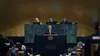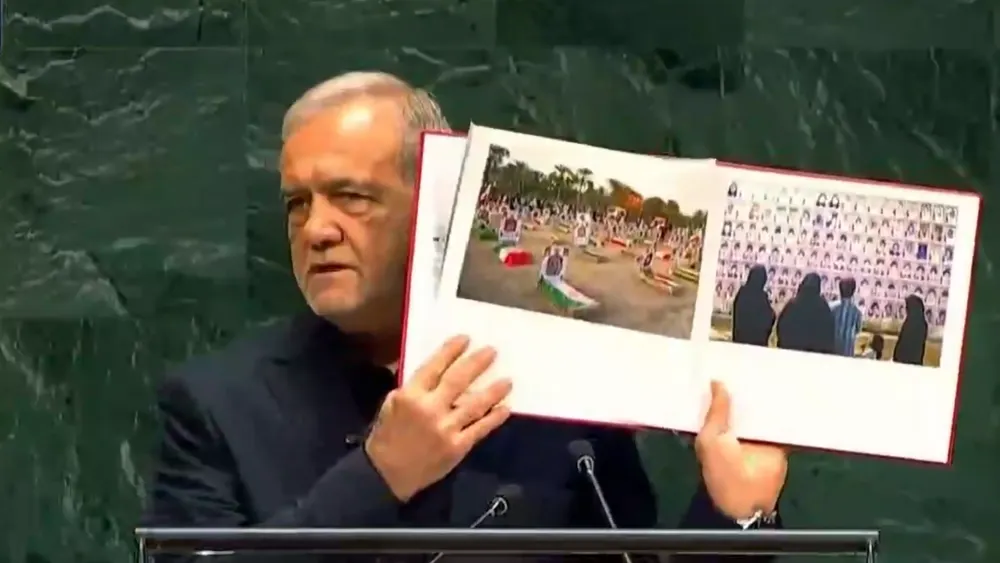
On September 23, Masoud Pezeshkian walked to the podium of the United Nations General Assembly carrying photographs. One showed Ayatollah Ali Khamenei, killed in the first hours of the joint US-Israeli strikes on February 28. Others showed more than 150 Iranian schoolchildren who died in the opening days of the war. He held the photographs before the assembled delegates. He said nothing for a moment. Then he asked: 'Is this how the world's most powerful country practises international law?'
The US delegation walked out.
The previous day, from the same podium, Donald Trump had asked the same assembly whether to 'drive Iran into hell with no chance of survival and no hope of future greatness or generations.' The two speeches at the 81st General Assembly share one podium, one week and one fundamental question about what the United Nations exists to do. Trump's question was about his options. Pezeshkian's question was about the law. The institution's response to both was the same: nothing that changed anything on the ground.
Seven months into a war that has killed thousands of Iranians, shut a global oil chokepoint, depleted American weapons stocks and divided its own Senate, the United Nations General Assembly has served as the stage for the most direct exchange of the conflict's central argument. The US president asked whether he should annihilate a member state. The Iranian president held up photographs of the people already killed and asked whether this is how international law is practised. The gallery of 193 nations watched both. Neither speech produced a resolution, a mandate, an order or an obligation. The institution that exists to answer both questions has no mechanism that can reach either man.
What the Photographs Contain
The children in Pezeshkian's photographs were killed in the opening days of the war. The DiploPolis Analysis published September 8, Amir-Mohammad Was Four, documented one of the subsequent civilian strikes — a September 1 attack on a wedding in Kuhestak that killed five people including a four-year-old boy, confirmed by Reuters, the BBC and the Associated Press as a direct US munition. The school strike in February, which Pezeshkian cited explicitly from the UNGA podium, killed more than 150 children and teachers. The Trump administration has not accepted responsibility for the school strike.
Pezeshkian told the assembly: 'Those who are terrorists and train and protect terrorists describe us as such. We have only defended ourselves.' He cited the assassination of Khamenei as having occurred 'without any legal framework,' as an act of state execution carried out by a country that simultaneously presents itself as the enforcer of international law. He contrasted the treatment of Iran's nuclear programme with that of Israel's. 'The nuclear weapon is in Israel, but the inspectors are in Iran,' he said. 'President Trump says the US obliterated the programme, so why do they need to inspect?' He added that Iran was willing to receive inspectors.
Iran has presented a plan through mediators that would reopen the Strait of Hormuz in seven days if the US agrees to certain conditions — conditions similar to the Islamabad Memorandum the US signed in June and subsequently abandoned. Pezeshkian also told journalists that Iran wants a deal made before the November midterms. He is reading the same political calendar that Trump named from the podium the day before — the calendar that governs when and whether the war ends.
The photographs and the negotiating proposal exist in the same speech, in the same person, on the same day. This is the specific analytical complexity that the photograph moment at UNGA demands: Pezeshkian is simultaneously making the accountability argument — these are the children your bombs killed — and signalling the diplomatic exit — we will open Hormuz in seven days. He is not choosing between moral argument and political pragmatism. He brought both to the same podium. The photographs are the record of what happened. The seven-day Hormuz offer is the record of what could stop.
The Question the Institution Cannot Answer
The question 'Is this how the world's most powerful country practises international law?' has a formal answer in the instruments of international law. The International Court of Justice's provisional measures in South Africa versus Israel addressed exactly this kind of question — whether a state's conduct in war violates the Genocide Convention. Those measures sit on the record unenforced. The International Criminal Court issued arrest warrants for Netanyahu in November 2024 and removed its chief prosecutor in July 2026. The Security Council has received Iran's formal complaint about threats to its existence and cannot act on it because the US holds a veto.
The US delegation walked out during Pezeshkian's speech. The walkout is a diplomatic tool — it removes the audience from the message and signals refusal to hear the argument. It is also a statement. The US chose not to hear the photographs. The US chose not to remain present while the Iranian president asked whether this is how the world's most powerful country practises international law. The absence is in the record of the 81st General Assembly alongside the question that produced it.
Netanyahu arrived in New York this week under an active ICC arrest warrant for war crimes and crimes against humanity. He addressed the General Assembly on Thursday. He met Secretary of State Rubio rather than Trump — a shift in bilateral protocol that the DiploPolis Liability State analysis has tracked as the patron managing the ally through the foreign minister rather than the president. The week's UNGA contains both the annihilation threat and its target's photographic response, and a third element that is present without being named: the ally who extends the war and cannot be disciplined, arriving at the institution that issued a warrant for his arrest and finding the warrant as inactive as the day it was issued.
What the Photographs Did That Warrants Could Not
The DiploPolis Nuremberg Files series has tracked the accountability architecture across seven months of this war. The argument from Lemkin's Funeral through the Nuremberg Paradox to Prosecutor Down is consistent: international law has instruments that name the crime, courts that document the violation and orders that cannot be enforced against those with the power to resist them. The accountability gap is structural, not incidental.
Pezeshkian's photographs are not a legal instrument. They have no enforcement mechanism. They cannot compel any state to do anything. They are pieces of paper with images printed on them, held by a 71-year-old man at a podium in New York while the US delegation left the room. And yet they accomplished something that the ICC warrants, the ICJ provisional measures and the Security Council letters could not: they placed the specific dead inside the room where the living were making decisions about whether to keep killing.
The warrants for Netanyahu name him without producing his presence. The provisional measures ordered Israel to protect Palestinians without changing their protection. The Security Council letter about Trump's annihilation threats produced no resolution. Every formal accountability instrument has produced a document that could not compel.
Pezeshkian produced photographs. The photographs cannot compel either. But they changed what was in the room. For the duration of his silence before he spoke — the specific moment when he held the images before 193 delegations and said nothing — the schoolchildren were present in the General Assembly. The institution that cannot answer 'Is this how the world's most powerful country practises international law?' was, for that moment, asked the question with evidence in the room.
The US delegation left. That response is on the record. The question Pezeshkian asked is on the record. The photographs of Khamenei and 150 children are on the record. The institution cannot answer the question. The record of the question being asked, and the walkout that answered it, is more durable than the institution's formal silence.
Pezeshkian did not leave the door closed. He said Iran believed in diplomacy. His foreign minister offered seven days to Hormuz reopening. His speech to journalists said Iran wants a deal before November. The photographs were the record of what has happened. The offer through mediators is the record of what is available. Both are in the building from which the US delegation departed rather than remain in the room with the photographs of 150 children and a question about international law.
This Analysis piece is free to read. Future Analysis pieces will be available to registered DiploPolis members first. Free registration takes 30 seconds. No credit card required.
Find this piece interesting?
Dispatches by DiploPolis delivers sharp analysis and pointed commentary on power, politics, diplomacy, and world affairs — directly to your inbox.
No neutrality. No noise. Just argument.