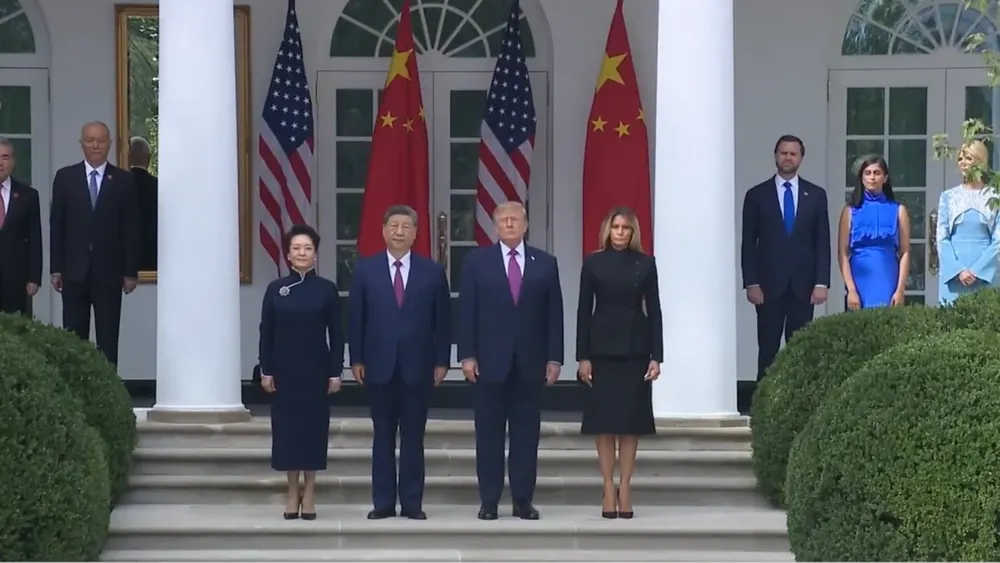
On Wednesday afternoon, a Chinese state aircraft landed at Joint Base Andrews outside Washington. Donald Trump walked out to the tarmac personally — the first time in over a decade an American president had greeted a foreign leader at the base. A military band played. Cannons fired a 21-gun salute. Two B-1B Lancer bombers, six F-16s and six F-22 Raptors flew overhead. Xi Jinping descended from the plane. The two leaders shook hands, spoke briefly and posed for photographs. China's national anthem played.
The B-1B Lancer is a long-range supersonic strategic bomber. It has been used in Operation Epic Fury to strike targets across southern Iran. Two of them flew over the arrival ceremony for the leader of the country that has been providing satellite imagery to help Iran target the aircraft and crews that fly them. The flyover was a military honour. It was also the most specific single image of the week: the bombers that have been bombing Iran flew over the arrival of the leader whose country has been helping Iran respond. Trump visibly flinched as the aircraft passed overhead. Xi stood perfectly still.
Xi's visit is his first to the United States since 2015 and his first state visit to Washington in over a decade. The agenda covers trade, artificial intelligence and the Iran war. The Busan Agreement — the US-China trade deal set to expire in November — was extended to January 10 as Xi landed. Treasury Secretary Bessent said Washington and Beijing had agreed to try for a larger deal rather than another series of extensions. China and the US could meet again in November at APEC and in December at the G20 in Miami. The two leaders have now met three times this year.
The Iran war is on the agenda and is unlikely to produce breakthroughs. China is Iran's largest trading partner. The Hormuz blockade has cut approximately 12 per cent of China's oil imports. Washington has held back from imposing secondary sanctions on Chinese companies doing business with Iran — a significant economic concession maintained throughout the seven-month war. China, in return, has urged Iran to resume negotiations while providing the satellite imagery and missile components that Senator Slotkin described in her letter to Trump last week. The concession and the assistance are running simultaneously. No one in either delegation has described this as contradictory.
Xi said at the arrival ceremony that China and the US should be partners and not rivals. Trump said it was a great meeting. Democratic and Republican lawmakers said separately that the spectacle was a celebration of a rival. The Senate was preparing a war powers vote. The IRGC was monitoring the Hormuz blockade. The bombers flew overhead and the military band played. Xi had arrived.