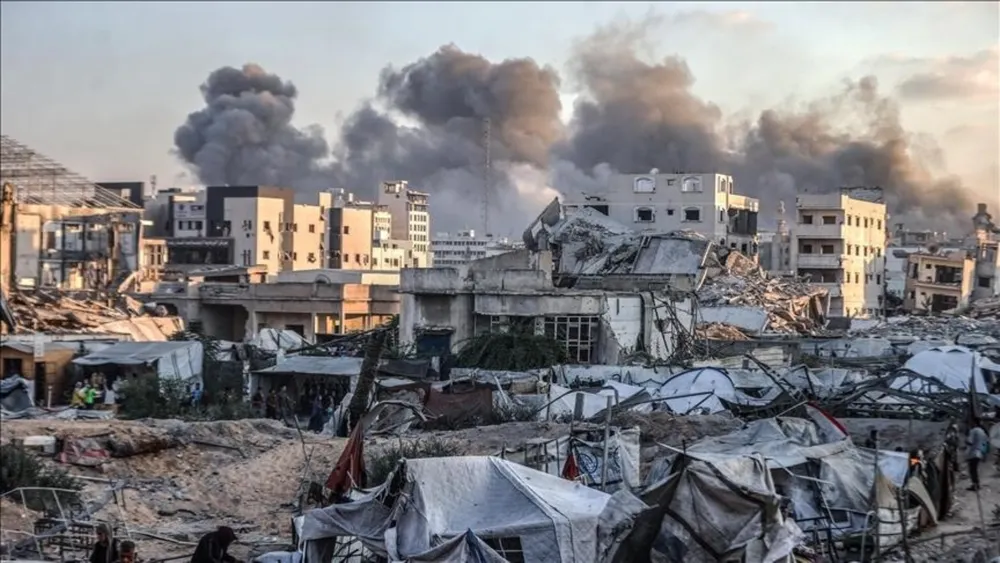
Israel killed Izz al-Din al-Haddad in a residential building in Gaza City on Friday. His wife died alongside him. So did his 19-year-old daughter. Israel called it a precision strike. It called al-Haddad an architect of October 7. It said the operation was significant. It said nothing meaningful about the ceasefire.
That ceasefire has been in place since October 2025. It has now killed more than 850 Palestinians. The official charged with implementing it, Nikolay Mladenov, the director-general of the Gaza Board of Peace, acknowledged last week that it is 'far from perfect'. The count of Israeli violations since October runs to 139 and climbing. None of this received much attention because the world's attention was in Tehran, then in Beijing. Gaza continued. In April, after Israel halted its joint bombing of Iran, Israeli strikes on Gaza increased by 35 per cent compared to the month before. The military capacity freed from one war was redirected into the other.
Al-Haddad was the last senior commander of Hamas's al-Qassam Brigades still alive. Israel had spent two years killing its way through Hamas's military leadership — Yahya Sinwar, Mohammed Sinwar, Mohammed Deif, and now al-Haddad. Each killing was described as significant. Each was carried out under a framework Israel called a ceasefire. Each produced the same statement from Jerusalem: a precision strike, an architect of October 7, a significant operation. The language has become a liturgy. The killing continues beneath it.
A ceasefire means the fighting stops. Not that it pauses while one side works through its list. Under this one, Palestinian families are still living in tents on barren land along the Gaza coastline. Aid enters at roughly a fifth of what the agreement requires. Israel occupies more than half of Gaza's territory and the line marking that occupation is shifting westward toward the sea, cramming two million people into an ever-narrower strip. Mladenov said plainly last week: 'Gaza is gone' if the status quo holds. The status quo is holding because nobody is demanding otherwise.
A Palestinian American businessman close to the Trump administration told NBC News what happened to Gaza once Iran became the story: 'Once the war ended and Hamas agreed to the ceasefire and the hostages were released, that was the priority of the US administration. Then the Iran war came and nobody talks about Gaza as a result.' The Trump administration flew to Beijing last week. It is meeting on May 19 to discuss potential military action against Iran. Gaza is not on the agenda.
Eight hundred and fifty people killed into a ceasefire. Strikes up 35 per cent since the other war paused. The last senior Hamas military commander dead in a residential building alongside his wife and daughter. And the man charged with overseeing the peace saying, quietly, from Jerusalem, that it is far from perfect.
The word 'ceasefire' has been doing a great deal of work in Gaza. It has meant: the cameras moved elsewhere. It has meant: the dying is slower now, and less reported. It has meant whatever needs to be meant on a given day.
On Friday, it meant a precision strike on a residential building.