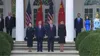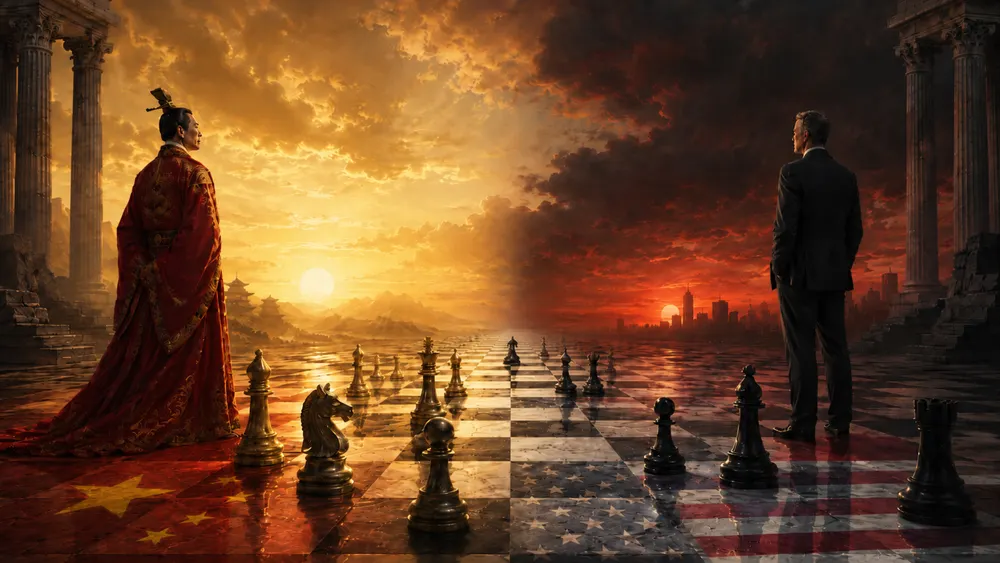
At the Great Hall of the People in Beijing on Thursday morning, Xi Jinping asked Donald Trump whether the two countries could avoid the Thucydides Trap — the theory, derived from ancient Greek history, that a rising power and an established power are structurally destined for conflict. 'Whether the two countries can transcend the so-called Thucydides Trap and pioneer a new paradigm of major-country relations,' is how Xi put it, according to the official CCTV broadcast. It was a question that Xi had clearly prepared. It was also a question that answered itself. A country that needs to ask whether it is a rising power is not asking from a position of anxiety. It is asking from a position of arrival.
The Thucydides Trap was popularised by Harvard political scientist Graham Allison in the early 2010s, drawing on the ancient Greek historian's account of the war between Sparta and Athens. His argument: when a rising power challenges an established one, conflict is the structural tendency rather than the exception. Allison found this pattern repeated across sixteen cases in five centuries of history. Xi has raised it with American presidents before, dating back to 2014. The fact that he raised it again in 2026 — this time with Trump in Beijing, on Chinese soil, with an elaborate ceremony of cannons and school children waving flags — is not a repetition. It is a reclassification. In 2014, China raised the Thucydides Trap as a warning against American overreach. In 2026, it raises it as a description of a transition that has already happened.
Trump's response to the question was characteristically unencumbered by its implications. He told Xi that their relationship was going to be 'better than ever before', praised him as a 'great leader' and said it was an 'honour to be your friend'. When asked about the talks by reporters during a visit to Beijing's Temple of Heaven, he said: 'It's great. Great place, incredible. China is beautiful.' The contrast between Xi's dark opening — a carefully constructed warning about structural conflict — and Trump's breezy warmth was not incidental. It was the summit in miniature.
Xi warned that mishandling the Taiwan issue would cause 'clashes and even conflicts, putting the entire relationship in great jeopardy.' There was no mention of Taiwan in the American readout, which focused on trade and the Iran war. The asymmetry of what each side chose to report is the most informative data point from the first day of the summit. Beijing is watching the existential question. Washington is watching the midterm elections. The distance between those two frames of reference is not a misunderstanding. It is the relationship.
China comes into this meeting far more confident than in 2017, when it feared even a small rise in US tariffs, according to Scott Kennedy, senior adviser at the Centre for Strategic and International Studies. 'In the last year, Xi has been able to push back and neutralise much of Trump's actions.' The US contingent in Beijing included Secretary of State Marco Rubio, Secretary of War Pete Hegseth and a delegation of American business executives — Elon Musk, Tim Cook and Jensen Huang among them. The presence of the CEOs signals that Washington is in Beijing primarily to do business. The presence of Xi's Taiwan warning in Beijing's readout signals that Beijing is in this meeting primarily to establish terms.
The Iran question — the reason Trump needed this summit — produced a single White House official's statement that both sides agreed the Strait of Hormuz must remain open and that Xi expressed interest in buying more American oil to reduce China's dependence on the strait. That is not a breakthrough on Iran. It is a statement of shared interest in the abstract, unaccompanied by any concrete commitment from Beijing to pressure Tehran. Rubio said Trump would make the case for Beijing to exert its influence on Iran. Trump told reporters he had downplayed suggestions that he would ask Xi to pressure Iran at all. The Secretary of State and the President were not describing the same mission. Both of them were in the same building.
The Donald Trump who arrived in Beijing on Thursday is not the Donald Trump who arrived in 2017. In 2017, he came to Beijing as the leader of an unquestioned global superpower to negotiate with a rising competitor. In 2026, he came carrying a war he cannot finish, a strait he cannot reopen and an Iran problem he cannot solve without Chinese cooperation that Beijing is not obliged to provide. The ceremony was the same — the red carpet, the military band, the state banquet, the school children with the flags. The underlying relationship had changed.
What the Beijing summit has produced so far is the management of a relationship between two countries that have agreed to manage their competition rather than resolve it. That is not nothing. Managed competition is better than unmanaged escalation. But it is not the breakthrough that the diplomatic language of strategic stability implies. The strait is still closed. Iran is still at war. Taiwan is still watching the readout for clues about what was traded in the room that was not put in the communiqué.
Xi asked the Thucydides question. It was not really a question. A rising power that invokes Thucydides is not asking whether conflict can be avoided. It is telling the other side that the transition is already underway and asking whether it has noticed. Trump said China was beautiful. Xi asked whether two great powers could rewrite history. One of those answers will define the century.
Find this piece interesting?
Dispatches by DiploPolis delivers sharp analysis and pointed commentary on power, politics, diplomacy, and world affairs — directly to your inbox.
No neutrality. No noise. Just argument.