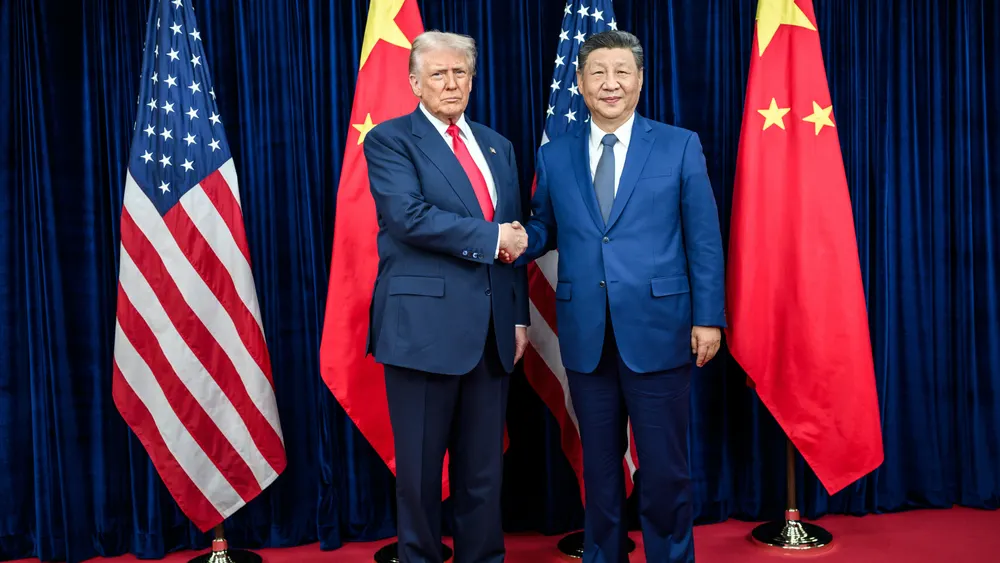
On Thursday, Donald Trump flies to Beijing to meet Xi Jinping for the first time since 2017. He arrives carrying a war he cannot finish, a strait he cannot reopen, a ceasefire he cannot enforce and a request he cannot make publicly: please help me with Iran. Treasury Secretary Scott Bessent has confirmed that the Iran war will be on the agenda and has urged China to join what Washington is calling an international operation to reopen the Strait of Hormuz. The most powerful country in the world is flying to Beijing to ask for a favour. Beijing did not need to do anything to earn this moment. Washington created it.
The summit was originally scheduled for March but was delayed by Trump due to the Middle East conflict. The delay is its own signal. Trump could not go to Beijing while the war was going well because the optics of asking China for anything mid-campaign would have undermined the narrative of American strength. He is going now because the war has stopped going well and the optics no longer matter as much as the outcome. The strait remains largely closed. The Iran war is likely to take centre stage at the summit, leaving less scope to resolve issues like tariffs and rare earth supplies. Washington came to Beijing wanting to talk trade. It will spend most of the summit talking about a war it started without consulting Beijing and cannot end without Beijing's help.
China feels confident enough to stand up to Trump on many key issues — sanctions, technology controls, critical minerals and Iran. That confidence is not accidental. It is the product of a specific sequence of events that Washington set in motion. The US sanctioned Chinese companies for buying Iranian oil. China instructed those companies to continue. The US and Israel vetoed — and China and Russia blocked — successive UN Security Council resolutions on the war. China hosted Iranian Foreign Minister Abbas Araghchi in Beijing on May 6 for the first time since the war began, positioning itself as the indispensable interlocutor between Washington and Tehran. Beijing has spent ten weeks watching Washington exhaust its options. It arrives at this summit knowing that Trump needs this meeting more than Xi does.
The agenda spans trade, technology, rare earth export controls, Taiwan, the Iran war and artificial intelligence. Each of those items represents a domain in which China holds meaningful leverage. Rare earth export controls affect every advanced economy. Technology restrictions on Chinese access to semiconductors are a persistent source of friction. Taiwan's status is Beijing's most sensitive demand. Taiwan will be watching closely for any changes in how the United States describes the cross-strait relationship, particularly worried that Beijing will persuade Trump to express support for peaceful unification. The countries that cannot attend the Beijing summit — Taiwan, the Gulf states, Europe — are the ones who will live longest with whatever is agreed inside it.
Xi may seek to use Trump's weakened negotiating position to extract concessions on Taiwan's status, US restrictions on Chinese access to advanced technology and tariffs on Chinese goods. This is the structural reality of the summit that the diplomatic language of mutual benefit and constructive dialogue will not change. Trump wants one thing from Beijing that only Beijing can deliver — enough pressure on Tehran to reopen the strait and allow him to declare the war over before the midterms. Xi wants several things from Washington that only Washington can deliver. The negotiation has a clear shape. The question is what Trump gives away to get what he needs.
The irony is structural and worth naming plainly. Washington spent three months sanctioning China for being too close to Iran. It is now flying to Beijing to ask China to use that closeness. Washington launched a war predicated on the assertion that the rules-based international order must be defended against state sponsors of terrorism. It is now asking the country that vetoed every resolution defending that order to clean up the mess. Neither diplomatic appeals nor economic pressure has moved Beijing on Iranian oil purchases, and analysts remain sceptical the summit will yield a breakthrough on Iran. Trump flies to Beijing on Thursday. The strait is still largely closed. The nuclear question is unresolved. The ceasefire is disputed.
Xi Jinping does not need to win this summit. He only needs to not lose it. That is already a stronger position than the one Trump is arriving with.