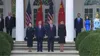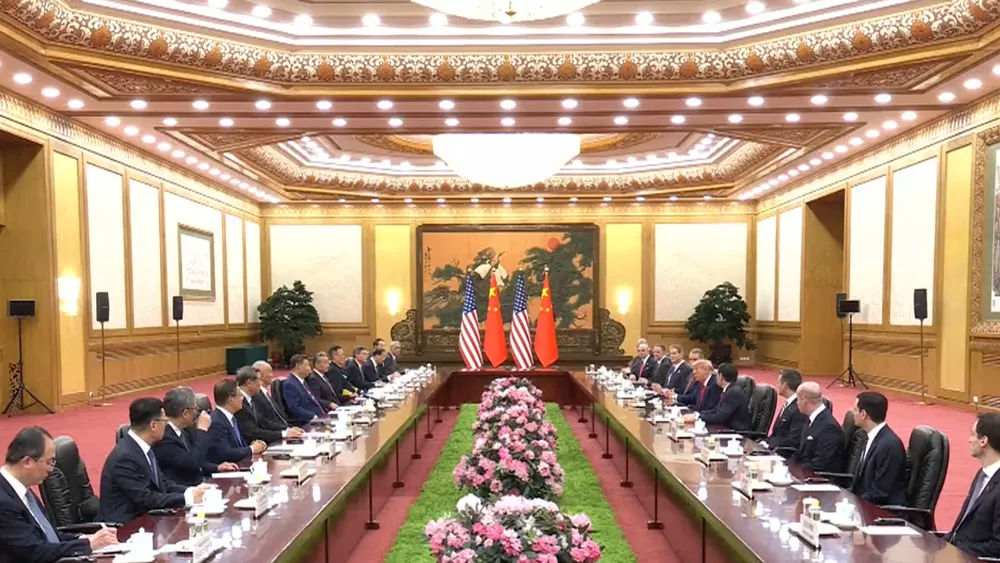
As Donald Trump's plane touched down in Beijing on Wednesday evening, the hashtag #WelcomeTrumpToChina was the top trending topic on Weibo, China's largest social media platform. Three hundred children in blue and white uniforms lined the tarmac waving American and Chinese flags. A military band played. A red carpet was rolled out. Chinese Vice President Han Zheng, Xi Jinping's designated envoy for ceremonial occasions, was there to receive him. The welcome was elaborate, choreographed and entirely on Beijing's terms. Then the Weibo users named him.
The nickname circulating on Chinese social media for Donald Trump is 'Chuan Jianguo.' It translates literally as 'Trump the Country Builder.' The implication, according to the users spreading it, is sardonic and specific: Trump's confrontational foreign policy, his tariffs, his trade wars and his isolationism have done more to build China's power than anything Beijing's own planners could have designed. He is not the country builder of America. He is the country builder of China. The mockery arrived before his plane did.
It is, as insults go, unusually precise. The tariffs Trump levied on China drove it toward self-sufficiency in technology, energy and food security at a pace that years of Chinese government planning had failed to achieve. The pressure to find alternatives to the American market pushed China to secure new partners in Southeast Asia and Africa, reducing its dependence on Washington and expanding its commercial footprint across the Global South. The attempt to weaken China produced a more resilient China. The name is not flattery. It is a verdict.
Trump came to Beijing carrying a request he cannot make openly and an agenda he cannot control. The Council on Foreign Relations put it bluntly in its pre-summit assessment: China will have the upper hand. Xi has told Communist Party cadres for years that 'the East is rising and the West is declining' and that 'time and momentum' are on China's side. The Beijing summit does not contradict that claim. It illustrates it. The last time Trump visited China, in 2017, Xi staged a state visit-plus — a private dinner in the Forbidden City, a parade through Tiananmen Square, $250 billion in business deals unveiled for the cameras. This time Trump arrives as a supplicant, not a peer, and both governments know it.
The Beijingers CNN spoke to outside the summit venue reflected that awareness. 'China has always stayed neutral,' said one resident. 'If they want to fight, that's their business, it has nothing to do with us.' The sentiment was not hostile. It was something more deflating — indifference with confidence behind it. The population of the country being asked for a diplomatic favour was not particularly interested in providing one.
What Trump wants from Beijing is specific. He wants Xi to press Iran to reopen the Strait of Hormuz and agree to a peace deal that allows him to declare the war over before the midterm elections. CSIS described the likely outcome as 'a relatively modest step toward greater stability' — the language of managed expectations rather than breakthrough diplomacy. China has already given Washington one concession in the lead-up to the summit: a high-level assurance from Beijing that it would not send weapons to Iran, specifically ruling out surface-to-air missiles. Washington received the assurance and called it progress. Beijing gave away nothing it had planned to do anyway.
What Xi wants from Trump is less publicly stated but widely understood. Taiwan is the price. American officials have expressed concern that Trump will negotiate on arms sales to Taiwan, undermining decades of carefully worded American policy to get what he needs on the strait. Taiwan, which had no seat at the table and no vote on the Iran war, is watching from outside the room while its security may be traded inside it. The countries that cannot attend the Beijing summit will live longest with whatever is agreed there.
The architecture of the visit tells the story as clearly as any communiqué will. Beijing rolled out the red carpet, played the military band and put 300 children on the tarmac. Washington sent a president carrying a war he cannot finish, a strait he cannot reopen and a request that requires the cooperation of the country he spent four years trying to weaken. The Weibo users named him correctly before the ceremony began. He is not here as the leader of the indispensable nation. He is here as the country builder — the man whose choices made the country he came to pressure stronger than when he started pressing.
The summit runs through tomorrow. The readout will speak of candid and constructive dialogue. The strait will remain largely closed. The nickname will remain on Weibo.
Find this piece interesting?
Dispatches by DiploPolis delivers sharp analysis and pointed commentary on power, politics, diplomacy, and world affairs — directly to your inbox.
No neutrality. No noise. Just argument.