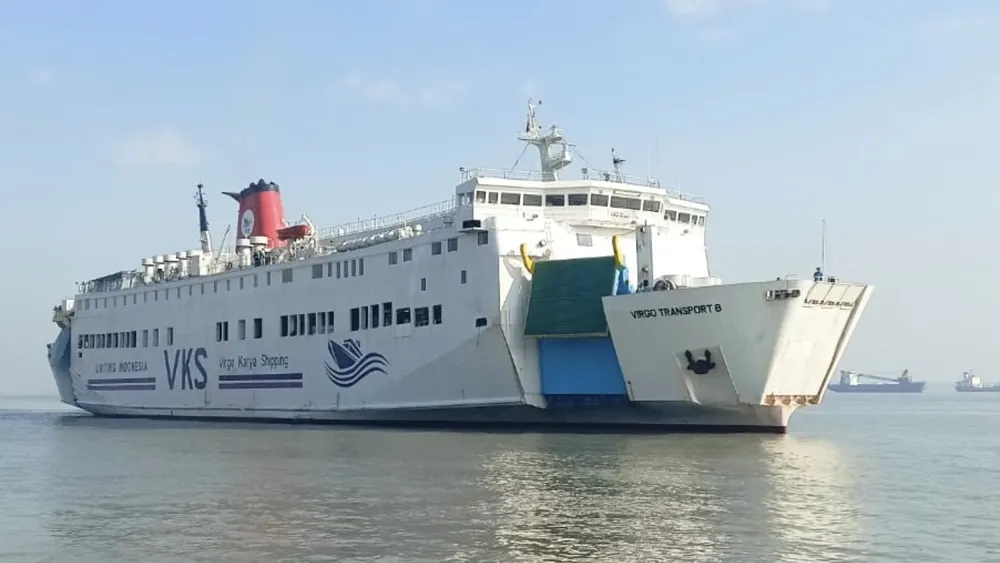
At approximately 2 in the morning on Sunday, the captain of the Virgo Transport 8 made his last communication. He reported that the ship was listing badly in rough seas with waves up to three metres high. Then the radio went quiet. By Sunday afternoon, Indonesian rescuers had pulled 108 people from the water around an overturned hull. The bottom of the 119-metre ferry was still visible above the surface. The vessel had capsized but not sunk. Six passengers were confirmed dead. One hundred and twenty-nine others could not be found.
The Virgo Transport 8 had left Surabaya the previous evening on one of the most routine crossings in the Indonesian archipelago — a standard overnight passage across the Java Sea to Banjarmasin on the island of Borneo. The ship was carrying 213 passengers and 30 crew. It was also transporting 89 vehicles. It was 37 years old, built in Japan in 1987, and only recently acquired by its Indonesian operator, PT Virgo Karya Shipping. Its manifest listed 243 people. It is common in Indonesia for the actual number of passengers to differ from the manifest.
The survivors' accounts are consistent. Ahmad Saudi, a bus driver who was transporting a vehicle, said the ferry appeared overcrowded, with many passengers sleeping in hallways and common areas because the cabins were full. He said the ferry suddenly listed without warning. 'People were panicking,' survivor Rinto Arahap told AFP. 'Some climbed onto tables, some were pushing each other.' Arahap speculated that the balance of the vessel may have been affected by trucks loaded unevenly on one side. Indonesia's transport minister said the cause — 'natural factors, technical factors or human factors' — awaited investigation. Rescuers deployed ships, a helicopter and 280 personnel to search waters around the ferry's last known position, 148 kilometres from Banjarmasin.
Indonesia has 17,000 islands and moves people and goods between them primarily by sea. The maritime sector is the connective tissue of one of the world's largest and most dispersed nations — a country of 270 million people spread across an archipelago that stretches 5,000 kilometres from west to east. The Java Sea, which the Virgo Transport 8 was crossing, is one of the world's busiest sea lanes. It has also been the site of repeated ferry disasters: the Senopati Nusantara in 2006 (400 dead), the Teratai Prima in 2009, the Marina Baru in 2022. The Virgo Transport 8 is not the first overcrowded, ageing vessel to capsize in these waters and is unlikely to be the last.
The accountability framework is specific and familiar. Indonesian law requires regular safety inspections for all passenger vessels. The 37-year-old ferry had been recertified. Overcrowding is illegal. The passengers sleeping in hallways represent a violation of that law that nobody enforced on the evening of September 12 when the Virgo Transport 8 departed Surabaya with 89 vehicles and an unverified number of passengers seeking berths they could not find. The three-metre waves were the weather. The 37-year-old hull, the overcrowded hallways and the 89 vehicles were the other factors.
By Sunday evening, the search had continued for more than 12 hours. One hundred and eight people were safe. Six were dead. One hundred and twenty-nine were missing. The ship's hull floated upside down in the Java Sea. The 129 were somewhere in the water around it. The overnight crossing between two islands — the most ordinary journey in the most island-dense country on earth — had produced one of its recurring disasters. The investigation had not yet begun. The search had not yet ended.