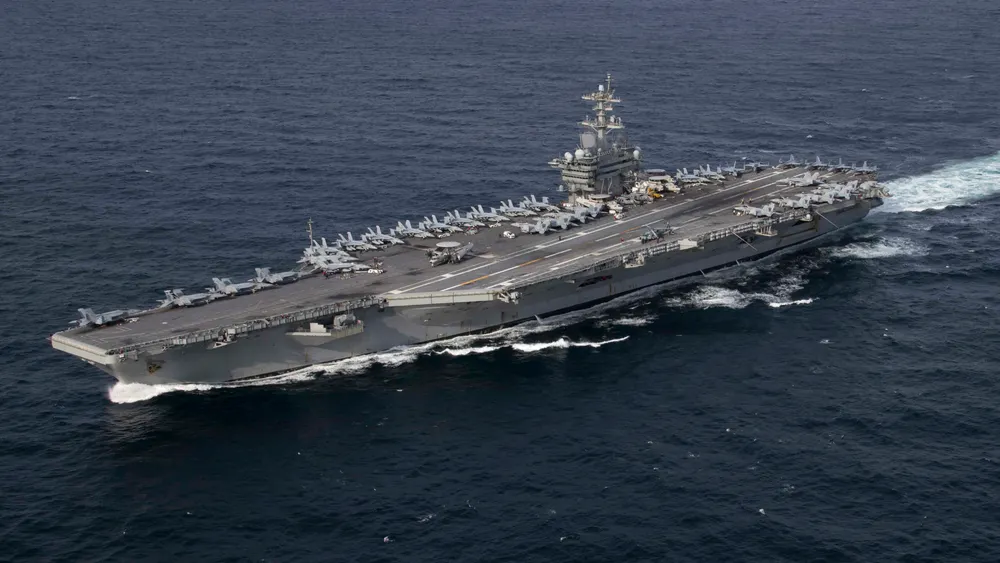
The USS Abraham Lincoln left San Diego on November 21, 2025. It was supposed to return after a standard six-month rotation. Instead it was redirected to the Middle East when the war with Iran began on February 28. By August 20, it had been at sea for 272 consecutive days — one of the longest continuous carrier deployments in modern US history. One sailor, speaking to CNN, described his year simply: he had not stepped off the ship at all in 2026. Another had watched the birth of his first child on FaceTime. He had never met her.
The Navy announced on August 20 that the Lincoln was finally heading home. The USS George Washington arrived in the region the same day to take its place. Admiral Brad Cooper, the CENTCOM commander, flew out to the Lincoln in the Arabian Sea and told the crew they were going home. He published an op-ed in the Wall Street Journal to make it official. After 272 days at sea — including 200 without a port call — the ship turned for San Diego.
The Lincoln's deployment produced a record. It also produced something else: the most documented account of what a prolonged naval deployment in a war of indefinite duration does to the people conducting it. Families had been raising alarms for months. Lawmakers from California, whose district includes the Lincoln's homeport, held hearings. Sailors described faulty plumbing, rationed meals of poor quality, shortages of basic supplies and the accumulated psychological weight of 200 days without stepping on land. One father in San Diego said his son, Devynn, had told him: 'The captain just announced that we're going home.' Devynn Sickinger had received the news through his father's forwarded news alert.
Stars and Stripes and Navy Times reported in August that conditions aboard the Lincoln had deteriorated significantly, with multiple sailors experiencing mental health crises. One confirmed incident saw a sailor go overboard wearing a life vest and was rescued within an hour. The Navy described it as a mental health episode. These are not the statistics of a sustainable operational tempo. They are the statistics of a war whose human cost has been accumulating on a ship in the Arabian Sea.
The Lincoln launched more than 10,000 combat sorties during its deployment. It flew them through Operation Epic Fury beginning February 28, through the naval blockade of Iranian ports, through the collapse of the Versailles MOU, through the second July pause and through the subsequent resumed bombing campaign. The ship was present for every significant escalation of the war from its launch through August. Its crew lived every day of 2026 on a steel deck in the Arabian Sea.
DiploPolis published 'Dangerously Low' in August, reporting that the US had depleted nearly 80 per cent of its THAAD interceptors and more than half its Patriots. The Lincoln's departure is partly a function of the same arithmetic. JD Vance described the war as entering a 'new phase' of economic pressure precisely as the military phase's human cost was becoming impossible to manage publicly. The Lincoln's rotation is the military's acknowledgment that 272 days was the limit.
The war that was supposed to last two to three weeks — Trump said this on April 1, 172 days before the Lincoln turned for home — has sent one aircraft carrier home after one of the longest continuous deployments in modern naval history. The USS Theodore Roosevelt has now been dispatched to relieve the George Washington when its rotation ends. The rotation that Hegseth called indefinitely sustainable is rotating. The cost of sustaining it is on a ship sailing toward San Diego, in the form of a sailor who watched his daughter's birth on a phone screen and has not yet held her.
She is the age of the war.