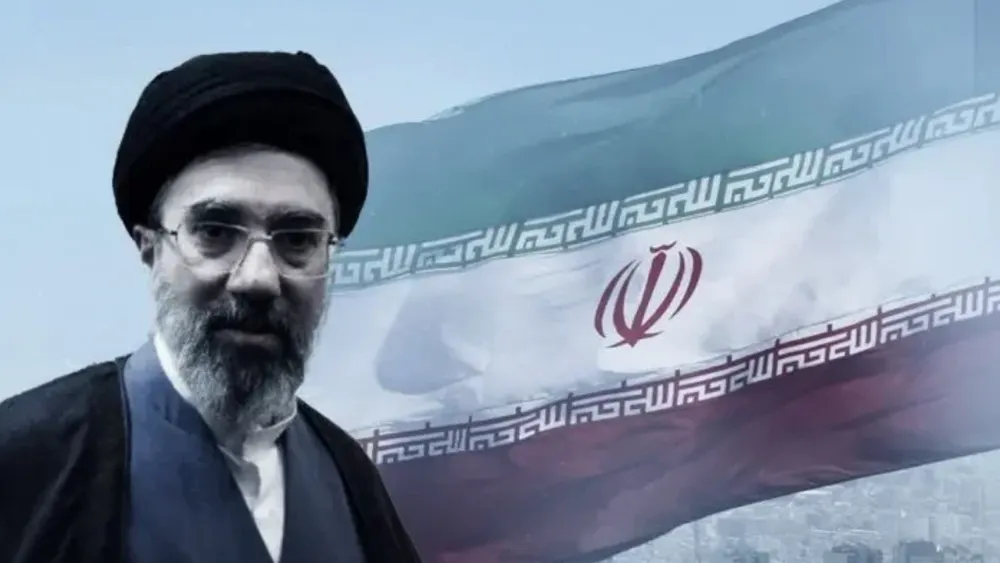
Since February 28, when US and Israeli strikes hit targets across Iran during the opening hours of Operation Epic Fury, the most specific unresolved question in the war has been whether Mojtaba Khamenei lost a leg. Reports circulated that Iran's new Supreme Leader, the man who has vowed revenge from a position of public invisibility since his father was killed, was severely injured in the strikes. He has not been seen in public since his appointment. Iranian officials deflected. No photograph has emerged.
On Saturday, Masoud Pezeshkian provided an answer. In an interview with CBS News' Margaret Brennan on Face the Nation, Iran's president said he had met with Mojtaba Khamenei twice since his father's death. The second meeting lasted seven-plus hours. They sat on the floor, what Pezeshkian described as sitting 'on the ground,' crossing legs, changing positions, staying in that posture for the duration of the meeting. 'He was healthy enough to be able to withstand those hours of that situation,' Pezeshkian said, after being asked directly whether Khamenei's legs had recovered and whether he could sit on the ground.
'Completely healthy,' Pezeshkian said when asked directly about Mojtaba's condition. 'He has no issues.' He cited his own medical training as a doctor in noting that he was qualified to assess this. The CBS interview transcript runs to several thousand words, and the exchange about Mojtaba's health, which CBS asked about explicitly including specific questions about his face and his legs, is the most detailed public statement any Iranian official has made about the new Supreme Leader since his appointment in March 2026.
The significance has two dimensions. The first is immediate: if Mojtaba is healthy, mobile and capable of seven-hour sitting meetings, the reports of serious injury that shaped coverage of Iran's new leadership for months are at minimum exaggerated and at maximum false. The second dimension is structural. Mojtaba's invisibility has been read since July as either a sign of injury or a deliberate choice to build a different kind of authority, less public and more opaque than his father. Pezeshkian's interview makes the invisibility a choice, not a constraint. He is not seen because he is choosing not to be seen. The seven-hour floor meetings are happening. The revenge vow is active.
Pezeshkian also told CBS that Mojtaba had been 'completely involved' in decisions about the war. That line is not verifiable. Iranian governments do not publish minutes of Supreme Leader meetings. But it confirms what DiploPolis has been tracking since August, when US intelligence assessed that Mojtaba was far more inclined than his father to seek nuclear weapons. The Supreme Leader who is choosing not to be photographed, sitting on the floor for seven hours with his president, is described by Iran's own president as active and involved. The war that started by killing his father is being managed by the son who has not yet shown his face.