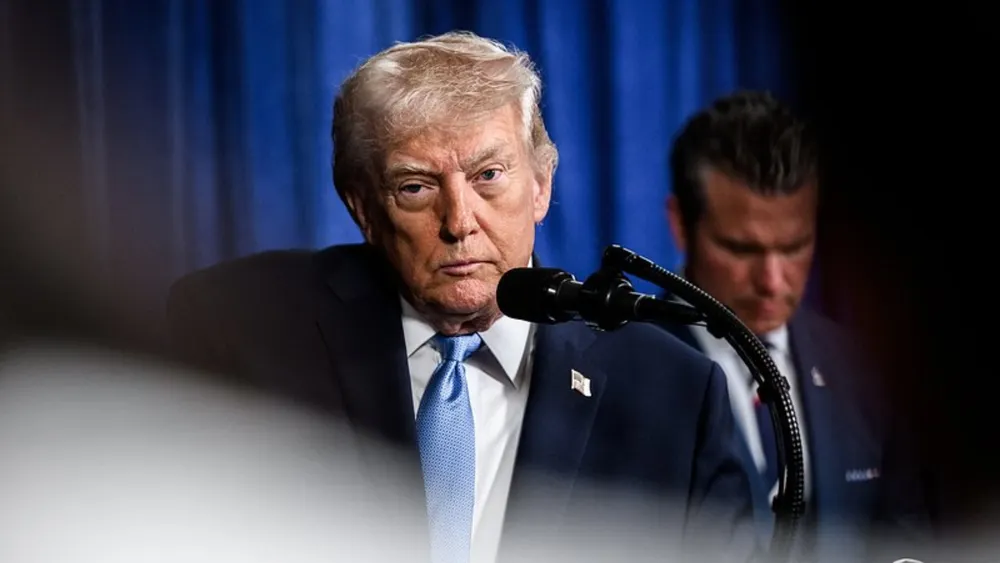
The Wall Street Journal reported on Friday that Donald Trump privately rejected Iran's proposal to reopen the Strait of Hormuz through the Qatari mediators who have been carrying messages between Washington and Tehran since June. The same report said Trump told aides he expects to resume bombing Iran after the November midterm elections. On Saturday, Trump confirmed both facts in a brief exchange with reporters on the South Lawn of the White House before boarding Marine One. 'They made a proposal, but I rejected it,' he said.
Iran's proposal, submitted by Araghchi on the sidelines of the UN General Assembly and relayed through Qatari mediators, would have reopened the Strait of Hormuz in exchange for an immediate lifting of the US naval blockade, the release of frozen Iranian assets and an end to the war across all what Iran calls 'resistance' fronts. Trump's characterisation of the rejection: Iran was losing badly and wanted out. The US had total control of the Strait and was not in a hurry. He posted this last part in all capitals.
The electoral timeline embedded in the rejection is the part that has received the least analysis. Trump told aides he expects to resume bombing after November. November is the US midterm elections. The war, which has killed 18 Americans, depleted 80 per cent of THAAD interceptor stocks and cost an estimated $37.5 billion, has apparently been paused not because a deal was reached, not because the military recommended it, and not because Iran's nuclear programme was destroyed. It has been paused because bombing Iran in October is bad for Republican incumbents. After November, the pause ends.
This is not a new kind of political logic. American presidents have historically timed military actions around domestic elections: they expanded or contracted operations to manage public sentiment, delayed escalations to avoid associating casualties with campaign cycles. What is new is that this particular electoral calculation is operating over an active naval blockade, an adversary that has said it has lost faith in Washington as a negotiating partner and a war that the US military's own commander described in July as having reached the limit of its effectiveness. The pause is not peace. It is an interlude timed to a ballot date in November. Iran knows this.
Gadi Eisenkot, the former IDF chief of staff who is now Netanyahu's primary challenger in Israel's October 27 elections, told Channel 12 on Saturday evening that Netanyahu views a 'forever war as a tool for political survival.' He was talking about Gaza, not Iran. But the sentence fits both conflicts with equal accuracy. Two heads of government, in two countries, on opposite sides of two different wars, are managing military operations around their electoral calendars. One faces an election in October. The other faces one in November. Neither war has a timeline determined by strategy.
Iran's President Pezeshkian told Al Jazeera from New York that his country has lost faith in Washington as a negotiating partner. 'We no longer have faith in Washington after the attacks and sanctions that have followed all negotiations,' he said. Qatar and Pakistan are continuing to mediate, he confirmed. The seven-day framework Iran submitted is still on the table. The US rejected it privately, then confirmed the rejection publicly. Iran stayed in New York through Wednesday, waiting for a definitive response. The response they have received is: after November.