On August 24, US Treasury Secretary Scott Bessent stood in the Cash Room at the Treasury Department, announced Operation Economic Outcast and waved goodbye to reporters. He had just described the campaign as 'an economic D-Day.' He said the US objective was to 'sever every economic lifeline that sustains this tyrannical regime until Tehran stands alone.' He promised 'the greatest coordinated economic isolation in the history of the world.' He sanctioned nearly 60 individuals and entities spread across Hong Kong, Singapore, Malaysia, the UK, France, Syria, Ukraine, Greece and the Marshall Islands.
He did not sanction a single Chinese financial institution.
Asked why, Bessent was direct. 'Why would I want to blow up the global financial system?' he said.
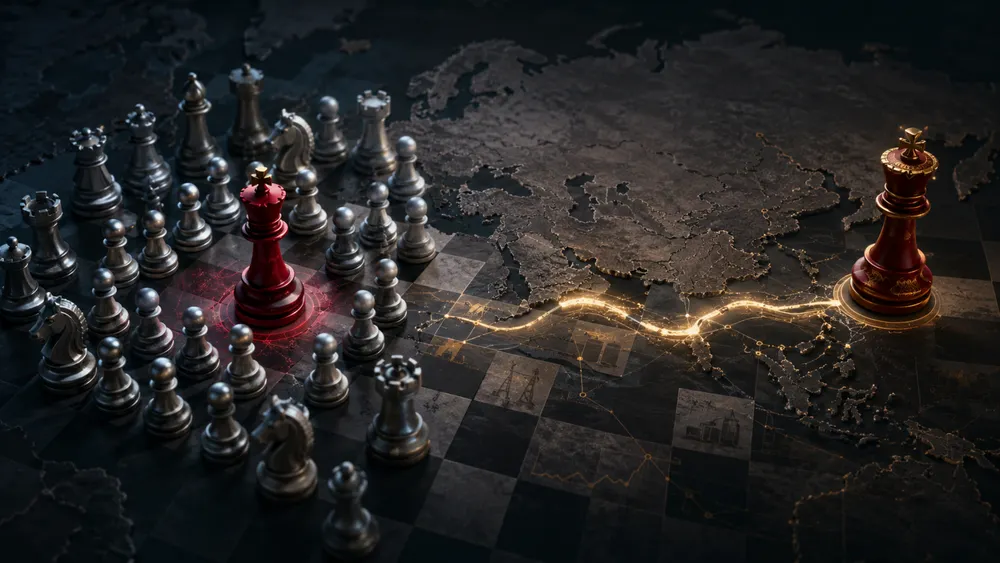
That question, from the man announcing the greatest economic isolation in the history of the world, contains the strategy's fundamental impossibility. China is Iran's largest oil buyer. Chinese financial institutions facilitate the transactions that keep Iranian oil revenue flowing. The greatest coordinated economic isolation in history cannot isolate Iran without stopping those transactions. Stopping those transactions requires sanctioning Chinese financial institutions. Sanctioning Chinese financial institutions risks the global financial system. Bessent has declined to do it.
The 60 entities sanctioned on August 24 are real and the network they represent is real. Several Chinese companies involved in procurement, logistics and shipping support for Iranian oil are named. What is not named is the financial architecture that makes the network function — and that architecture is Chinese.
What the Strategy Requires
Operation Economic Outcast operates on the premise that the United States can economically isolate Iran by sanctioning the entities through which Iran trades with the world. The premise has a specific structural requirement: the countries that matter most to Iranian trade must either comply with American pressure or face consequences severe enough to compel compliance.
Iran's key trading partners are China, India, Turkey, Iraq, the UAE and Pakistan. China is the largest buyer of Iranian oil by a substantial margin. India is the second. Turkey, Iraq, the UAE and Pakistan collectively account for most of the remainder. The UAE suspended trade with Iran this week — Bessent described the timing as 'not coincidental,' implying American pressure produced the result. The UAE represents a small fraction of Iranian trade compared to China.
China's foreign ministry spokesperson Lin Jian stated on August 25 that Beijing's economic cooperation with Iran 'has always been conducted within the framework of international law and should not be interfered with or disrupted.' China, Lin said, 'firmly opposes illegal unilateral sanctions' and 'will take all necessary measures to firmly safeguard its own rights and interests.' The statement was not a negotiating position. It was a refusal.
The Bloomberg reporting on August 25 captured what the refusal means strategically: Washington's plan 'risks derailing a fragile truce with China' — the trade framework that both sides have been managing carefully since 2025. Bessent has given companies a 'cure period' to sever ties with Iran, without specifying which companies, which countries or how long the period is. The ambiguity is deliberate. Naming China as a primary target would require either following through or publicly accepting a Chinese refusal. The cure period delays that choice.
Former NATO Supreme Allied Commander James Stavridis told CNN: 'China is only the first country that's going to decline the honour of being part of the blockade of Iran.' He was describing not a diplomatic failure but a structural condition: the countries most capable of enforcing an Iranian economic isolation are precisely the countries that have spent a decade building alternative economic infrastructure to avoid American leverage.
What the Sanctions Cannot Reach
The Al Jazeera reporting on the 60 entities reveals the specific architecture of what Operation Economic Outcast can and cannot do. The sanctioned network spans procurement intermediaries, logistics firms, shadow banking facilitators and shipping companies. It targets the arteries of Iran's shadow trade — the front companies and logistics chains that allow Iran to sell oil and import restricted technology despite existing sanctions.
What it does not target is the demand side. Iran sells oil because China buys it. China buys it because Iranian crude is cheap, available and outside the Western-controlled financial system. That equation does not change when American Treasury officials sanction a Hong Kong logistics firm or a Singapore shipping company. Iran develops new intermediaries. The cycle, described by Ali Akbar Dareini, a researcher at Tehran's Centre for Strategic Studies, is specific: 'Iran has a PhD in circumventing sanctions.' He told Al Jazeera that Iran has been running this curriculum since 1979.
Abbas Araghchi, Iran's foreign minister, placed the latest round in its historical sequence. 'This is a repetitive scenario, from the crippling sanctions imposed during the Obama administration to the maximum-pressure campaign during Trump's first administration and now the latest sanctions,' he said. 'All of these measures have been introduced under different titles, but they represent the same kind of bullying that we have always seen in American policy. In other words, it is the same movie they keep playing over and over again. We know this movie, so we know how to confront and deal with it.'
According to updated IMF projections, Iran's economy is expected to contract by nearly 5.5 per cent in 2026. Iran's currency hit a record low against the dollar on August 23. Fuel prices are surging, a pattern that preceded the 2019 protests and the 2026 uprising. The economic pressure is real and it is producing civilian suffering.
What it has not produced, across six months of war and sanctions, is the strategic outcome the administration announced: the surrender of Iran's nuclear programme, the dismantlement of its proxy network, the IRGC stripped of power. It has produced, instead, an IRGC with more control of the military than it had in February, a hardliner as head of Iran's supreme security council and an Iranian government that has characterised economic pressure as proof of battlefield defeat.
Former UN Special Rapporteur Alfred-Maurice de Zayas described the direction of travel: 'This will boomerang because more and more countries feel offended by US arrogance and resent the threats. They draw rational conclusions: decouple from the dollar.' Iran's foreign ministry characterised the strategy itself as legally incoherent: 'Economic coercion designed to force a sovereign State to alter its lawful policy choices constitutes an outright internationally wrongful act.' Sardar Mohebi of the IRGC said the US resorting to economic pressure was 'proof of its defeat on the battlefield.'
The Gap Bessent Named
The strategy's core difficulty is not operational. It is structural. American economic coercion works when the countries being asked to comply depend on access to the American financial system for their economic functioning. The sanctions architecture of the 2010s worked against Iran because Western banks, dollar clearing and the SWIFT network were the infrastructure Iran needed and could not replace. That infrastructure is no longer the only game in the global economy.
China has spent two decades building alternatives to dollar dependency — in settlement systems, in currency swap arrangements, in bilateral trade mechanisms that operate outside SWIFT. The renminbi's share of global trade settlements has increased materially since 2022. Russia's 2022 exclusion from SWIFT accelerated the development of non-Western alternatives. Iran has been adapting to dollar exclusion since 1979 and has developed the circumvention infrastructure that Dareini describes as a PhD programme.
Bessent's question — 'Why would I want to blow up the global financial system?' — is honest and revealing. He is acknowledging that the leverage required to actually isolate Iran financially would damage the infrastructure that makes American financial power meaningful. The threat to sanction a major Chinese financial institution exists as a threat because using it risks consequences the US is not prepared to absorb. China knows this. Iran knows this. The cure period is the gap between promising the greatest economic isolation in history and declining to use the tool that would make it possible.
Just Security confirmed on August 21 that Vance had said the war entered 'a new phase of economic pressure' with the aim of achieving 'the final objective.' The final objective has not changed: Iran's nuclear surrender and the end of the IRGC's regional influence. The new phase involves sanctioning companies in Singapore and Greece while specifically declining to sanction the financial institution through which Iran's oil revenue actually flows. The greatest coordinated economic isolation in the history of the world has a specific opening. China is standing in it.
This Analysis piece is free to read. Future Analysis pieces will be available to registered DiploPolis members first. Free registration takes 30 seconds. No credit card required.
Find this piece interesting?
Dispatches by DiploPolis delivers sharp analysis and pointed commentary on power, politics, diplomacy, and world affairs — directly to your inbox.
No neutrality. No noise. Just argument.