Nine years ago this week, Myanmar's military and armed Rakhine civilians burned hundreds of Rohingya villages and killed at least 6,700 people in a single month. Between 700,000 and 750,000 people crossed into Bangladesh in that wave alone. It was the largest and fastest displacement of people since the Rwandan genocide. The United States called it a genocide. The United Nations Secretary-General called it a textbook example of ethnic cleansing. The world watched, held emergency summits, pledged emergency funding and moved on.
On August 25, 2026, NPR published a report from the camps. The headline was drawn from a quote given by Jessica Olney, an independent researcher who has worked with the Rohingya for a decade. 'Forget about going back right now,' she told the reporter. 'People are still coming in, and nobody seems to talk pragmatically about that.' The report noted that the world's attention was fixed on the Middle East and Ukraine. The ninth anniversary of the largest single-month displacement of people in a generation passed largely unnoticed.
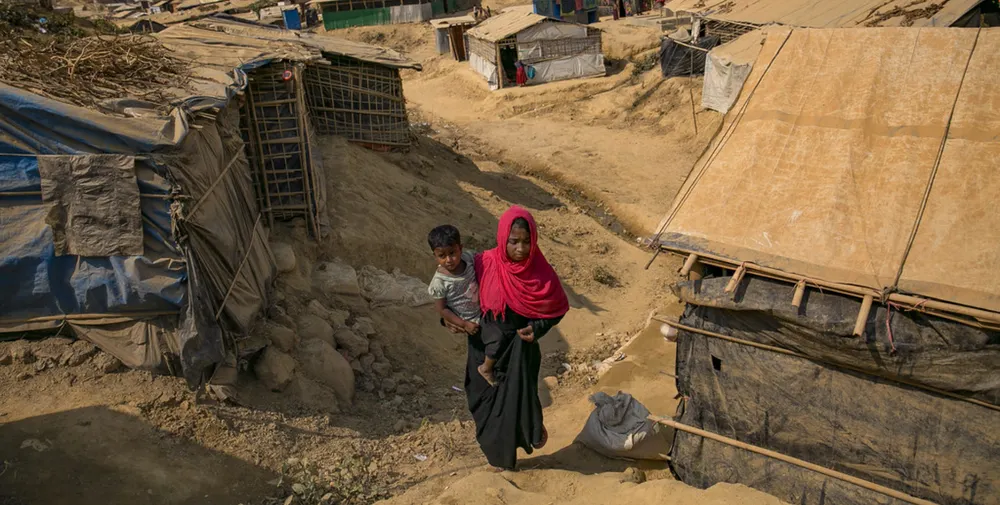
More than one million Rohingya are in the camps around Cox's Bazar, Bangladesh. The World Food Programme's food ration for some of them is now $7 per person per month. In 2023, the ration was cut from $12 to $8 while 40 per cent of children under five were already chronically malnourished. It was restored to $12 in 2024. This April, it was cut again, to as little as $7 under a new tiered system. The Rohingya are barred from legally working in Bangladesh. They depend almost entirely on humanitarian assistance. The humanitarian assistance is shrinking. Some are risking 1,000-mile boat journeys to Malaysia because the camps have become intolerable.
And still they are coming. More Rohingya continue crossing from conflict-torn Rakhine state into southern Bangladesh, even as the million who crossed before them have nowhere to go.
What Nine Years Has Built
The Kutupalong-Balukhali camp complex near Cox's Bazar is the largest refugee camp in the world. It was not designed to be permanent. Nothing about the international community's response to the 2017 exodus was designed to be permanent. The emergency shelters, the emergency rations, the emergency funding appeals, the emergency summits — all were framed as temporary measures for a population that would return home once conditions permitted. Nine years later, the conditions do not permit it. The temporary measures have become the permanent architecture of a stateless population's existence.
The Rohingya were not citizens of Myanmar before August 2017. They have been denied citizenship since the 1982 Citizenship Law excluded them from the list of recognised national races. They were stateless in Myanmar before the crackdown. They are stateless in Bangladesh after it. The children born in the Cox's Bazar camps in 2018, 2019, 2020 and 2021 have never lived anywhere but a temporary shelter. They are growing up without the legal right to work, to move freely, to access formal education beyond what NGOs can provide, or to claim citizenship in any country. Their parents cannot go back. They have nothing to go back to.
Myanmar's military junta, which seized power in February 2021, has intensified the violence in Rakhine state. The Arakan Army — a Rakhine ethnic armed organisation — has been fighting the junta across the region, and the conflict has produced a new wave of displacement on top of the one that never resolved. People crossing into Bangladesh in 2026 are not the same people who crossed in 2017. They are a different population being driven out by a different phase of the same violence in a country where the political conditions for Rohingya return have, if anything, deteriorated since the exodus began.
The Gambia filed a case against Myanmar at the International Court of Justice in November 2019, under the Genocide Convention, on behalf of the Organisation of Islamic Cooperation. In January 2020, the ICJ ordered provisional measures requiring Myanmar to protect the Rohingya from genocide. Myanmar was required to preserve evidence, prevent genocidal acts and report to the court on its compliance. The measures exist. The reports were submitted. Myanmar's military then staged a coup. The ICJ's jurisdiction extends to the government that signed the court's measures. The government that signed the measures no longer exists. The violence in Rakhine state continues.
The Architecture of Structural Neglect
The DiploPolis piece published in April 2026, The Refugee the West Made, made an argument about the global displacement crisis that the Rohingya case now illustrates with specific precision. The piece argued that the international community manages refugee crises with initial emergency generosity and permanent structural neglect — that the funding follows attention, and the attention follows geopolitical interest, and the crises that do not connect to the strategic interests of powerful states are the ones that get the $7 food ration.
The Rohingya do not have oil. Rakhine state is not a chokepoint for global trade. Myanmar's military junta has no Security Council patron willing to advocate for Rohingya return. The Gambia's genocide case at the ICJ — brought by a small West African state acting on behalf of Islamic solidarity, not by any of the states with the power to enforce the court's orders — is a measure of precisely how far outside the centres of geopolitical power the Rohingya crisis sits.
The funding architecture confirms the structural argument. The UNHCR Bangladesh operation requested $876 million for 2024 and received 49 per cent of it. The WFP's food assistance for the Rohingya has been chronically underfunded — hence the ration cuts. Programs to support the Rohingya were only around half funded in 2025, and are only 19 per cent funded this year. The gap between what is requested and what is provided is not random. It tracks the attention cycle. When Bangladesh floods or Myanmar makes the news, donations increase. When the Strait of Hormuz is the centre of the world's energy anxiety, Bangladesh's camps are not.
The world's attention this week is on Operation Economic Outcast and what China will do about it. The world's attention last week was on the Islamabad Memorandum's collapse and Iran's military restructuring. The week before that, it was on Netanyahu's rejection of Trump's 15-point plan. All of these stories matter. All of them generated DiploPolis analysis pieces. None of them has any practical bearing on whether a nine-year-old child in Kutupalong gets a food ration of $7 or $12 this month.
What Accountability Has Produced
The international community's accountability machinery has been applied to the Rohingya crisis with an unusual level of seriousness. The Gambia's ICJ case is proceeding. The court's provisional measures are on the record. Several countries have used the word genocide, including the United States under Joe Biden. Multiple UN special rapporteurs have documented the violence and the displacement with precision and regularity. Human rights organisations have produced thousands of pages of testimony from survivors. The evidence of what happened in August 2017, and of what has continued to happen since, is not contested.
What the accountability machinery has not produced is accountability. No member of Myanmar's military leadership has been arrested. No senior official has appeared before any court. The junta that staged the coup in 2021 is the entity now being asked, through diplomatic pressure, to create conditions for Rohingya return — the same military institution whose commander-in-chief, Senior General Min Aung Hlaing, has been sanctioned by Western governments and has continued to govern without consequence.
The pattern the Rohingya crisis describes is the pattern the Nuremberg Files series has been tracing across DiploPolis's coverage of international accountability: legal instruments that name the crime, courts that document the violation and orders that cannot be enforced against those with the power to ignore them. The ICJ ordered Myanmar's military to protect the Rohingya in January 2020. The military staged a coup thirteen months later. The orders are still on the record. The Rohingya are still in Cox's Bazar.
What Nobody Is Talking About Pragmatically
The NPR report's central finding is that the discussion of repatriation — the conversation about when and how the Rohingya might go home — is premature. It is premature because the violence in Rakhine state has not stopped, because Myanmar has not offered any framework for Rohingya citizenship or security, because the political conditions for return do not exist and there is no credible mechanism for creating them. More people are crossing in than the existing population has any prospect of leaving.
The discussion that is not happening, the one Olney identifies as the pragmatic one, is about the camps themselves — about what it means for the international community to have created, funded and then underfunded a permanent city of stateless people on the edge of Bangladesh. Cox's Bazar's Rohingya population is larger than the population of many of the countries whose diplomats attend UN emergency sessions on their behalf. They are not a temporary crisis requiring emergency management. They are a permanent population requiring a permanent solution. And the permanent solution — citizenship, security, a political framework for their existence — requires decisions from the Myanmar military that the international community has no mechanism to compel.
Olney's instruction — forget about going back — is addressed to the policy community that still frames the crisis as a repatriation problem. But it is also the instruction that the international community has effectively issued to the Rohingya themselves through the decisions it has and has not made over nine years. The emergency shelters that became permanent structures. The rations that started at $12 and ended at $7. The attention that moved to the Strait of Hormuz and the 60-day nuclear deadline and the sanctions on Singapore shipping companies. The Rohingya did not disappear from Cox's Bazar when the world's attention moved elsewhere. They are still there, and still coming, and the world is still not talking pragmatically about that.
This Analysis piece is free to read. Future Analysis pieces will be available to registered DiploPolis members first. Free registration takes 30 seconds. No credit card required.
Find this piece interesting?
Dispatches by DiploPolis delivers sharp analysis and pointed commentary on power, politics, diplomacy, and world affairs — directly to your inbox.
No neutrality. No noise. Just argument.