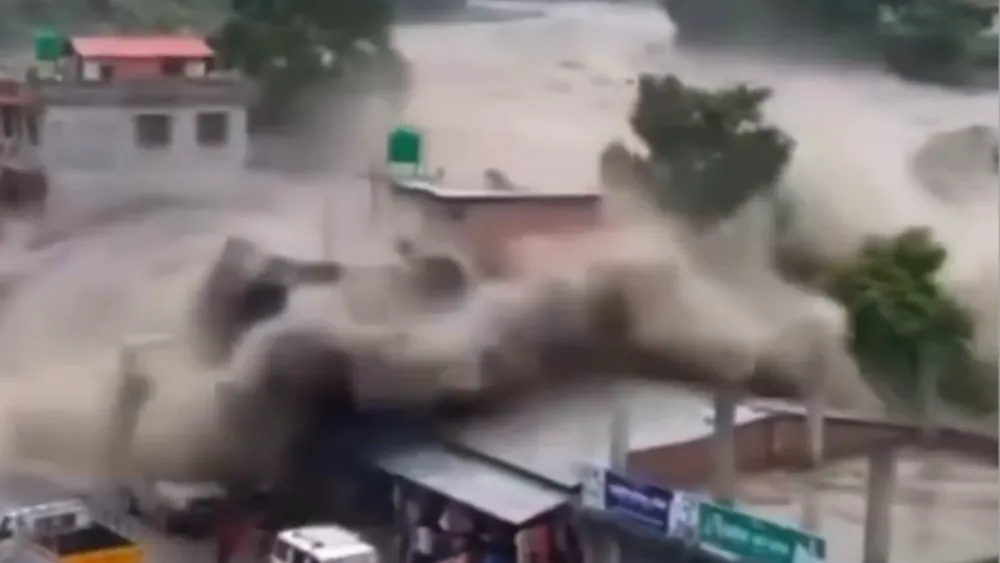
The collapse of a glacier sent a wall of water, ice, rock and mud down the Bhotekoshi River on August 27, sweeping entire villages off the Nepal-Tibet border. More than 390 people were confirmed dead and more than 1,300 are missing, including more than 600 foreign tourists who were in the border region when the flood struck. Buildings were swept from their foundations. Roads connecting the valley towns to Kathmandu were cut. The Bhotekoshi valley — a narrow gorge connecting Nepal's Sindhupalchok district to the Tibetan plateau — has flooded before. It has never flooded like this.
The collapse was not a surprise in the geological sense. The Bhotekoshi corridor is one of the world's most flood-prone mountain passages. It carries the principal overland trade route between Nepal and China, a route that has been disrupted repeatedly by landslides and glacial lake outbursts since monitoring began. The US Geological Survey confirmed that what initially appeared to be a 4.4 magnitude earthquake was actually the seismic energy generated by the sudden collapse of glacial rock and ice, followed by a massive debris flow. Climate researchers have been documenting the acceleration of glacial melt in the Hindu Kush Himalaya for decades. The glaciers are retreating faster, the glacial lakes are growing larger and the probability of catastrophic outburst events is increasing with each degree of warming. Wednesday was one of those events. The villages in the valley had no evacuation warning that was sufficient. Many of them had nowhere higher to go.
More than 600 of the missing are foreign tourists. They were trekking the Friendship Highway — the high-altitude route connecting Kathmandu to Lhasa — when the flood struck. Among the missing: 90 Americans, 24 Canadians, 34 Australians, 133 Indians and nationals from across Europe and Asia. Some were from countries whose foreign policy has been entirely consumed by the Iran war's diplomatic management since February 28. Their governments are, at this moment, simultaneously monitoring ceasefire negotiations with Iran and searching for their citizens in the Bhotekoshi valley.
The Nepal-Tibet floods have produced no Security Council emergency session. They have produced no presidential statement from the United States. They have produced no coordinated international response commensurate with 390 confirmed dead and 1,300 missing people in a mountain gorge. They have produced NPR's August 27 report and the Washington Post's live updates and the missing persons lists being compiled by embassies in Kathmandu. They have produced the specific, measurable attention that a humanitarian disaster receives when the world's institutional attention is directed elsewhere.
Elsewhere is Tehran, and Doha, and the Strait of Hormuz, and the UN Security Council in New York where Mladenov warned of the next Gaza war, and the Kenscoff hills in Haiti where the gang leader's video is still circulating, and the Arabian Sea where the Lincoln has finally turned for home. The world has its agenda. The Bhotekoshi has its flood. Both are happening simultaneously. The 1,300 missing are in neither agenda.
This is the displacement that DiploPolis has been naming since February 28: the war that consumed global attention also consumed the institutional capacity to respond to everything that was happening in the weeks and months around it. The Nepal-Tibet floods are the most specific proof available. More than 390 confirmed dead. More than 1,300 missing. More than 600 of them tourists from countries with embassies and emergency protocols and diplomatic capacity. The response is live updates.
The villages are gone. The world watched the Strait.