On March 19, 2026, Germany quietly did something it had loudly promised it would never do. It walked away from Israel’s defence at the International Court of Justice.
Two years earlier, Berlin had stood before the world and called South Africa’s genocide case against Israel baseless — political instrumentalization of the Genocide Convention, it said. Germany, of all countries, would not allow the Holocaust’s memory to be weaponised against the Jewish state. It would intervene. It would defend. It would stand firm.
It did not stand firm.
When the deadline arrived this week to formally file that intervention, Germany was absent. The explanation was procedural — Berlin is now itself a defendant at the ICJ, sued by Nicaragua for arming Israel, and felt it could not intervene on Israel’s behalf without compromising its own legal defence. Sensible lawyers had prevailed over solemn promises.
But read the subtext. Germany — Israel’s second largest weapons supplier, the country whose entire post-war identity was constructed around the obligation to protect Jewish survival — has decided that defending Israel at The Hague is now too legally toxic to risk. Not morally wrong. Legally toxic. That is a different calculation entirely. And it tells you everything about how much the ground has shifted.
The case at The Hague is no longer a distant legal abstraction. The International Court of Justice — the highest court of the United Nations, which resolves disputes between states — has already issued binding provisional measures ordering Israel to prevent genocidal acts, ensure humanitarian aid reaches Gaza, and preserve evidence of what has occurred. These are not recommendations. They are legally binding orders. Israel has been accused by multiple human rights organisations and UN bodies of repeatedly violating them. A final ruling on whether Israel has breached the 1948 Genocide Convention — the treaty written in direct response to the Holocaust — could come as late as 2028. The court has not yet delivered that verdict. But it has seen enough to act.
On the same day Germany was quietly retreating from The Hague, Benjamin Netanyahu was scheduled to appear in Budapest.
Netanyahu is not a free man in the eyes of international law. The ICC issued an arrest warrant for him on November 21, 2024 — for the war crime of starvation as a method of warfare and crimes against humanity including murder and persecution. Every one of the 125 ICC member states is legally obligated to arrest him if he sets foot on their territory. Hungary is still, for another 73 days, one of those states.
He was scheduled to speak in person at CPAC Hungary — the annual conservative conference hosted by Orbán in Budapest. He cancelled his in-person appearance, citing security concerns related to the ongoing Iran war, participating instead only remotely. But this was not an isolated incident. It was the latest in a pattern.
In January 2026, Netanyahu skipped the World Economic Forum in Davos after Switzerland confirmed it would arrest him — missing even the signing ceremony for Trump’s own Gaza ‘Board of Peace,’ of which Netanyahu was a named member. The warrant has not put him in a courtroom. But it has put him under house arrest on the world stage. The only ICC member state Netanyahu has physically entered since the warrant was issued is Hungary — the one country whose leader celebrated his arrival rather than arresting him.
In April 2025, Netanyahu visited Hungary and was not arrested. The ICC found Hungary in formal non-compliance. The Assembly of States Parties noted the finding. Nobody acted.
The reason Hungary will not arrest him is not legal confusion. It is deliberate political choice. Orbán did not merely ignore the warrant. He celebrated it. During Netanyahu’s last visit he announced Hungary’s withdrawal from the ICC — a gesture so contemptuous of international law it amounted to a public declaration that the court’s authority ends wherever political friendship begins.
Trump went further. He sanctioned the ICC judges personally — the individuals who signed the warrant — using the economic power of the United States government to punish jurists for doing their jobs. The message from Washington and Budapest is not subtle: issue warrants against our allies and we will come for you.
What we are witnessing is not the failure of international justice. It is its active sabotage by the very powerful nations that once championed it.
And yet the court still stands. The case still proceeds. The warrant still has Netanyahu’s name on it.
That is because of a different set of countries entirely.
The nations leading the charge at the ICJ are not the western powers that built the post-war legal order. They are South Africa — a country that lived under apartheid while western governments looked away and called it an internal matter. They are Nicaragua — small, poor, with no obvious geopolitical stake in the conflict — which filed a separate case against Germany itself for arming Israel, and in doing so forced the world’s most Holocaust-haunted nation to abandon Israel’s legal defence. They are Colombia, one of the earliest to file a declaration of intervention, calling the Genocide Convention “a cardinal instrument of international law.” They are Bolivia, which told the court that “Israel’s genocidal war continues, and the Court’s orders remain dead letters to Israel.” They are Chile, whose president announced the intervention in his annual address to Congress. They are Ireland, which overcame its own hesitation rooted in Holocaust memory to file its declaration in January 2025. And they are Namibia — which carries the memory of its own genocide at German hands, committed between 1904 and 1908, and which filed its ICJ declaration in March 2026 drawing that parallel explicitly, while also blocking a vessel carrying military shipments bound for Israel. Together with Belize, Bolivia, Chile, Colombia, Honduras, Senegal, South Africa and Malaysia, Namibia also helped form The Hague Group — a formal coalition of Global South nations created specifically to defend the legitimacy of international legal institutions against the pressure being brought to bear by the United States.
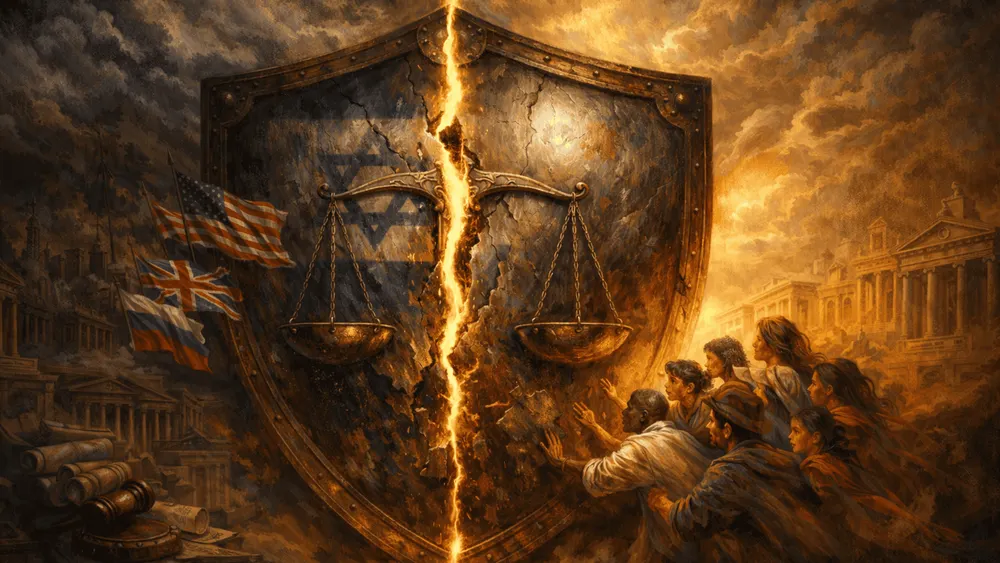
On March 12, 2026, the same day Namibia filed its declaration at the ICJ drawing the parallel to its own genocide, the United States and Hungary filed their own declarations — on Israel’s behalf, arguing the Genocide Convention should be interpreted narrowly and that Israel is not committing genocide. Hungary, which that same month was hosting Netanyahu in defiance of his ICC arrest warrant, was simultaneously filing legal papers defending him at The Hague. The United States, which has sanctioned the ICC judges who issued that warrant, was fighting Israel’s legal battles in the civil court while punishing the criminal court for doing its job. The shield does not merely endure. It is being actively reinforced.
As of March 2026, more than eighteen countries have filed declarations at the ICJ in support of South Africa’s case — among them Colombia, Bolivia, Chile, Ireland, Namibia, Mexico, Spain, Turkey, Cuba, Belgium, Brazil, Iceland and the Netherlands. Three countries have filed in Israel’s defence: the United States, Hungary, and Fiji. The numbers speak for themselves.
The irony is precise and painful. The countries with the least power in the international system are using its legal instruments most faithfully. The countries with the most power are either sabotaging those instruments or retreating from them when the cost becomes too high.
The shield is cracking. Not because the powerful have found courage. Because the powerless have refused to be silent.
History does not always move in the direction of justice. But sometimes, unexpectedly, it moves because of the people who have the least reason to believe it will.
South Africa did not have to file that case. Nicaragua did not have to sue Germany. Namibia did not have to speak. These are not powerful countries. They do not have vetoes at the Security Council. They cannot sanction judges or withdraw from treaties without consequence. They have no protection if the powerful decide to retaliate.
They acted anyway. Because they have seen this before. Because they know what it looks like when the world decides that some lives are worth less than others, that some crimes are too inconvenient to prosecute, that some perpetrators are too important to hold accountable. They have lived that story. And they have decided they will not be silent witnesses to its repetition.
The shield that protected Israeli state conduct from accountability for seven decades was not built from stone. It was built from guilt, from geopolitical interest, from the quiet agreement among powerful nations that certain questions would not be asked. It is cracking now — not because those nations have found courage, but because smaller, braver ones have refused to accept the agreement.
The questions they are forcing into the open are not comfortable ones. They cut to the heart of what international law is actually for — whether it exists to protect the powerful from accountability or to hold all states equally to the principles the world agreed upon in the ruins of the Second World War.
Those principles have a name. They were established at a place called Nuremberg. And the full story of what they demand, of who has been shielded from them, and why, and for how long, is a reckoning the world can no longer avoid.