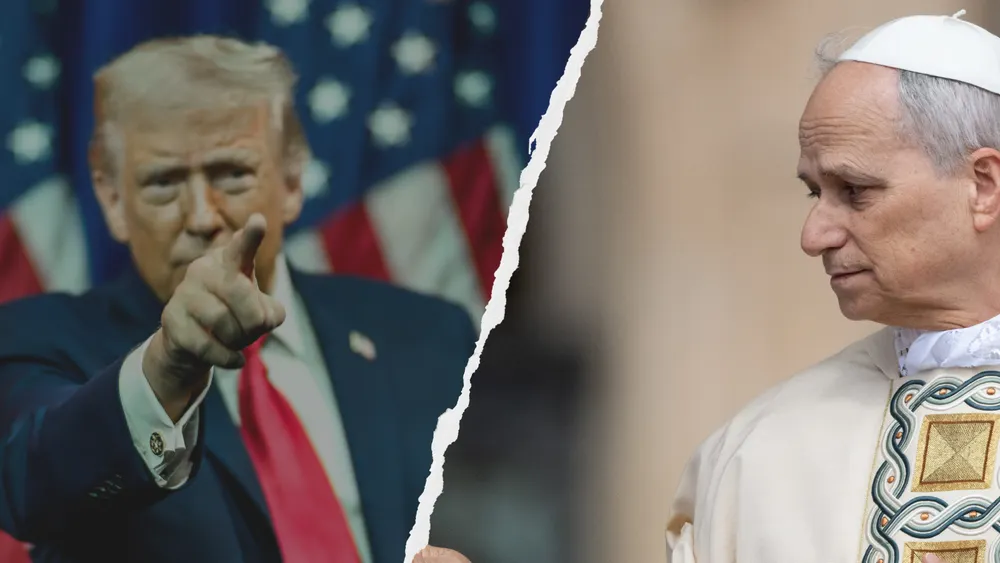
On April 12, Donald Trump wrote on Truth Social that he did not want a pope who thinks it is acceptable for Iran to have a nuclear weapon. He has repeated the claim in interviews and in a second post days later. The claim is false. Pope Leo XIV has never said Iran should have a nuclear weapon. He has said the opposite, in writing, on video and from the altar, repeatedly. In March he said: 'May the nuclear threat never again dictate the future of humanity.' In June 2025 he called for 'a world free from nuclear threat.' In July he said nuclear weapons 'offend our shared humanity.' The record is unambiguous. The lie is deliberate.
What followed the lie is the more instructive story. Marco Rubio, a practising Catholic and the United States Secretary of State, is flying to Rome this week. Not to correct his president. To manage the consequences of his president's words. Rubio told reporters Trump does not understand why anyone would think it a good idea for Iran to have a nuclear weapon — a framing that accepts the false premise rather than names it. Italy's prime minister Giorgia Meloni, a long-time Trump ally, pushed back on the Pope comments and was promptly criticised by Trump in return. Italy's foreign minister called the remarks 'neither acceptable nor helpful.' Nobody in the administration said the simplest, most obvious, most necessary thing: that what Trump claimed about the Pope is not true.
Trump also wrote that if he were not in the White House, Leo would not be in the Vatican. The papacy, in his account, is a reaction to Donald Trump. This is the psychology of a man who believes the world arranges itself around him. It also reveals why the Pope is worth attacking. Leo is not a minor irritant. He is a problem.
The lie was allowed to stand. It is standing still.
This matters because of what Leo has actually been saying, and why it is apparently threatening enough to require fabrication. Since the US-Israel war on Iran began in February, the Pope has done something no head of state, no secretary-general and no international body has managed with any consistency: he has told the truth about the war. He called Trump's threat to destroy Iranian civilisation 'truly unacceptable.' He said the war fails the basic criteria for moral justification: diplomacy was not exhausted, civilian harm is disproportionate, there is no clear objective oriented toward peace. On Palm Sunday he said: 'Jesus is the king of peace, who rejects war, whom no one can use to justify war' — a direct response to Defence Secretary Pete Hegseth's repeated invocation of scripture to frame the bombing as divinely sanctioned. When asked if he fears the White House, Leo said: 'I have no fear of the Trump administration or speaking out loudly of the message of the Gospel.'
Washington Archbishop Robert McElroy said last week that there is 'no prophetic moral voice in the world at this time, other than Pope Leo.' He is right. The observation is not a compliment to Leo. It is an indictment of everyone else.
The leaders watching this war — in Europe, across the Global South, in the permanent seats of the Security Council — have issued statements, registered abstentions and moved on. The institutions designed precisely for moments like this have produced language and little else. The Pope commands no army, controls no oil supply, holds no veto and governs a city smaller than many Indian residential colonies. He is the only figure on the world stage saying plainly that this war is wrong, that threats against civilians are wrong, that invoking God to justify bombing is wrong.
Trump cannot ignore Leo because moral authority, even stripped of every material instrument of power, is still authority. It shapes opinion, names reality, provides the language people reach for when official discourse has been exhausted. The lie was an attempt to neutralise that authority by attributing to the Pope a position so extreme that anyone who agrees with him becomes indefensible. It failed. Leo simply asked to be criticised truthfully.
Nobody with power is doing that. The silence of everyone who could is the verdict.