The interception happened 600 miles from Gaza. Not at the edge of the blockade zone. Not in contested waters off the Palestinian coast. Six hundred miles away, near the Greek island of Crete, in the eastern Mediterranean, where Greek search-and-rescue law applies and EU treaty obligations nominally govern.
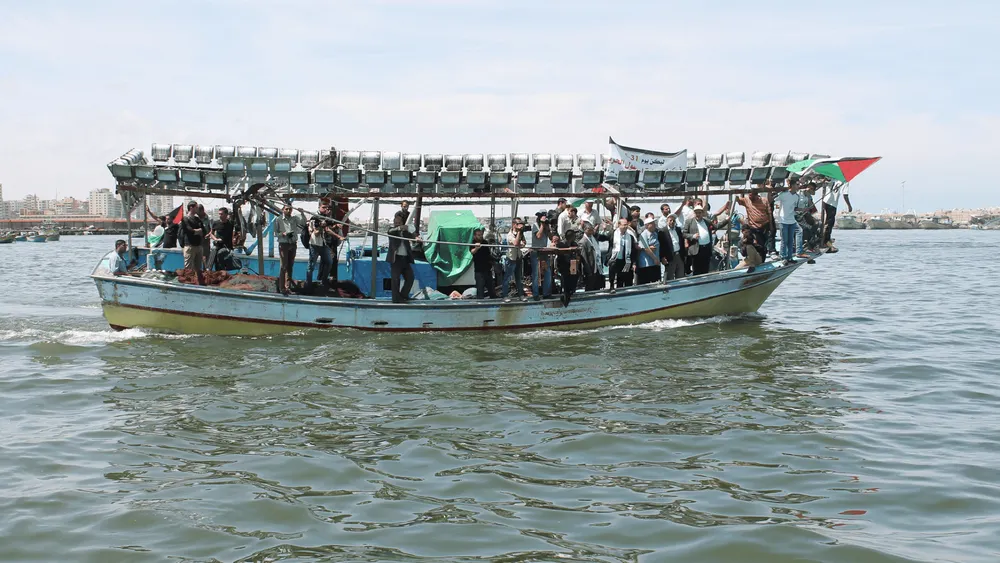
Israel sent warships and drones. It seized 22 of the 58 vessels of the Global Sumud Flotilla on the night of April 29. It detained 175 activists at gunpoint, transferred the majority to Greece where 36 required medical attention, left one boat sinking, and took two men — Saif Abukeshek, a Spanish-Swedish national of Palestinian origin, and Thiago Ávila, a Brazilian national — to Shikma Prison in Ashkelon.
Neither has been charged with anything.
Lawyers from the Israeli legal rights organisation Adalah visited Abukeshek and Ávila in Shikma on Saturday and reported testimony of severe physical abuse amounting to torture. Ávila told his lawyers he had been dragged face-down across the floor of the military vessel and beaten until he lost consciousness twice. Abukeshek was kept hand-tied and blindfolded from the moment of seizure. Released activists said they could hear him screaming from below deck during the voyage. Both men declared a hunger strike. An Israeli court extended their detention. Today is the date set for the next decision.
Israel's justification is familiar. Abukeshek is accused of affiliation with a terrorist organisation. Ávila is accused of illegal activity. The United States State Department threatened consequences against any port that hosted the flotilla's ships, casting the mission as pro-Hamas. On the basis of these designations, European citizens were seized by a foreign military in European waters, transported to a foreign prison, subjected to what lawyers documented as torture, and held without charge while a court in a country they had not travelled to extended their detention on a schedule convenient to their captors.
This is not the beginning of the story. In 2010, the Mavi Marmara was boarded by Israeli forces in international waters and nine activists were killed. The UN Human Rights Council found the raid illegal and the force deployed against civilians disproportionate and brutal. Nothing changed. In 2025, the first Global Sumud Flotilla was intercepted closer to Gaza. The world condemned it. Israel arrested and deported more than 450 participants, including Ávila himself, who reported abuse in custody that time too. Israel denied it and moved on. This time, the interception happened further from Gaza and closer to Europe. The jurisdiction expanded. The silence was the same.
The mechanism is the terrorism designation. Once applied, the law withdraws. Jurisdiction dissolves. The right to be charged before being detained disappears. The obligation of European governments to protect their citizens from the armed forces of a foreign state, in European waters, is suspended. Adalah argued before the Israeli court that there is no legal basis for the extraterritorial application of Israeli criminal law to foreign nationals in international waters. The court extended the detention anyway.
Spain's Prime Minister Pedro Sánchez called it an abduction. Spain's foreign minister called it a kidnapping and demanded Abukeshek's immediate release. Italy opened a prosecutorial investigation after the vessels were found to be flying Italian flags. Eleven countries, including Brazil, South Africa, Pakistan and Colombia, issued a joint statement describing the operation as a flagrant violation of international law. The UN Special Rapporteur on the occupied Palestinian territories called it an abomination.
And Greece, in whose search-and-rescue zone the interception took place, facilitated the transfer of the majority of activists to shore and let the two designated targets go to Ashkelon.
This is the part that matters. Not what Israel did. Israel has done this before. Israel will do it again. What changed this time is where. Europe was not a bystander to this interception. Europe was the location. Israeli warships operated inside Greece's search-and-rescue zone. The activists seized were nationals of EU member states. The vessels boarded were flying Italian flags. And the European response was statements, vigils and a prosecutor's letter that will take years to go anywhere, if it goes anywhere at all.
Abukeshek has three children. The youngest is one year old. Ávila has a daughter who is 18 months old.
Whether they are released today or held again, the verdict is already written. Israel has established, through repetition and the reliable acquiescence of the international community, that the Mediterranean falls within its operational jurisdiction. Every condemnation that produces no consequence teaches that lesson. Every statement issued and forgotten moves the interception point a little further from Gaza and a little closer to the ports of Europe.
The blockade holds. The 600 miles was already the provocation. Next time, the number will be smaller.
Find this piece interesting?
Dispatches by DiploPolis delivers sharp analysis and pointed commentary on power, politics, diplomacy, and world affairs — directly to your inbox.
No neutrality. No noise. Just argument.