On August 9 and 10, 1941, two men sat across from each other aboard the U.S.S. Augusta in Placentia Bay, Newfoundland, and decided the shape of the world to come. Franklin D. Roosevelt and Winston Churchill had not yet won the war. The outcome was far from certain. And yet they produced, in those few days at sea, a document — the Atlantic Charter — that would become the foundation of the post-war international order.
What strikes you, looking back, is not just what they agreed. It is how they carried themselves. There was an understanding, unspoken but absolute, that the moment demanded everything they had. A Briton watching Churchill in those years felt something that went beyond politics. They felt pride. Pride in the office, in the bearing, in the sense that their country was represented by someone equal to the gravity of the hour.
Fourteen years later, on the other side of the world, Jawaharlal Nehru stood before twenty-nine newly independent nations in Bandung, Indonesia. It was a landmark gathering — and its vision of the world order belonged neither to Washington nor to Moscow. It insisted that the voices of Asia and Africa had as much right to shape the future as the great powers of the West.
The politics were different. The tradition was different. The side of history was different. And yet the quality of the moment was the same. An Indian watching Nehru at Bandung felt exactly what a Briton felt watching Churchill at sea — pride. The pride of seeing your leader rise to meet the weight of what history was asking.
Churchill and Nehru agreed on almost nothing. One fought to preserve an empire, the other devoted his life to dismantling it. But both understood something that seems to have gone missing from the world's leading democracies — that leadership is not merely about power. It is about the authority that comes from being taken seriously. It is about gravitas.
On March 19, 2026, in the Oval Office of the White House, a Japanese reporter asked President Donald Trump why the United States had not informed its ally Japan before launching strikes on Iran. It was a fair and important question. Japan depends on the Strait of Hormuz for a significant portion of its energy supplies. The war had begun without warning, without consultation, and with consequences the world was still struggling to absorb. The reporter said the decision had "confused" the Japanese.
Trump's answer was a joke. "We wanted surprise. Who knows better about surprise than Japan? OK? Why didn't you tell me about Pearl Harbor?"
Seated beside him was Japanese Prime Minister Sanae Takaichi, visiting Washington for the first time since her landslide election victory. She had come to discuss trade and security in the middle of a war her country had not been consulted about. Hearing Trump's response, she stiffened. Her eyes widened. On the American side, Vice President JD Vance, Secretary of State Marco Rubio, and other senior officials laughed. On the Japanese side, there was silence.
Pearl Harbor is not a historical footnote. It is a wound, on both sides, that took generations to heal. In 2016, Japanese Prime Minister Shinzo Abe made a solemn visit to the Pearl Harbor memorial alongside President Barack Obama, offering what he called sincere and everlasting condolences. It was a moment of extraordinary diplomatic care — two leaders, representing countries that had once been at war, choosing gravity over convenience.
Nine years later, his successor sat in silence while the American president made it a punchline.
There was a time when the world listened when an American president spoke. Now it watches to see what he will say next.
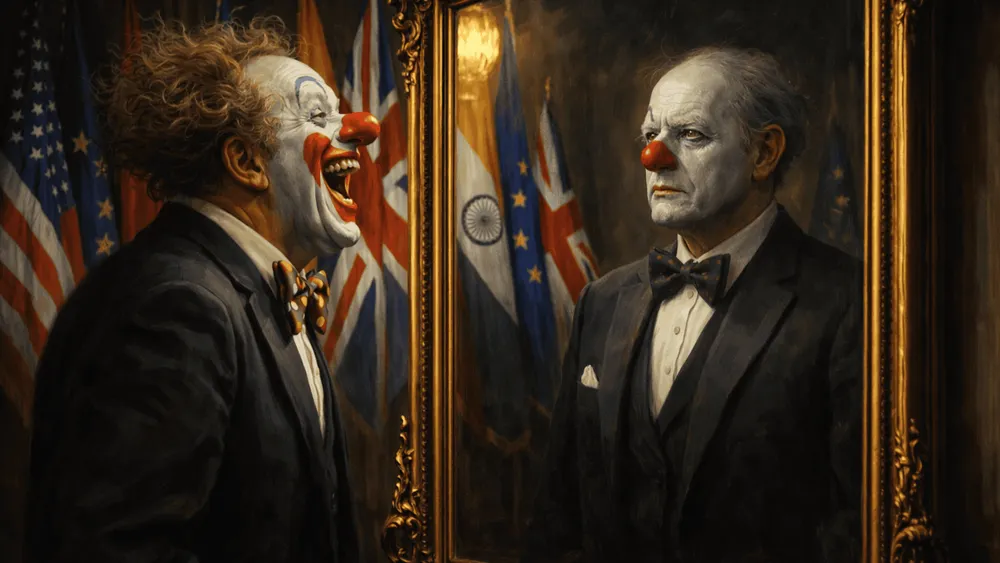
Trump is not alone in this. Across the democratic world a new style of leadership has emerged that mistakes performance for statecraft, volume for authority, and visibility for power. Nowhere is this more visible than in India, where Prime Minister Narendra Modi has elevated the embrace to an instrument of foreign policy.
The hugs are legendary. Bear hugs, back-slapping embraces, lingering clasps that seem to catch their recipients visibly off guard. World leaders have been pulled into Modi's arms at summits, at bilateral meetings, on the sidelines of multilateral forums. The Indian media, and the ecosystem of ministers and officials that surrounds him, presents each embrace as evidence of India's rising global stature — proof that the world's leaders seek Modi out, that India is now a country others come to rather than overlook. But there is a difference between being sought out and being grabbed. And there is a difference between warmth and theatre. The hug that is photographed, captioned, and shared across a hundred government social media accounts within minutes is not diplomacy. It is content. And content, however viral, does not build alliances, resolve disputes, or construct the patient architecture of trust that serious international relationships require.
Boris Johnson understood the performance instinct — and weaponised it deliberately. The dishevelled hair, the bumbling manner, the jokes at inopportune moments — Johnson cultivated an image of loveable chaos that his supporters read as authenticity. On the international stage it was something else entirely. Two former British Prime Ministers from opposite parties, John Major and Tony Blair, jointly accused him of “shaming” the country. European counterparts found themselves genuinely uncertain when Johnson was being serious — an uncertainty that was not an asset during the Brexit negotiations but a liability that Britain is still paying for. As Foreign Affairs concluded, far from achieving the promised “Global Britain,” Johnson left the country without a stable relationship with Europe and barely present in much of the developing world. The persona that played so well domestically was, internationally, a slow and costly erosion of trust.
In each of these cases, the inner circle around the leader tells its own story. When six American soldiers were killed in the Iran war and reporters asked difficult questions, Secretary of War Pete Hegseth did not grieve publicly or reflect seriously on the cost of war. He stood at a Pentagon briefing and declared that the world, Europe, and even the American press should be saying one thing to Donald Trump — thank you. Not for a policy achievement. Not for a diplomatic success. Simply for being Trump. In India, Modi’s ministers compete on television to attribute every foreign policy development, however small, to the Prime Minister’s personal vision. Johnson’s advisors, meanwhile, famously told him what he wanted to hear until the contradictions became impossible to sustain.
The sycophancy is not incidental. It is structural. When those closest to power stop pushing back, the leader stops being corrected. When the leader stops being corrected, the behaviour escalates — the jokes get cruder, the hugs get tighter, the performance gets louder. There is no one left to say: this is not what the moment requires.
Roosevelt had people who pushed back. Churchill’s cabinet argued with him fiercely — sometimes bitterly. Nehru had V.K. Krishna Menon, described as the second most powerful man in India, who was formidably difficult, and Sardar Patel, who challenged him directly on China policy until his dying day. Serious leaders were surrounded by people willing to say no. Today they are surrounded by people competing to say thank you.
There is a temptation to treat all of this as entertainment — to scroll past the Pearl Harbor joke, to share the hug meme, to file it all under the general category of political embarrassment that democracies somehow survive. The meme is the medium now. A leader's most undignified moment becomes a gif within hours, translated into dozens of languages, replayed endlessly across platforms that have no memory and no mercy. What once faded is now permanent. What once stayed in the room now circles the globe before the press conference is over.
But the stakes are not merely reputational. They are civilisational.
The world in 2026 faces a convergence of challenges that has no precedent since 1945. Climate change is rewriting the geography of habitable land and reliable water. Artificial intelligence is reshaping economies, militaries, and the very infrastructure of democratic decision-making. Nuclear arsenals are expanding rather than contracting. The rules-based international order — imperfect, contested, but functional for eight decades — is fraying at every seam. The Strait of Hormuz, through which a significant portion of the world's energy supplies once flowed freely, is now a war zone.
Meeting these challenges requires exactly what the post-war generation provided — leaders capable of sustained, serious, trust-based diplomacy. Leaders whose word means something. Leaders whose allies do not leave their meetings wondering whether the whole thing was a performance. Leaders in whose presence a Japanese Prime Minister does not have to sit in silence, her eyes wide, while a joke about Pearl Harbor lands on the other side of the table.
In 1945, the architects of the post-war order understood that the moment demanded more than power. It demanded credibility — the intangible authority that comes from being taken seriously by friend and adversary alike. Churchill and Roosevelt had it. Nehru had it, in a different register, for a different world. It was not given to them by their office. It was earned, over decades, through the quality of their seriousness.
Credibility, once lost, is not easily rebuilt. Wars damage hard power — armies can be rebuilt, economies can recover. But the authority that comes from being taken seriously is a different kind of asset entirely. It cannot be manufactured or purchased. It can only be demonstrated, patiently, over time — and it can be destroyed in a moment. In an Oval Office. In front of a silent Japanese delegation. With a joke about Pearl Harbor.
The world is not short of power. It is short of leaders equal to the power they hold.
That is the deficit we cannot afford.