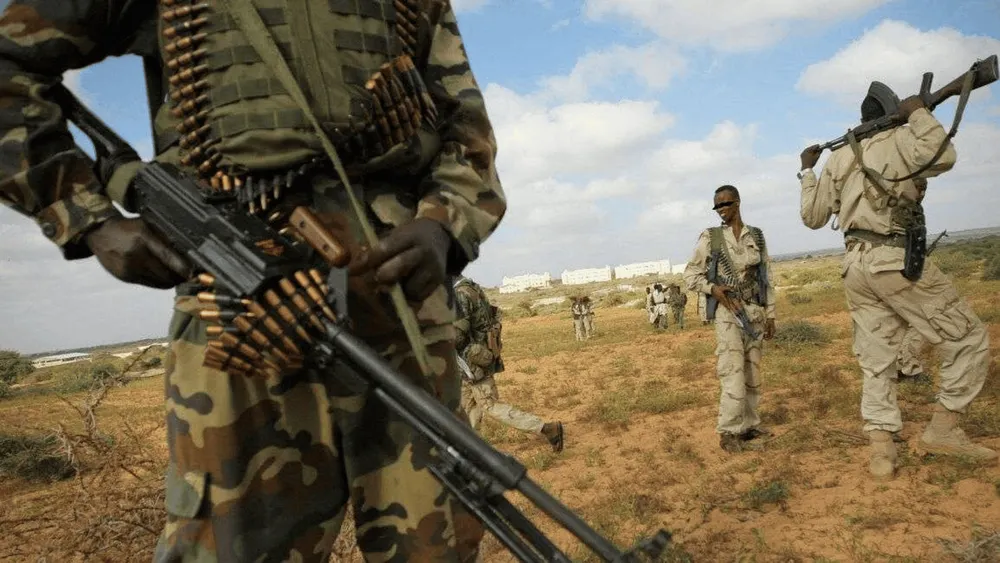
At 6am on Saturday, explosions and sustained gunfire erupted near Modibo Keita International Airport in Bamako. Helicopters circled. Flights were cancelled. The defence minister's house was destroyed. The army declared the situation under control and then spent the next twelve hours fighting to make that statement true. By nightfall, the governor of Bamako had imposed a three-day curfew. In Kidal, the Tuareg-led Azawad Liberation Front claimed to have taken the city. Mali's military government, which seized power in 2021 promising to restore security, was fighting for its capital.
This is the result of a choice. Not a failure of international attention. Not a consequence of the Gulf war consuming the Security Council's bandwidth. A deliberate choice, made by a junta that decided the West had failed Mali and that Russia would succeed where France had not.
The junta's logic was not irrational. French forces had been in Mali since 2013, fighting a jihadist insurgency that only spread. MINUSMA (United Nations Multidimensional Integrated Stabilization Mission in Mali), the UN peacekeeping mission, deployed 15,000 troops for ten years and could not stop the advance of JNIM (Jama'at Nusrat al-Islam wal-Muslimin) the al-Qaeda affiliate that claimed responsibility for Saturday's attacks on the airport and four other cities. Malians had genuine grievances. The colonial framework of French military presence felt to many like occupation dressed as assistance. When the junta expelled France in 2022 and asked MINUSMA to leave in 2023, there was real popular support for both decisions.
What replaced them was Africa Corps, the rebranded successor to Wagner Group, operating under direct Kremlin control. Russia's pitch was simple: we deliver results, we ask no questions about governance or human rights, we are partners not patrons. The junta accepted. Africa Corps fighters embedded with Malian forces, fought alongside the army across the Sahel and were present in Kidal and Gao, where the insurgency was strongest. According to witnesses cited by Al Jazeera, Russian mercenaries were fighting near the airport on Saturday morning. They were there. The airport burned anyway.
There is a detail in the reporting that deserves more attention than it has received. Africa Corps has been stretched. The demands of the Ukraine front have pulled Russian military capacity eastward. Fighters have been withdrawn from Mali. The security architecture the junta built on Russian partnership is operating with fewer Russian partners than it was a year ago. The junta bet on a patron whose own war has made Mali a lower priority. That is not a failure of the international order. It is a failure of the bet.
JNIM has been fighting in the Sahel since 2017. The Azawad Liberation Front has been contesting Malian sovereignty in the north for longer than that. Neither group became more dangerous because the world was watching the Gulf. They became more capable because the security vacuum in the Sahel deepened every year, through every iteration of external military partnership and every coup that promised stability and delivered more of the same. Saturday's coordinated attacks are not a sudden escalation. They are the logical conclusion of fourteen years of compounding failure.
The junta told Malians that sovereignty meant choosing their own partners. It was right about that. Sovereignty does mean choosing your own partners. What it does not mean is immunity from the consequences of those choices. Mali chose Africa Corps over MINUSMA. It chose Assimi Goita's five-year mandate over elections. It chose to be governed by a military council that has now been unable to prevent its capital from being attacked at dawn, its defence minister's house from being destroyed and its northern city from being seized.
The West did not fail Mali on Saturday. Mali's choices failed Mali on Saturday. That is a harder verdict than blaming a distracted Security Council. It is also the honest one.
Find this piece interesting?
Dispatches by DiploPolis delivers sharp analysis and pointed commentary on power, politics, diplomacy, and world affairs — directly to your inbox.
No neutrality. No noise. Just argument.