Pakistan, not long ago, was a bad actor. Not anymore. Today it is indispensable.
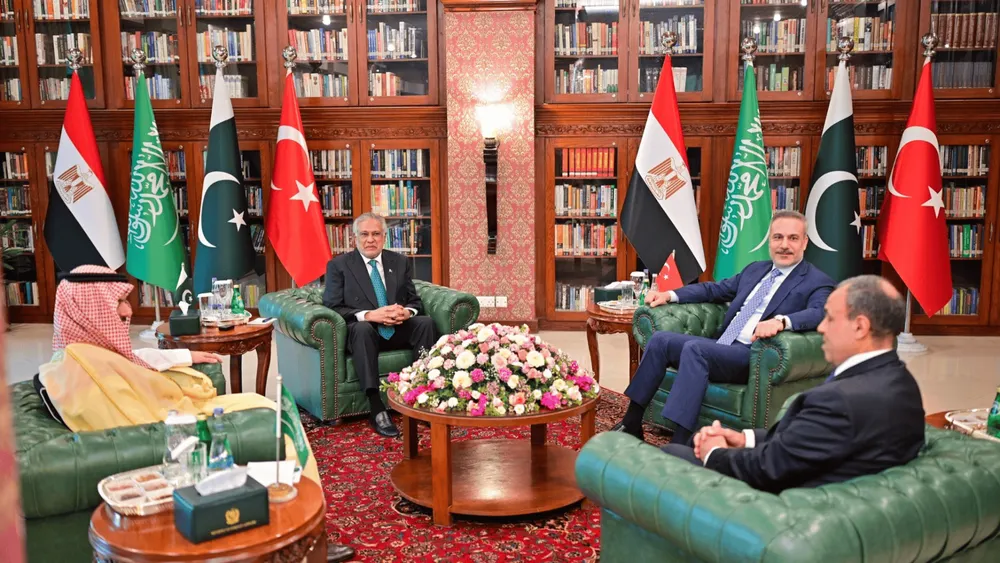
On Sunday morning, Pakistan's foreign minister Ishaq Dar hosted his counterparts from Turkiye, Saudi Arabia, and Egypt in Islamabad to discuss what he called 'possible ways to bring an early and permanent end to the war in the region.' The foreign ministers were briefed on a potential framework for US-Iran talks. Their purpose, in short, was to consolidate a diplomatic track that has placed Islamabad at the centre of efforts to end the US-Israel war on Iran, relaying proposals between Washington and Tehran that neither side will deliver directly to the other.
Deputy Prime Minister/Foreign Minister Senator Mohammad Ishaq Dar received H.H. Prince Faisal bin Farhan Al Saud, Foreign Minister of the Kingdom of Saudi Arabia, at the Ministry of Foreign Affairs today. The two sides will engage in comprehensive consultations on the evolving… pic.twitter.com/9HpnJcyXXE
— Ministry of Foreign Affairs - Pakistan (@ForeignOfficePk) March 29, 2026
'Bad actor' is the language of American foreign policy, applied to states that operate outside accepted norms. Washington has had occasion to use it about Pakistan with some regularity. In January 2018, President Trump terminated all military aid to Islamabad, lamenting that over fifteen years the United States had handed Pakistan more than $33 billion and received nothing but "lies and deceit" in return. His grievances were not without foundation — but they omitted an inconvenient history. The Taliban emerged from the mujahideen networks that Washington and Islamabad built together during the Soviet-Afghan war, funded by the CIA and managed by Pakistan's ISI. In 2011, Osama bin Laden was found living in Abbottabad, less than a mile from the country's premier military academy, after years as the world's most wanted man — whether Pakistani intelligence knew and chose silence, or simply failed to notice, neither answer reflects well.
But it is a third fact that connects most directly to the war being mediated today. In February 2004, Abdul Qadeer Khan, the father of Pakistan's nuclear programme, confessed on live television to having transferred nuclear weapons technology to Iran, Libya, and North Korea over the course of two decades.
President Musharraf pardoned Khan the following day. When asked about the pardon, the US State Department spokesperson replied: "I don't think it's a matter for the United States to sit in judgment on." That statement has aged poorly.
The centrifuge designs and components that Pakistani scientists supplied to Iran's secret enrichment programme form the foundation of the nuclear capability that is used as a justification for the strikes that began on February 28. Pakistan seeded the crisis that Pakistan is now being relied upon to resolve.
Today, the United States is routing a 15-point peace framework through Islamabad. Pakistan's army chief, Field Marshal Asim Munir, has built a working relationship with President Trump. Pakistan's foreign minister announced that Iran had agreed to allow twenty Pakistani-flagged ships through the Strait of Hormuz, a first confidence-building measure in a war that has now killed nearly two thousand Iranians and drawn in Lebanon, Iraq, and Yemen.
The Wall Street Journal, reporting on Pakistan's current mediation role, called it 'a remarkable return to the White House's confidence' for a country Trump had dismissed as a bad-faith actor. The Journal noted that Pakistan's return to American favour was less a matter of geopolitical rehabilitation than deliberate cultivation; it was deals involving Trump's inner circle, cryptocurrency, and critical minerals that propelled Islamabad back into Washington's good graces.
None of this is to say the mediation will fail. A ceasefire, if it comes, will matter more than who arranged it. But the ease with which the bad actor designation is set aside when Washington needs something from Islamabad should give pause. Pakistan has not transformed. Its record has not been expunged. What changed is the calculation of need.