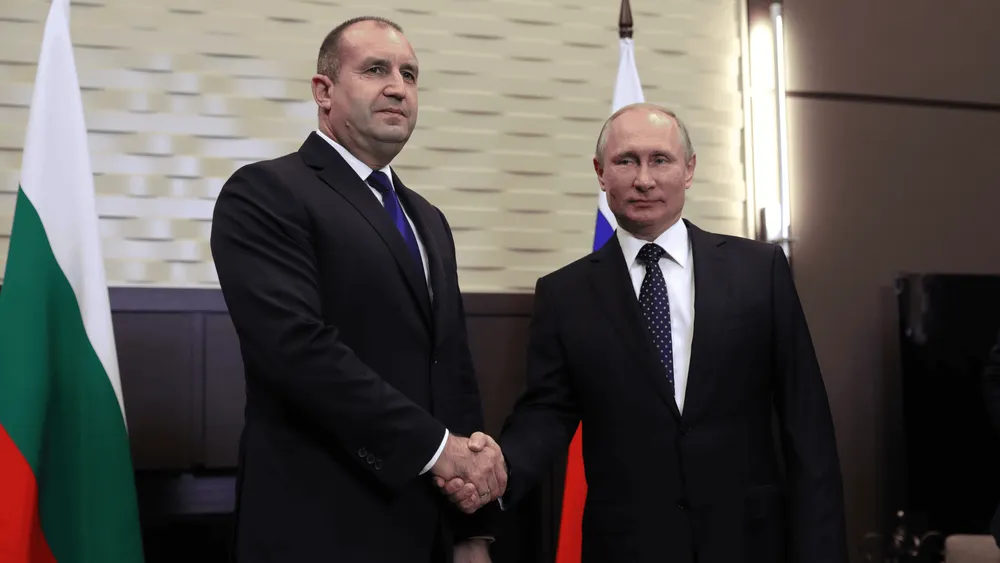
One week after Hungarian voters ended sixteen years of Viktor Orbán, Bulgaria handed a landslide to Rumen Radev. His Progressive Bulgaria party took 44.7 per cent of the vote, enough to govern alone. Radev, a former fighter pilot, two-term president and committed Eurosceptic, campaigned on resuming Russian gas flows, opposing arms for Ukraine and ending what he called the 'oligarchic' capture of the Bulgarian state. Brussels congratulated him. The Kremlin did too.
The temptation is to read the two elections as cancelling each other out. Budapest moves west, Sofia drifts east, Europe muddles through. That reading is wrong. The reason is not ideology. It is geography. Hungary is landlocked. Bulgaria is on the Black Sea.
The 2006 US-Bulgaria Defence Cooperation Agreement gives Washington shared use of four military facilities across Bulgarian territory, including Bezmer Air Base, described by Foreign Policy as one of the six most strategically important overseas United States Air Force installations, partly for its proximity to the Middle East, and Novo Selo training range, where V Corps rotates armoured and airborne units within 200 miles of Crimea. A planned United States rotation of 625 personnel was moving through Varna port nine days before the election. A Radev government is not legally required to terminate these arrangements. It does not need to. Political friction alone is enough to make them expensive.
Then there is the pipe. Since Russian gas transit through Ukraine ended on 1 January 2025, TurkStream has been the only pipeline through which Russia directly supplies Europe. It enters the European Union at the Turkish-Bulgarian border and feeds Serbia, Hungary, Greece and Slovakia. A record 63.2 million cubic metres a day now flows through the Bulgarian network, generating an estimated $12 billion annually for Gazprom and its intermediaries, while Sofia collects roughly $250 million in transit fees. Radev has said plainly that he wants to protect this arrangement, not restrict it. Every molecule of Russian gas reaching Europe now passes through a country whose incoming prime minister calls EU energy sanctions self-defeating.
On March 30, Bulgaria's outgoing caretaker government signed a ten-year security agreement in Kyiv covering joint drone production, ammunition manufacturing, intelligence sharing and Black Sea maritime security. Radev denounced it as 'a risk to national security'. A caretaker deal carries no binding obligation on a successor government with a parliamentary majority. The agreement, signed three weeks before the election, may already be finished.
This is the situation in which Brussels must now find unanimity on the €90 billion Ukraine financing package that Orbán had blocked for months. Budapest's obstruction is gone. Sofia's is arriving. Moscow did not lose a veto point inside the European Union. It traded one for another, and the replacement sits on the sea where the actual war is being fought.
Washington is not watching. The Trump administration is managing a collapsing ceasefire in the Gulf, a naval blockade of Iranian ports and a second round of talks in Islamabad. Nobody in the administration is talking about Bulgaria.
And this is where the argument gets uncomfortable for Brussels. Radev won cleanly, in the most stable election Bulgaria has held in five years, with a mandate that is not seriously disputed. Bulgarians voted this way. Treating the result as a Kremlin operation rather than a genuine verdict on energy prices, euro adoption costs and the perceived burden of Ukraine commitments is precisely the kind of condescension that produced the result in the first place. The EU's eastern problem is not an information war it is losing to Moscow. It is a legitimacy problem it is losing to its own citizens.
When the flag changes over the harbour at Burgas, the question is not whether Radev is a Russian asset. The question is whether anyone in Brussels noticed in time that the Black Sea flank just changed hands at the ballot box.
Find this piece interesting?
Dispatches by DiploPolis delivers sharp analysis and pointed commentary on power, politics, diplomacy, and world affairs — directly to your inbox.
No neutrality. No noise. Just argument.