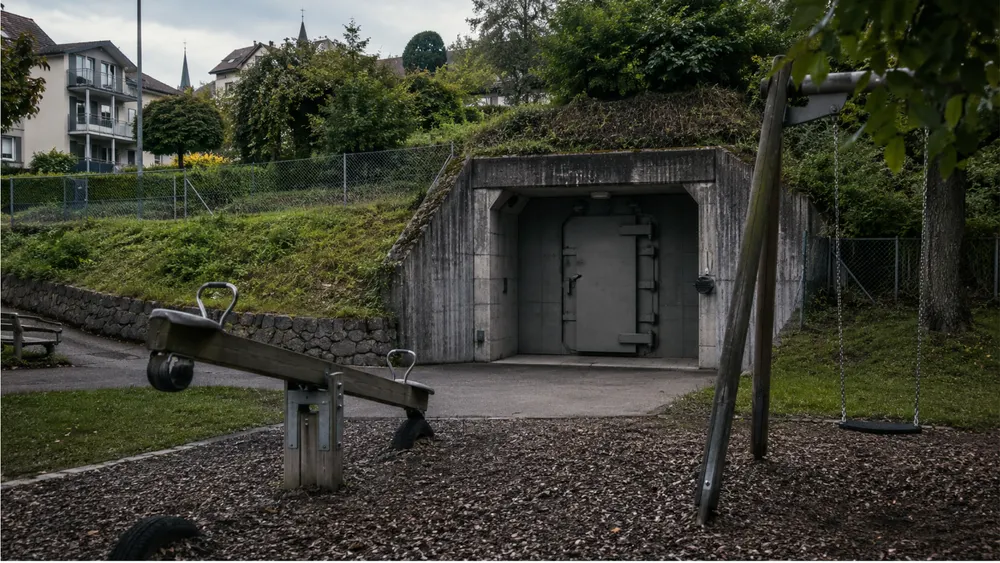
The entrance to the Sonnenberg nuclear bunker in Lucerne is in the middle of a children's playground. Past the seesaws and swing sets, carved into a hill, is a blast-proof door. Beyond it, a tunnel descends underground for as far as the eye can see. The bunker was built in the 1970s to house 20,000 people — one third of Lucerne's population at the time. 'Back then, 20,000 people constituted a third of our city's inhabitants,' says Zora Schelbert, who guides visitors through the complex. It has a hospital. A prison. Bunk beds. Diesel generators with two weeks of fuel. It has never been used for its original purpose. The Swiss government spends tens of millions of dollars a year maintaining it. Just in case.
Switzerland has more than 370,000 nuclear bunkers — more than any country on earth. Every one of its nine million citizens is guaranteed a space in one. This is not a Cold War relic kept by bureaucratic inertia. It is maintained policy. The Swiss government never scrapped the network when the Soviet Union collapsed. It kept building. The legal requirement that every new building include nuclear shelter capacity remains in force. The seesaws above the blast-proof door are not irony. They are the Swiss government being honest about what it is building for.
Switzerland has spent more than 200 years watching Europe's wars from the outside. It watched the Franco-Prussian War, both World Wars, the Cold War, the Balkans, Iraq, Ukraine and now the US-Israel war on Iran — all from the same neutral position, absorbing the consequences without the combatant's agency. When a country with that vantage point looks at the world and decides to maintain 370,000 nuclear bunkers, in peacetime, at tens of millions of dollars a year, it is making an institutional judgment about the world's trajectory. The Swiss are not alarmists. They are the world's most experienced observers of other people's catastrophes. Their conclusion, maintained for eight decades, is: underground shelter is a reasonable precaution.
The Sonnenberg bunker's capacity was reduced from 20,000 to 2,000 in 2002, when the Cold War's end made the full scale seem excessive. The floors that once housed bunk beds for 20,000 now shelter asylum seekers and the homeless. Some have protested against being housed underground in a nuclear bunker. The bunker serves two emergencies simultaneously — the one it was built for, and the one the world is currently producing. The same structure designed to protect citizens from nuclear fallout is housing people fleeing the wars and climate disruptions of a world that insists it has moved past the need for nuclear bunkers. It has not moved past the need. It has moved the asylum seekers into one.
DiploPolis published two pieces last week that the Swiss bunker policy quietly answers. Wednesday's piece established that the United States has burned through 80 per cent of its THAAD interceptor inventory — the missiles designed to shoot down nuclear-tipped ballistic missiles — in a conventional war. Thursday's piece established that the institutional framework built after Hiroshima to prevent nuclear proliferation is being unlearned in every direction simultaneously. North Korea opened a new nuclear bomb fuel production facility in August. Iran's new Supreme Leader is assessed by US intelligence as more inclined to seek nuclear weapons than his predecessor. The Non-Proliferation Treaty has not been meaningfully implemented by any nuclear-armed state in 58 years. The Comprehensive Test Ban Treaty has not been ratified by the United States, China, India, Pakistan or Israel. The International Criminal Court — the institution that would examine the use of weapons of mass destruction against civilians — is being taken apart.
The Swiss response to this landscape is: maintain the bunkers. Not as a prediction. As a precaution. The difference matters. A prediction assumes inevitability. A precaution assumes possibility. The Swiss are not predicting nuclear war. They are maintaining the infrastructure for surviving it, as they have maintained it through every decade since 1945, because the possibility has never fully receded in the more than 200 years they have been watching.
The Sonnenberg's capacity was cut to 2,000 in 2002 because the threat seemed lower. It was not decommissioned. The Swiss government considered the difference between lower and gone, and decided lower did not justify removing the infrastructure entirely. That decision — quiet, institutional, expensive and entirely rational — is the most honest assessment of nuclear risk that any government has produced in the post-Cold War period. It is not in a treaty. It is not in a speech. It is in a playground in Lucerne, in front of a blast-proof door that leads to a hospital, a prison and two weeks of diesel fuel, waiting.