
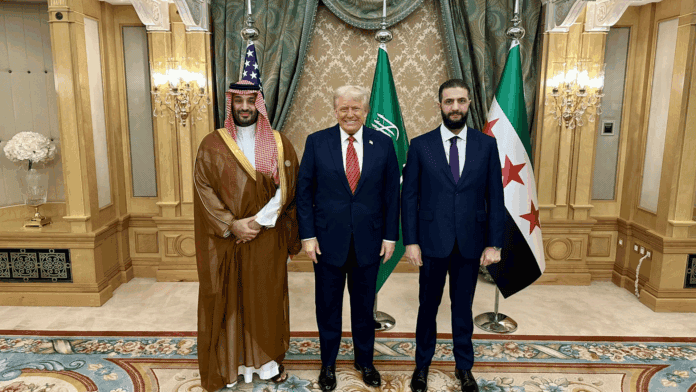
When Syrian President Ahmed Al-Sharaa steps into the White House on November 10, he will cross a threshold no Syrian head of state has ever approached. The meeting with President Donald Trump represents more than a diplomatic first—it signals a fundamental recalibration of American engagement with a country that spent decades as a pariah state, and marks a stunning personal transformation for a man who once commanded jihadist forces against American troops in Iraq.
The symbolism is extraordinary. Less than a year after rebel forces led by Al-Sharaa’s Hayat Tahrir al-Sham (HTS) toppled Bashar al-Assad’s 54-year family dynasty in an 11-day lightning offensive, the former militant leader designated a terrorist by Washington just two years ago will receive the legitimacy that comes with a presidential audience. Yet beneath the historic imagery lies a complex diplomatic calculation with profound implications for Middle East stability, counterterrorism strategy, and the delicate balance of regional power.
From Jihadist Commander to Presidential Envoy
Ahmed Al-Sharaa’s journey epitomizes the contradictions and possibilities of Syria’s post-Assad transition. Operating under his nom de guerre Abu Mohammed al-Jolani, he spent years leading Syria’s al-Qaeda affiliate before breaking with the network in 2016. He joined insurgents fighting American forces in Iraq during the 2000s and once carried a $10 million U.S. bounty on his head. His organization was delisted as a foreign terrorist organization only in July 2025, following intense debate within the Biden and early Trump administrations about whether HTS’s evolution from extremist militia to governing authority was genuine or tactical.
The rapid sequence of events since December 2024 has been dizzying. Assad’s regime, weakened by years of civil war and the distraction of his key backers—Russia in Ukraine and Iran and Hezbollah in conflicts with Israel—collapsed with stunning speed when HTS launched its November offensive. What began as an attack on Aleppo on November 27 cascaded into the capture of Hama, Homs, and finally Damascus by December 8. Assad fled to Moscow, ending more than five decades of his family’s authoritarian rule.
In January 2025, militia leaders appointed Al-Sharaa as Syria’s interim president. His government faces the monumental task of unifying a fractured country, addressing the needs of a population devastated by 14 years of war, and navigating the competing interests of regional and international powers—all while attempting to shed the stigma of its militant origins.
The Strategic Imperatives Behind the Engagement
Trump’s decision to meet with Al-Sharaa reflects a pragmatic calculation about American interests in a transformed Middle East landscape. At their first encounter in Riyadh in May, facilitated by Saudi Crown Prince Mohammed bin Salman, Trump outlined five core principles for U.S.-Syria normalization. These centered on preventing an Islamic State resurgence, normalizing relations with Israel, resolving disputes with the Kurdish-dominated Syrian Democratic Forces (SDF), protecting minority communities, and implementing verifiable political reforms.
The November 10 meeting is expected to formalize Syria’s entry into the Global Coalition to Defeat ISIS, the 89-member international alliance that has worked since 2014 to combat the extremist group. This represents a remarkable diplomatic pivot: a former jihadist organization joining an anti-terror coalition. Yet the strategic logic is clear. ISIS has exploited Syria’s post-Assad security vacuum, with independent observers documenting more than 100 attacks in eastern and central Syria in 2025—double the number from 2023. The group has seized weapons from abandoned regime stockpiles and conducted prison breaks to free extremist fighters.
U.S. officials have already begun sharing secret intelligence on ISIS threats with Al-Sharaa’s government, reflecting rising alarm about a potential resurgence. With approximately 2,000 American troops deployed in Syria—a presence Trump has signaled will be reduced—Washington needs capable local partners to prevent a repeat of ISIS’s territorial conquests from 2014-2017. The Syrian government, despite its troubled origins, has demonstrated both capability and motivation in combating ISIS, having clashed with the extremist group since 2013.
The Sanctions Question: Economic Strangulation vs. Reconstruction Hope
Perhaps no issue carries more immediate practical significance than the fate of U.S. economic sanctions. The Caesar Syria Civilian Protection Act, passed in 2019 and named after a Syrian defector who documented the Assad regime’s torture apparatus, imposed sweeping secondary sanctions targeting anyone providing support to the Syrian government, military, or oil and gas sector. The law was designed to prevent the Assad regime from profiting from reconstruction and to hold it accountable for war crimes.
With Assad gone, the Caesar Act’s original rationale has evaporated, yet the law remains a formidable obstacle to Syria’s recovery. Trump announced in May that his administration would lift many sanctions and issued a 180-day waiver of mandatory Caesar Act provisions, authorizing transactions in energy, telecommunications, healthcare, and education. However, the law itself requires congressional action for permanent repeal. A bipartisan coalition has introduced legislation to eliminate the Caesar Act, with supporters arguing it now “suffocates a nation seeking to rebuild” rather than pressuring a regime that no longer exists.
The stakes are immense. The World Bank estimates Syria’s reconstruction will cost $216 billion—nearly ten times the country’s 2024 GDP. Without sanctions relief, foreign businesses and investors will remain wary of exposure to U.S. penalties, even as 90% of Syria’s population lives in poverty and critical infrastructure lies in ruins. A high-level Syrian delegation met with Washington officials in October to advocate for complete sanctions removal, arguing that reconstruction cannot proceed under the current framework.
Yet some lawmakers and pro-Israel advocacy groups remain cautious, viewing sanctions as leverage to ensure Al-Sharaa’s government follows through on commitments regarding minority protection, democratic reforms, and security arrangements. The tension between providing economic breathing room for Syria’s battered population and maintaining pressure for political reforms will likely dominate the Washington discussions.
The ISIS Conundrum: Partnership with Former Enemies
The counterterrorism dimension of U.S.-Syria engagement presents particularly complex ironies. Al-Sharaa’s HTS spent years fighting both ISIS and the Assad regime, positions that simultaneously aligned with and contradicted American interests. Now, with ISIS conducting escalating attacks in Deir ez-Zor and other eastern provinces, Washington finds itself coordinating with a government led by former extremists to combat current extremists.
The U.S. military maintains partnerships with both the Kurdish-led SDF in northeast Syria and Syrian Free Army forces based at the Al-Tanf garrison. These groups have begun coordinating with Al-Sharaa’s Ministry of Defense, creating an unusual three-way counterterrorism arrangement. Joint operations have already occurred, including coordinated raids that killed senior ISIS commanders in August and October 2025.
Field intelligence suggests ISIS has evolved from territorial control to “flexible dormancy”—operating through sleeper cells of fewer than ten fighters who conduct ambushes, plant improvised explosives, and carry out assassinations. The group maintains between 2,500 and 3,000 active fighters in Syria, according to local security sources, with operations financed through black market activities and recruitment occurring in detention camps like Al-Hol, which houses tens of thousands of ISIS family members.
The challenge is compounded by the U.S. troop drawdown. American forces have transferred three of eight bases to the SDF and reduced personnel from 2,000 to approximately 1,400, with further cuts planned. This withdrawal creates precisely the kind of security vacuum ISIS has historically exploited. Syria’s formal entry into the anti-ISIS coalition could provide coordination mechanisms and intelligence-sharing frameworks to mitigate these risks, but success will depend on the new government’s capacity to project security beyond Damascus and major cities into remote desert regions where ISIS thrives.
Regional Calculations: The Israel-Syria-Saudi Triangle
The diplomatic choreography surrounding Al-Sharaa’s Washington visit reveals the intricate regional power dynamics at play. His meeting with Trump occurs just one week before Saudi Crown Prince Mohammed bin Salman’s scheduled November 18 White House visit—timing that is hardly coincidental. MbS has emerged as Al-Sharaa’s key regional patron, facilitating his introduction to Trump and tying Syria’s future to broader questions of regional normalization.
The Saudi position represents a significant evolution. Riyadh has made clear that any consideration of normalizing relations with Israel—a centerpiece of Trump’s Middle East strategy—now includes conditions about Syrian sovereignty. This means Israel must cease military operations in Syria and withdraw to borders agreed in the 1974 disengagement agreements. Since Assad’s fall, Israel has conducted hundreds of airstrikes across Syria and expanded control in the Golan Heights, actions Jerusalem justifies as necessary to prevent weapons transfers and to protect Syria’s Druze minority.
A fifth round of direct U.S.-mediated negotiations between Israel and Syria is expected after Al-Sharaa’s Washington visit, with American officials aiming for a security agreement on the Syrian-Israeli border by year’s end. For Israel, the primary concerns center on preventing Syria from becoming a corridor for Iranian weapons shipments to Hezbollah and ensuring the new government does not threaten Israeli security. For Al-Sharaa, Israeli military operations represent a violation of Syrian sovereignty that complicates his efforts to consolidate authority and demonstrate national credibility.
The Turkish dimension adds further complexity. Ankara supported the rebel offensive that ousted Assad and maintains significant influence through its backing of the Syrian National Army, which controls territory along the Syrian-Turkish border. Turkey’s primary objective remains preventing Kurdish autonomy in northeast Syria, viewing the SDF’s links to the Kurdistan Workers Party (PKK) as a direct security threat. The SDF signed an agreement in March 2025 to integrate with Syria’s national security forces by year’s end, but implementation has been uneven and tensions persist.
Iran and Russia, Assad’s key backers, face dramatically diminished influence. Iran’s logistical corridor to Hezbollah has been severed, and Russia risks losing its strategic foothold at Syrian military bases. Moscow persuaded Assad to accept exile rather than fighting to the end, likely calculating that removing a discredited client was preferable to a prolonged conflict that would further strain Russian resources already committed to Ukraine.
Minority Rights and Democratic Governance: Rhetoric vs. Reality
Al-Sharaa’s government faces intense scrutiny over its treatment of Syria’s diverse religious and ethnic communities. The country’s Alawite, Christian, Druze, Kurdish, and other minority populations harbor deep anxieties about potential persecution or marginalization under HTS-dominated rule. These concerns are not unfounded given HTS’s Islamist origins and the sectarian dynamics that have plagued Syria’s civil war.
The new authorities have made public commitments to protect minority rights and implement inclusive governance. Al-Sharaa met with Christian leaders and has appointed members of minority groups to cabinet positions. HTS declared the dissolution of all military factions and revolutionary bodies, calling for their integration into state institutions—though progress has been inconsistent.
Yet troubling incidents continue. Sectarian violence in Syria’s Alawite coastal regions in March 2025 killed hundreds, with a UN-commissioned report finding that both government forces and armed groups likely committed war crimes. Violence in Druze areas of southern Syria followed in July, prompting Israeli intervention claiming to protect the Druze minority. The UN Security Council issued a presidential statement “strongly condemning” the widespread violence against Alawites.
For Washington, verifiable progress on minority protection and democratic reforms represents a key condition for deepening engagement. Syrian authorities have issued a five-year transitional constitutional framework and held local committee elections in October to select members of an interim parliament. Whether these steps represent genuine democratic transition or window dressing for continued authoritarian rule will significantly influence the trajectory of U.S.-Syria relations.
The Reconstruction Challenge: Beyond Sanctions Relief
Even with complete sanctions removal, Syria faces staggering reconstruction challenges. Fourteen years of war have devastated roads, hospitals, electrical grids, water systems, and housing—particularly in Damascus countryside and Aleppo, which saw the heaviest fighting. More than half of Syria’s pre-war population has been displaced, with over four million Syrian refugees in neighboring countries and millions more internally displaced.
Refugee return remains stalled, with European countries halting new asylum claims amid fears of renewed instability while simultaneously hesitating to encourage returns to a country still plagued by violence and economic collapse. The fragile security situation, characterized by continuing clashes between communities and ISIS attacks, makes large-scale voluntary repatriation unlikely in the near term.
Reconstruction requires not just capital but also technical expertise, functioning institutions, and reliable security—all of which Syria currently lacks. The transitional government’s limited administrative capacity, combined with the challenge of integrating multiple armed factions under unified command, complicates efforts to create the stable environment necessary for reconstruction. Foreign investors will demand assurances about security, rule of law, and contract enforcement before committing substantial resources.
The economic dimensions extend beyond physical reconstruction to include currency stabilization, banking sector reform, employment creation, and service delivery. Syria’s economy effectively collapsed during the war years, with the Syrian pound plummeting and inflation devastating purchasing power. Rebuilding economic institutions and establishing investor confidence will require sustained international support and domestic reforms that the current government may struggle to implement.
What Success Looks Like: Modest Goals, High Stakes
The November 10 meeting should be understood not as a culmination but as a beginning—the start of what will likely be a long, uncertain process of U.S.-Syria normalization. Realistic success metrics for this initial engagement include:
Formal coalition membership: Syria’s accession to the anti-ISIS coalition, providing frameworks for intelligence sharing and operational coordination against extremist threats.
Sanctions pathway: Clear congressional commitment to Caesar Act repeal or permanent waiver, allowing foreign businesses to engage Syria’s reconstruction without fear of U.S. penalties.
Security understandings: Progress toward agreements with Israel that reduce military tensions and with Turkey regarding Kurdish areas, creating space for consolidation of state authority.
Minority protections: Concrete mechanisms for monitoring treatment of religious and ethnic minorities, with international verification of commitments.
Reconstruction planning: International donor coordination and World Bank engagement in reconstruction planning, even if major capital flows await further political developments.
What success emphatically does not include—at least in the near term—is full Syrian democracy, complete resolution of sectarian tensions, or transformation of Al-Sharaa’s government into a model of liberal governance. The Trump administration’s approach appears refreshingly realistic in this regard, focusing on security cooperation and economic stabilization rather than ambitious political transformation.
The Broader Strategic Picture: Reshaping Middle East Architecture
Al-Sharaa’s White House visit occurs within the context of Trump’s broader effort to reshape Middle East geopolitics around containment of Iran, Israeli-Arab normalization, and reduced American military presence. The administration has pursued a transactional approach emphasizing burden-sharing with regional partners and skepticism of traditional diplomatic processes.
The collapse of Assad’s regime has fundamentally altered regional dynamics. Iran’s “axis of resistance” has been severely weakened, with its land corridor to Hezbollah severed and its primary Arab ally eliminated. Russia’s position has deteriorated as Moscow struggles to maintain its Syrian bases while prosecuting the war in Ukraine. Turkey has gained influence through its support for the rebellion but faces ongoing tensions over Kurdish issues. Israel has achieved tactical gains through military operations but faces new uncertainties about Syria’s future orientation.
For the United States, Syria represents both opportunity and risk. Successful stabilization could demonstrate that American engagement, even with imperfect partners, can produce meaningful security gains without massive military deployments. It could create a model for post-conflict transitions in the Middle East that balances pragmatism with principles. Conversely, failure could produce another Libya-style fragmentation, providing renewed space for extremist groups and refugee flows that destabilize neighboring countries.
The Syrian situation also intersects with the Israeli-Palestinian conflict and prospects for Israeli-Saudi normalization. Saudi Arabia has explicitly linked its potential recognition of Israel to multiple conditions including a pathway to Palestinian statehood and, now, respect for Syrian sovereignty. This complicates Trump’s hopes for expanding the Abraham Accords and demonstrates how regional issues remain interconnected despite American attempts to pursue separate bilateral deals.
The Road Ahead: Fragile Progress in Dangerous Times
The historic nature of Al-Sharaa’s Washington visit should not obscure the profound challenges that will outlast the symbolism. Syria remains a fractured country with competing power centers, unresolved ethnic and sectarian tensions, active insurgent threats, and an economy in ruins. The transitional government has demonstrated neither the capacity nor, in some cases, the willingness to address these challenges comprehensively.
Regional powers have competing visions for Syria’s future. Turkey wants to prevent Kurdish autonomy. Israel demands security guarantees and the end of Iranian presence. Saudi Arabia and other Gulf states seek stability that allows refugee returns and reconstruction investment. Iran and Russia aim to salvage what influence they can from the wreckage of Assad’s fall. These competing interests will continue to shape Syria’s trajectory regardless of U.S. policy.
The Trump administration’s engagement represents a calculated bet that working with Al-Sharaa’s government, despite its problematic origins, offers better prospects for American interests than isolation or continued sanctions. This approach has precedent—Washington has worked with unsavory partners throughout its history when strategic interests demanded pragmatism over purity.
Whether this bet pays off will depend on factors largely beyond American control: Al-Sharaa’s willingness and ability to govern inclusively, regional powers’ capacity to coordinate rather than compete, and the Syrian people’s resilience after 14 years of suffering. The November 10 meeting provides a diplomatic foundation, but transforming that foundation into sustainable peace and reconstruction will require years of sustained effort, substantial resources, and considerable luck.
What is certain is that the Middle East that emerges from this period will look fundamentally different from the one that existed before December 2024. Assad’s fall represents the most significant regional transformation since 2011’s Arab Spring—with consequences that have only begun to unfold. Al-Sharaa’s walk through the White House doors marks one chapter in this unfolding story, a moment when decades of hostility give way to tentative cooperation in pursuit of stability that has eluded the region for far too long.
For continuous coverage of Syria’s transition and U.S. Middle East policy, follow our ongoing analysis of regional diplomatic developments.