
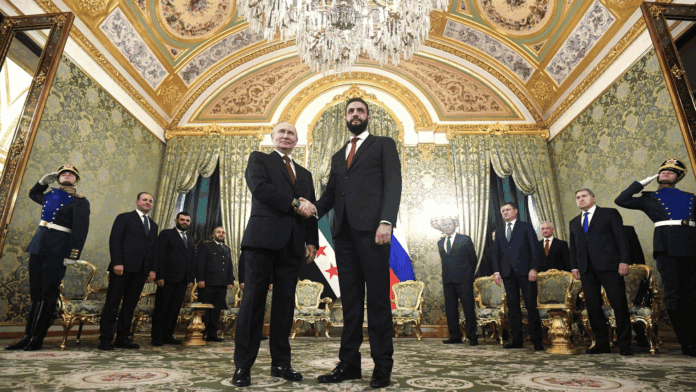
The transformation from Assad’s Syria to Sharaa’s Syria represents nothing less than a geopolitical earthquake that has sent shockwaves through the Middle East’s established power architecture. As Ahmed al-Sharaa prepares for his unprecedented White House visit on Monday, November 10, 2025, the former jihadist leader’s ascent from U.S. terrorism blacklists to presidential red carpets encapsulates how dramatically Syria’s fall has reshuffled regional influence. This historic moment—the first time a Syrian president will officially visit the White House in modern history—crystallizes a broader reality: regional powers are racing to secure their foothold in Syria’s new order, each bringing distinct capabilities, competing interests, and fundamentally different visions for the country’s future.
The stakes could not be higher. Syria’s reconstruction carries an estimated price tag of $216 billion according to World Bank projections, but the real contest isn’t merely about economic opportunities. Turkey seeks to consolidate its influence while managing Kurdish separatism. Iran desperately attempts to salvage remnants of its Axis of Resistance that Syria once anchored. Russia fights to preserve strategic military bases as its Ukraine war drains resources. Gulf states aim to displace Iranian influence while containing Turkish-backed Islamist expansion. And threading through all these competing agendas is the United States, newly positioning itself as powerbroker-in-chief. The scramble for Syria is not simply about one fractured nation—it’s a microcosm of the broader power recalibration reshaping the entire Middle East.
Turkey’s Assertive Positioning: From PKK Peace to Syrian Influence
Turkey has emerged from Assad’s collapse in perhaps the strongest position among regional powers, but Ankara’s ambitions face complex challenges that require delicate balancing acts across multiple fronts. President Recep Tayyip Erdoğan’s government is leveraging its long-standing support for Hayat Tahrir al-Sham (HTS) and the Syrian opposition to position itself as the primary external influence on Damascus. Yet Turkey’s Syrian strategy cannot be separated from its most pressing domestic security concern: the four-decade Kurdish insurgency that has claimed 40,000 lives.
The Turkish government is preparing legislation to allow thousands of Kurdistan Workers Party (PKK) fighters and civilians to return home from northern Iraq under a peace process launched a year ago. This proposed law would enable roughly 1,000 civilians and non-combatants to return first, followed by approximately 8,000 fighters after individual screening. The legislation stops short of general amnesty but represents a historic shift in Turkish policy. However, approximately 1,000 senior and mid-level PKK figures remain a sticking point, with Turkey proposing their relocation to third countries, possibly in Europe—a plan that some negotiators worry could fuel renewed insurgency if PKK leadership is excluded from reintegration.
The PKK peace process directly shapes Turkey’s calculus in Syria. Kurdish forces, particularly the Syrian Democratic Forces (SDF), control northeastern Syria and maintain close ties with the PKK. Turkey views the SDF as a direct security threat, an extension of the PKK that could enable cross-border attacks or inspire Turkish Kurdish separatism. Ankara’s influence over the new Syrian government—which owes its military victory partly to Turkish backing—provides Turkey unprecedented leverage to address this threat. The SDF’s current negotiations to integrate into Syria’s military structure are taking place under the shadow of Turkish pressure, with Ankara demanding the dismantling of autonomous Kurdish governance structures.
Beyond security concerns, Turkey sees Syria’s reconstruction as a massive economic opportunity. Turkish construction, transport, and manufacturing companies are positioned to profit from the largest projects in rebuilding Syria, though Ankara recognizes it lacks the financial resources to fund reconstruction alone. This necessitates collaboration with Gulf Arab monarchies, particularly Saudi Arabia and the UAE, who possess the capital but worry about empowering Turkish-backed Islamist governance. Turkey’s relationship with Qatar—the Gulf state most aligned with Islamist movements—provides additional economic and diplomatic support for Ankara’s Syria strategy.
Ankara’s positioning in Syria also carries symbolic weight in the broader Muslim world. By supporting the overthrow of Assad’s secular Baathist dictatorship and backing an Islamist-leaning transitional government, Turkey reinforces its image as a champion of political Islam and resistance to authoritarianism. This narrative competes directly with Saudi Arabia’s Vision 2030 model of economic modernization without political liberalization, creating ideological friction even as the two powers cooperate pragmatically on Syria’s stability.
Yet Turkey’s dominance faces potential constraints. The new Syrian leadership, while grateful for Turkish support, must balance relationships with multiple regional powers to secure reconstruction funding and international legitimacy. HTS leader Sharaa has signaled his intention to maintain positive relations with diverse actors, from Russia to Gulf states, suggesting Damascus will resist becoming a Turkish client state. Turkey’s assertive regional posture—from northern Syria to Libya to the South Caucasus—has also alarmed Gulf states who view Ankara as a strategic competitor. The question is whether Turkey can translate its current influence into enduring structural power, or whether other actors with deeper pockets will gradually dilute Turkish primacy.
Iran’s Strategic Recalibration: Losing the Axis’s Keystone
For Iran, Assad’s fall represents nothing less than catastrophic strategic defeat—the collapse of a carefully constructed regional architecture built over four decades. The Islamic Republic had invested billions of dollars and immense political capital to preserve Assad’s regime during Syria’s civil war, dispatching Islamic Revolutionary Guard Corps (IRGC) forces, recruiting Shia fighters from Pakistan and Afghanistan, and organizing pro-regime militias. This investment wasn’t merely about supporting an ally; Syria served as the critical land corridor connecting Tehran to Lebanese Hezbollah, the most powerful non-state actor in Iran’s so-called Axis of Resistance.
As analyst Ali Vaez of the International Crisis Group noted, “There is no axis without access.” The loss of Syria severs Iran’s logistical backbone to the Levant, fundamentally undermining its deterrence strategy against Israel and the United States. Without Syrian territory to transit weapons, train fighters, and establish forward bases, Iran faces severe challenges in supporting Hezbollah’s rebuilding efforts after its devastating confrontation with Israel. The implications extend beyond military logistics: Iran has lost its strategic depth, the buffer zone that allowed it to project power while maintaining plausible deniability.
Iranian military officials have acknowledged the severity of this setback. Brigadier General Behrouz Esbati, who oversaw Iran’s military operations in Syria and coordinated with Syrian and Russian commanders, delivered a remarkably frank assessment at Tehran’s Valiasr mosque: “I don’t consider losing Syria something to be proud of…We were defeated, and defeated very badly, we took a very big blow and it’s been very difficult.” Such candor from a senior military figure underscores how profoundly Assad’s collapse has shaken Iran’s strategic posture.
The new Syrian government, led by Sunni Islamists backed by Turkey, has vowed to deny the IRGC-QF use of Syrian territory. HTS leader Sharaa has stated that Assad’s collapse has “set the Iranian project in the region back by 40 years.” This represents more than rhetorical posturing: Syria’s Sunni majority harbors deep resentments toward Iran and Hezbollah for their brutal suppression of the 2011 uprising. The sectarian dimensions of Syria’s conflict create natural barriers to any Iranian attempt to rebuild influence networks.
Compounding Iran’s regional setbacks are severe domestic crises that constrain its foreign policy bandwidth. President Masoud Pezeshkian has warned that Tehran faces an unprecedented water and energy crisis, with dam reservoirs at their lowest levels in 60 years. “If it doesn’t rain in Tehran by late November, we’ll have to ration water. And if it still doesn’t rain, we’ll have to evacuate Tehran,” Pezeshkian stated. The capital’s 9.1 million residents face potential water rationing and power shortages as hydroelectric capacity plummets. Decades of mismanagement, sanctions-induced underinvestment, and climate change have created a perfect storm of domestic vulnerabilities that limit Iran’s capacity for expensive foreign adventures.
Yet Iran’s Axis of Resistance, while severely weakened, is not entirely destroyed. The Islamic Republic is now doubling down on its remaining regional allies. Western intelligence reports from July 2025 indicate Iran has intensified weapons shipments to Houthi forces in Yemen and Iraqi Shia militias, including advanced ballistic and cruise missiles. Iran is attempting to rebuild deterrent capabilities through these proxies, though their geographic distance from Israel limits their strategic utility compared to Hezbollah’s former threatening posture on Israel’s northern border.
Iran’s long-term strategy appears focused on exploiting any potential chaos in post-Assad Syria. As analyst Farzan Sabet noted, “If the civil war in Syria is not quickly settled and a new order created, it might become precisely the type of environment where the Islamic republic has historically thrived.” Tehran has reportedly engaged Sunni extremists to destabilize Syria’s transitional government and facilitate smuggling networks, though these efforts face significant obstacles from Israeli surveillance and U.S. pressure. The specter of Iranian nuclear weaponization also looms larger as Tehran’s conventional deterrence capacity erodes, raising concerns that a weakened, cornered Iran might accelerate its nuclear program as an alternative security guarantee.
Russia’s Diminished but Persistent Presence: Pragmatic Retrenchment
Russia’s position in Syria embodies strategic ambiguity—maintaining military assets while accepting diminished influence, clinging to bases whose future remains uncertain. Moscow’s Tartus naval base and Khmeimim Air Base represent Russia’s only military installations outside the former Soviet Union, providing crucial Mediterranean access and logistical support for operations in Africa. Yet the rapid collapse of Assad’s regime—despite years of Russian military intervention that propped up the dictator—has exposed the limits of Moscow’s commitment and capabilities.
In January 2025, Syria’s caretaker government terminated the treaty allowing Russian military presence in Syria, and revoked the contract with Russian company Stroytransgaz to manage commercial areas of Tartus port. This legal termination appeared to signal Russia’s ejection from Syria. However, by February 2025, Syria’s Defense Minister Murhaf Abu Qasra stated that Russia would be allowed to maintain the bases “if we get benefits for Syria out of this.” As of October 2025, Russia continues using the port for resupplying its airbase while negotiations over the bases’ fate continue.
This precarious arrangement reflects Russia’s weakened bargaining position. The Ukraine war has drained Russian military resources and attention, forcing Moscow into a more reactive posture across its other theaters of engagement. Satellite imagery from December 2024 showed Russia withdrawing significant equipment and massing forces at both bases, suggesting preparations for potential evacuation. The Russian fleet temporarily left Tartus to avoid potential seizure, anchoring at sea before eventually returning—a military precaution highlighting Moscow’s vulnerability.
Russia has also been relocating assets to Qamishli Airport in northern Syria, near the Turkish border in Kurdish-controlled territory. Since March 2025, Russia has intensified cargo flights transferring troops and equipment to Qamishli, while upgrading the base’s infrastructure and defensive capabilities. This hedging strategy suggests Moscow is preparing for possible loss of coastal facilities while attempting to maintain some Syrian foothold. The Qamishli location, however, lacks the strategic maritime access that makes Tartus so valuable.
Russian Foreign Minister Sergei Lavrov has suggested the bases could be repurposed as “humanitarian hubs” for sending supplies to Africa, rather than purely military installations—a face-saving narrative that acknowledges reduced capabilities while maintaining presence. This reframing aligns with Russia’s broader Africa strategy, where it operates through mercenary groups and military advisors supporting authoritarian regimes. Loss of Syrian bases would severely disrupt logistics for Russia’s Africa Corps operations, particularly in Libya and sub-Saharan Africa.
Russia’s pragmatic engagement with Syria’s new government represents a remarkable pivot. Moscow is negotiating with the very Sunni Islamist forces it bombed for years in support of Assad. This flexibility reflects Russia’s transactional approach to Middle East relations—prioritizing strategic interests over ideological consistency. The Kremlin has been quick to establish contacts with HTS leadership, offering to maintain security and economic cooperation. Russia’s ability to provide Assad safe haven in Moscow may have even facilitated the dictator’s peaceful exit, making negotiations with the new government easier.
Yet Russia’s diminished capacity limits its leverage. Unlike Gulf states with vast financial resources, or Turkey with deep opposition networks, Russia has little to offer Syria’s reconstruction beyond weapons and diplomatic support. Moscow’s own economy struggles under Western sanctions and war expenditures. The question is whether Russia can convert its existing military presence into a sustainable arrangement that serves Syrian interests, or whether the bases will gradually become untenable as Syria realigns toward Western and Gulf Arab patrons.
Gulf States’ Return and Competition: Checkbooks and Strategic Hedging
The Gulf Arab monarchies—particularly Saudi Arabia, the UAE, and Qatar—have moved with remarkable speed to shape Syria’s post-Assad trajectory, viewing Damascus as both opportunity and imperative. These states had spent years gradually normalizing relations with Assad’s regime, reopening embassies and advocating for Syria’s readmission to the Arab League in 2023. Assad’s sudden overthrow left them diplomatically empty-handed, but Gulf states quickly pivoted to embrace the new HTS-led government with a pragmatic calculation: better to invest early in shaping Syria’s transition than cede influence to rivals.
The Gulf response has been swift and substantial. Saudi Arabia and Qatar jointly paid off Syria’s $15.5 million debt to the World Bank in May 2025, enabling international financial institutions to re-engage with Damascus. Both countries announced financial assistance to pay public sector salaries—highly practical measures addressing Syria’s immediate governance needs. Gulf states collectively pledged to invest approximately $14 billion in Syria’s reconstruction in 2025, positioning themselves as primary financiers of the country’s recovery.
Saudi Arabia’s approach reflects Crown Prince Mohammed bin Salman’s post-Yemen recalibration toward economic statecraft over military adventurism. After getting bogged down fighting Houthi forces, MBS pivoted to Vision 2030’s focus on internal development and regional stability. Syria’s transition aligns with this strategy: Riyadh seeks to counter Iranian and Turkish influence through financial leverage rather than military intervention. Saudi Foreign Minister Faisal Bin Farhan has expressed “cautious optimism” about the new Syria, noting a “great opportunity” for the country to go in a “positive direction.”
The symbolic weight of Sharaa’s first foreign visit being to Riyadh in February 2025 underscored Saudi Arabia’s self-perception as leader of the Arab world and primary shaper of regional order. At the World Economic Forum in Davos, Syria’s Foreign Minister Assad al-Shaibani referred to the “new Syria” as being inspired by Saudi Vision 2030—language clearly designed to flatter Riyadh and align Damascus with Gulf modernization narratives. A large Saudi business delegation traveled to Syria in July 2025 for an inaugural Syrian-Saudi Investment Forum, showcasing private sector interest in reconstruction opportunities.
The UAE has adopted a more cautious approach, maintaining public support while carefully calculating the risks of empowering Islamist actors. Abu Dhabi prioritizes managed stability and harbors deep skepticism toward HTS’s declared moderation. The UAE was the last Gulf country to publicly signal positive engagement with Syria’s new administration, marked by a December 2024 phone call between foreign ministers. Emirati concerns center on HTS’s Islamist ideology, which Abu Dhabi views through the lens of the Muslim Brotherhood threat it has opposed across the region. Yet the UAE recognizes it cannot afford to remain on the sidelines while Saudi Arabia and Qatar secure influence, creating competitive pressure to engage despite reservations.
Qatar occupies a unique position as the Gulf state most comfortable with Islamist movements. Doha supported opposition forces throughout Syria’s civil war and maintains the closest relationships with Turkey, HTS’s primary external backer. Qatar has been particularly proactive in providing immediate humanitarian support, facilitating the reopening of Damascus airport, and offering electricity assistance in cooperation with Turkey. Qatar’s approach reflects its broader regional strategy of supporting Islamist political movements—from the Muslim Brotherhood to Hamas—as legitimate representatives of popular will against authoritarian regimes.
These divergent Gulf approaches—Saudi pragmatic engagement, Emirati caution, Qatari embrace—create both cooperation and competition dynamics. All three states share fundamental interests in Syrian stability, countering Iranian influence, managing the refugee crisis, and preventing extremist resurgence. Yet they differ significantly on means and acceptable outcomes. Saudi Arabia and the UAE worry about Turkish dominance creating an Islamist-leaning Syria aligned with Ankara and Doha. Qatar sees opportunities to support compatible ideological forces. These tensions are modulated by recognition that Gulf disunity would only empower rivals.
The broader normalization trend sweeping the Middle East also factors into Gulf calculations. Kazakhstan’s recent joining of the Abraham Accords—while largely symbolic given existing Israeli-Kazakh ties—signals the expanding acceptability of normalization with Israel. Trump administration officials hope this development will reinvigorate the Abraham Accords expansion, particularly toward Saudi Arabia. Yet Riyadh has made clear it cannot normalize relations without at least a pathway to Palestinian statehood, creating tension with Trump’s vision of a “new Middle East” incorporating Israeli influence over Syria.
Gulf states’ leverage in Syria comes from what Turkey lacks: massive financial resources to fund reconstruction. Turkish companies may secure construction contracts, but Gulf capital will ultimately determine the scale and pace of Syria’s rebuilding. This financial power translates into political influence—Damascus will need to maintain positive relations with Gulf states to access reconstruction funding. However, Gulf states face their own constraints: Syria’s humanitarian and reconstruction needs far exceed even Gulf resources if Western sanctions remain in place, and Gulf states must coordinate with the Trump administration on sanctions relief to make their investments viable.
The United States Factor: Arbiter and Power Broker
The United States has positioned itself as the ultimate arbiter among competing regional powers in Syria, wielding sanctions relief, security guarantees, and diplomatic recognition as leverage. The Friday decision to remove Sharaa from terrorism blacklists days before his White House visit crystallizes Washington’s central role in Syria’s international rehabilitation. The UN Security Council vote to lift sanctions on Sharaa was led by the United States, and the U.S. removal of the terrorist designation for HTS in July 2025 opened the door for other countries to engage with Damascus without legal complications.
The Sharaa White House visit represents a major diplomatic gamble by the Trump administration. As analyst Nick Heras of the New Lines Institute noted, “Trump is bringing Sharaa to the White House to make a big statement that Sharaa is not a terrorist anymore.” This legitimization carries substantial risks—Sharaa was once affiliated with Al-Qaeda, and HTS remains controversial in U.S. policy circles. Yet Trump appears to view Sharaa as “a pragmatic, and importantly pliable, leader who under American and Saudi guidance will secure Syria as a strategic bulwark in the region for decades to come.”
The strategic calculus behind U.S. engagement reflects multiple objectives. First, preventing extremist resurgence: the United States wants to ensure Syria doesn’t become a safe haven for ISIS or Al-Qaeda as instability creates vacuums. Sharaa is expected to sign an agreement joining the international U.S.-led anti-ISIS coalition, formalizing cooperation against jihadist threats. Second, countering Iranian influence: weakening Tehran’s regional position aligns with longstanding U.S. Middle East policy. Third, managing allied interests: Washington must balance competing pressures from Turkey (NATO ally seeking free hand against Kurdish forces), Gulf states (seeking reconstruction opportunities and Iranian containment), and Israel (demanding security guarantees and hoping for eventual normalization).
Reports of U.S. plans to establish a military base near Damascus “to coordinate humanitarian aid and observe developments between Syria and Israel” underscore America’s intention to maintain direct influence. Though Damascus denied these reports, the discussion itself signals U.S. interest in permanent presence beyond its existing northeastern Syria deployment protecting Kurdish-held oil fields. The status of the Syrian Democratic Forces and their integration into Syria’s military will be a key negotiation point—the SDF played a vital role defeating ISIS but face Turkish pressure for dismantlement.
The Israeli dimension adds further complexity to U.S. policy. Trump has expressed hope that Syria will join the Abraham Accords and normalize relations with Israel. Yet Sharaa has downplayed normalization prospects while remaining open to a security deal to ease Israeli-Syrian tensions. Israel has deployed troops in the UN-patrolled buffer zone separating Syrian and Israeli forces, and launched hundreds of strikes on Syrian territory since Assad’s fall—attacks Damascus has notably not retaliated against. Some analysts suggest Israel views Russian military presence in Syria as a “counterbalance” against Turkey, preferring a weak Syria with competing influences rather than one dominated by Turkish-backed Islamists.
U.S. sanctions relief remains the critical variable determining reconstruction pace. The Caesar Act and other sanctions measures have crippled Syria’s economy for years. Unless the Trump administration removes or significantly eases sanctions enforcement, reconstruction efforts will be severely constrained regardless of Gulf financial commitments. Gulf states are actively lobbying Washington to lift sanctions, arguing that Syria’s reintegration into the global economy is essential for stability and preventing extremist exploitation of economic desperation.
New Great Game and Syrian Sovereignty in Question
Syria has become the stage for a new great game where regional and global powers test competing visions of Middle Eastern order. Turkey champions a model of Sunni Islamist governance aligned with popular sovereignty movements. Iran fights to preserve revolutionary resistance ideology even as its network crumbles. Russia demonstrates pragmatic flexibility prioritizing strategic assets over ideological consistency. Gulf states wield financial power to shape outcomes while hedging between cooperation and competition. And the United States positions itself as ultimate arbiter, though Trump’s transactional approach creates uncertainty about sustained American engagement.
The fundamental question emerging from this competition is whether Syria will achieve genuine sovereignty or remain a battlefield for external agendas. The Assad regime’s fall theoretically creates space for Syrians to determine their own future after decades of dictatorship. Yet the new government’s survival depends on navigating relationships with multiple regional powers who each bring resources Syria desperately needs—Turkish political support, Gulf reconstruction funding, Russian security cooperation, American international legitimacy. This dependence creates structural constraints on Damascus’s autonomy regardless of leadership intentions.
The implications for regional stability remain deeply uncertain. Optimists suggest that competing external interests could paradoxically create balance, preventing any single power from dominating Syria while incentivizing cooperation on basic stability measures. The shared interests in preventing extremist resurgence, managing refugee flows, and containing conflicts provide potential foundations for coordination. Pessimists warn that the same competitive dynamics risk turning Syria into a proxy battlefield once again, with regional rivals undermining each other’s influence rather than building sustainable peace.
The Syrian people themselves remain largely absent from these calculations beyond rhetorical invocations. After enduring thirteen years of brutal civil war, massive displacement, and now uncertain transition, ordinary Syrians face the prospect of their country’s future being determined by foreign powers’ strategic competitions. Whether the new Syria will represent genuine liberation from tyranny or merely a reshuffling of external dominance remains an open question—one that will be answered not in November 2025 when Sharaa visits the White House, but through years of difficult reconstruction, governance building, and power consolidation ahead.
The broader Middle East watches Syria’s trajectory with acute interest. If the post-Assad transition produces relative stability and economic recovery, it could model how failed states can be rebuilt through coordinated international support. If Syria descends back into chaos or becomes dominated by a single external power, it will reinforce pessimism about the region’s capacity for peaceful transformation. The scramble for Syria is ultimately about more than one country—it’s a test case for whether the Middle East’s emerging multipolar order can produce outcomes that serve populations rather than simply perpetuating great power competition on other peoples’ territories.
For continuous coverage of Syria’s transition and U.S. Middle East policy, follow our ongoing analysis of regional diplomatic developments.