
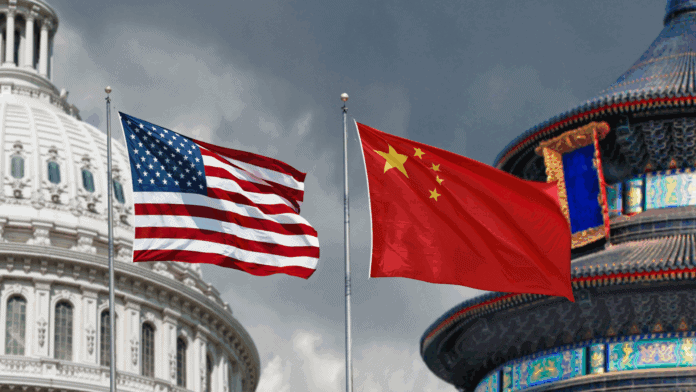
When OpenAI’s leadership approached the Trump administration in late October 2025 with an ambitious request to expand Chips Act tax credits beyond semiconductor fabrication to cover AI data centers, they illuminated a fundamental shift in geopolitical competition. The infrastructure of artificial intelligence—the server farms, electrical grids, and specialized processors powering large language models—has become as strategically vital as the manufacturing of the chips themselves. This development, coupled with the European Union’s move toward legally binding phase-outs of Chinese telecommunications equipment, reveals how technology policy has transcended the realm of commerce to become the defining battleground of contemporary diplomacy.
The competition between Washington and Beijing over semiconductors and AI is not simply a trade dispute magnified. It represents a comprehensive restructuring of international alignments, where alliances are tested not through traditional security commitments but through the willingness to absorb economic costs in service of technological sovereignty. For nations caught between these competing powers, the choice is increasingly stark: accept immediate economic pain to secure long-term strategic autonomy, or maintain profitable arrangements that may become untenable as the bifurcation deepens.
New Battlefield: Infrastructure as Strategy
OpenAI’s request for expanding the Advanced Manufacturing Investment Credit—currently offering a 35 percent tax incentive for semiconductor fabrication—to encompass electrical grid components, AI servers, and data centers signals how private sector interests and national security imperatives have become indistinguishable. Chief Global Affairs Officer Chris Lehane’s letter to the White House argued that broadening the credit would “lower the effective cost of capital, de-risk early investment, and unlock private capital” to accelerate AI infrastructure development domestically. The company even proposed creating a strategic reserve of raw materials including copper, aluminum, and processed rare earth minerals needed for AI infrastructure.
This blurring of lines reflects a fundamental recalculation of what constitutes strategic infrastructure. During the Cold War, steel production and shipbuilding capacity defined industrial power. Today, the ability to train and deploy frontier AI models—which requires massive computing power housed in energy-intensive facilities—has become the measure of technological leadership. When OpenAI CEO Sam Altman announced commitments of approximately 1.4 trillion dollars for data center construction over eight years, he wasn’t simply outlining a corporate strategy. He was describing the infrastructure requirements of an emerging great power competition.
The diplomatic implications extend far beyond corporate subsidies. By treating AI infrastructure as essential to national security, Washington is establishing a precedent that will shape international negotiations for decades. If data centers are strategic assets comparable to semiconductor foundries, then their location, ownership, and the flow of data they process become legitimate subjects of diplomatic pressure and interstate bargaining. Countries hosting such facilities may find themselves facing scrutiny over their technology governance frameworks, cybersecurity standards, and relationships with Chinese firms—all factors that previously existed at the periphery of diplomatic discourse.
China’s response has followed a parallel trajectory. Through its “Delete America” initiative, formalized in 2022 by the State-owned Assets Supervision and Administration Commission, Beijing has systematically worked to reduce dependence on Western technologies across the semiconductor value chain. While presented as a defensive measure against recurring American export controls, the policy reveals China’s recognition that long-term strategic autonomy requires control over the full technology stack. Chinese firms have accelerated investments in domestic alternatives even in areas where American technology remains superior, accepting short-term inefficiencies to build indigenous capabilities that cannot be denied through export restrictions.
Alliance Architecture Under Strain
The European Union’s November 2025 consideration of legally binding requirements to phase out Huawei and ZTE equipment from telecommunications networks—converting a 2020 recommendation into regulation backed by potential financial penalties—exemplifies how technology restrictions are testing alliance cohesion in unprecedented ways. European Commission Vice President Henna Virkkunen’s proposal marks a significant escalation, as member states that have resisted full bans on Chinese vendors now face the prospect of infringement procedures for maintaining what Brussels has deemed “high-risk” infrastructure.
The economic costs are substantial and unevenly distributed. Countries like Germany, which only committed to prohibiting Chinese components in core 5G networks starting in 2026, have significant existing investments in Huawei infrastructure. Replacing this equipment requires not only capital expenditure but also temporary service disruptions and the development of relationships with alternative suppliers who may offer less favorable commercial terms. For smaller EU members with limited telecommunications budgets, the financial burden of accelerated equipment replacement strains national resources while delivering security benefits that may seem abstract compared to immediate fiscal constraints.
This dilemma differs fundamentally from traditional security burdens within alliances. When NATO members agreed to defense spending targets, the threat was visible and kinetic—Soviet tank divisions positioned across the inner-German border. The security risks posed by Chinese telecommunications equipment are more ambiguous: potential vulnerabilities that might be exploited in future conflicts, backdoors that could enable espionage, or supply chain dependencies that provide Beijing with leverage during crises. The uncertainty makes it politically difficult for European leaders to justify the costs to skeptical publics, even as intelligence services warn of genuine risks.
The diplomatic tension extends beyond transatlantic relations. Washington’s success in persuading allies like the United Kingdom and Sweden to restrict Huawei gear, while others including Finland expand their bans, creates a patchwork regulatory landscape that complicates European single market integration. Telecommunications networks do not respect national borders, and divergent security standards can fragment infrastructure in ways that undermine the efficiency gains that European integration was designed to achieve. This fragmentation, in turn, makes European telecommunications providers less competitive globally compared to Chinese firms that benefit from a unified domestic market and state support.
Asymmetric Competition and Its Diplomatic Implications
The semiconductor competition is fundamentally asymmetric, with each side leveraging different advantages in ways that shape their diplomatic strategies. The United States maintains dominance in chip design, with firms like NVIDIA and AMD leading in graphics processing units essential for AI training. American companies also control critical components of the semiconductor manufacturing equipment supply chain, particularly electronic design automation software and certain precision manufacturing tools. This leadership in cutting-edge technology provides Washington with “chokepoint” leverage—the ability to deny China access to capabilities that cannot be easily replicated.
China’s advantages lie elsewhere. Beijing controls approximately 90 percent of rare earth processing capacity and dominant shares of production for critical minerals including gallium, germanium, and antimony. These materials are essential not only for semiconductor manufacturing but also for defense systems, renewable energy technologies, and telecommunications infrastructure. In October 2025, China imposed its strictest rare earth export controls to date, requiring licenses for exports of twelve rare earth elements and applying extraterritorial provisions to products made outside China using Chinese-origin materials. This move—mirroring the Foreign Direct Product Rule that Washington has used to restrict semiconductor exports—demonstrates Beijing’s willingness to weaponize its control over raw materials.
The diplomatic dynamics of this asymmetry create complex calculations for both sides. When the United States tightens semiconductor export controls, it inflicts immediate pain on Chinese technology firms but also accelerates Beijing’s investments in indigenous alternatives. Research from Peking University in March 2025 claimed breakthroughs in two-dimensional transistors that could “change lanes in the semiconductor race” by circumventing silicon-based limitations. Whether such claims prove substantive or aspirational, they reflect how export restrictions can paradoxically strengthen the strategic resolve and innovation imperative of the targeted country.
Conversely, when China restricts rare earth exports, it provides immediate leverage but also incentivizes Western investments in alternative supply chains. The U.S. Department of Defense’s 400 million dollar investment in MP Materials, including ten-year offtake agreements at prices significantly above market rates, demonstrates how mineral export controls can catalyze the diversification they ostensibly prevent. Beijing’s temporary suspension of rare earth export restrictions in November 2025, following negotiations with Washington, suggests Chinese policymakers recognize that overuse of this leverage could accelerate the erosion of their market dominance.
This dynamic of action and counter-action extends beyond the bilateral relationship to affect multilateral institutions. Both countries have sought to reshape technology governance frameworks to favor their approaches. China has promoted concepts like “cyber sovereignty” and “technological fairness” in international forums, arguing that export controls constitute economic coercion and violate principles of free trade. The United States counters by emphasizing the national security imperatives that justify restrictions on dual-use technologies, while working to establish coalitions—such as the Chip 4 alliance with South Korea, Taiwan, and Japan—that can coordinate export control policies.
Third-Party Perspective: Navigating the Divide
For countries outside the U.S.-China dyad, the semiconductor and AI competition creates dilemmas with no easy resolution. Nations that depend on American technology for innovation while relying on Chinese markets for economic growth find themselves pressured to choose sides in a competition where both outcomes carry substantial costs.
East Asian economies face particularly acute tensions. South Korea hosts Samsung, a crucial player in advanced semiconductor manufacturing, and SK Hynix, a leader in memory chips. Both companies have significant operations in China, their largest export market, while simultaneously depending on American design tools and equipment. When the Biden administration removed Samsung and SK Hynix facilities from the Validated End User program in September 2025—effectively requiring licenses for semiconductor equipment sales to their Chinese operations—Seoul faced the prospect of seeing its flagship companies caught between competing regulatory regimes.
Taiwan’s position is even more precarious. Taiwan Semiconductor Manufacturing Company controls over 90 percent of advanced chip production, making the island central to both American technological leadership and Chinese aspirations for self-sufficiency. Washington’s payments to TSMC to establish fabs in Arizona represent not only industrial policy but also a strategic hedge against potential disruptions to Taiwanese production. For Taipei, this creates a paradox: American investment in alternative production capacity may reduce Taiwan’s strategic importance, potentially weakening American commitments to the island’s security, yet refusing to participate in Washington’s supply chain diversification could strain the alliance at a moment when Beijing’s pressure is intensifying.
Southeast Asian nations have sought to position themselves as alternative manufacturing hubs without explicitly aligning with either power. Countries like Vietnam, Malaysia, and Indonesia have attracted investments in semiconductor assembly and testing operations as firms diversify away from China-concentrated supply chains. However, this apparent neutrality has its limits. When Chinese firms seek to circumvent American export controls by routing products through third countries, these nations face pressure from Washington to tighten their own export control enforcement—a demand that carries economic costs and diplomatic complications with Beijing.
Middle Eastern and African nations present a different dynamic. These regions have become focal points for Chinese technology infrastructure investments, from 5G networks to smart city systems, often financed through Belt and Road Initiative projects. Gulf states, despite their security partnerships with Washington, have maintained pragmatic relationships with Chinese technology firms. When American officials press for Huawei restrictions, they encounter resistance rooted not in ideological alignment with Beijing but in economic calculus: Chinese firms offer competitive pricing and flexible financing arrangements that Western competitors struggle to match.
Future of Technology Governance
The trajectory of the semiconductor and AI competition points toward a more fragmented international system, where technology standards, supply chains, and governance frameworks develop along divergent paths aligned with geopolitical blocs. This bifurcation carries profound implications for the multilateral institutions designed to manage technological development and trade.
The World Trade Organization’s consensus-based decision-making and rules designed for an era of economic globalization appear ill-suited to address trade restrictions justified by national security considerations. When member states invoke security exceptions to exempt export controls from WTO disciplines, they exploit provisions that were intended for exceptional circumstances but are now becoming routine tools of economic statecraft. The cumulative effect risks hollowing out the multilateral trading system, replacing it with a patchwork of bilateral and plurilateral arrangements organized around strategic alignments.
Alternative frameworks are emerging, though their effectiveness remains uncertain. The European Union’s Critical Raw Materials Act and the United States’ Chips and Science Act represent efforts to build resilience through industrial policy and supply chain diversification. However, these initiatives also risk escalating subsidy competitions that smaller economies cannot match. When the U.S., EU, and China collectively deploy hundreds of billions of dollars in semiconductor subsidies, they create market distortions that disadvantage countries lacking similar fiscal capacity.
The challenge for policymakers lies in balancing legitimate security concerns with the recognition that technological progress has historically benefited from international collaboration and economies of scale. Export controls that are too broad or unpredictable can undermine the innovative capacity they aim to protect, while controls that are too narrow may prove ineffective against determined efforts at circumvention. The optimal approach likely involves sustained diplomatic engagement to establish norms around technology export controls, distinguish between genuinely sensitive military applications and commercial technologies, and create mechanisms for regular review as technological capabilities evolve.
For smaller and middle-power nations, the path forward requires strategic hedging rather than definitive alignment. Maintaining access to both American and Chinese markets while building domestic capabilities in areas of comparative advantage offers more resilience than exclusive partnerships with either power. This will necessitate sophisticated diplomacy—managing relationships with both Washington and Beijing while investing in research institutions, technical education, and niche areas where indigenous innovation can reduce dependence on external suppliers.
The semiconductor and AI competition is transforming international relations in ways that extend far beyond the technology sector. As export controls expand, supply chains reorganize, and alliances realign around technological capabilities, diplomats are discovering that the most consequential negotiations of this era may not occur in traditional forums for security or trade but in technical standard-setting bodies, licensing negotiations, and infrastructure investment decisions. The countries that navigate this landscape most successfully will be those that recognize the strategic dimension of technological development while maintaining the flexibility to adapt as the competition evolves in unpredictable directions.
The chessboard is set, the pieces are in motion, and the outcome will shape the international order for decades to come. What remains uncertain is whether this competition will ultimately produce a stable equilibrium with clearly defined rules and spheres of influence, or whether it will accelerate fragmentation until the global technology ecosystem fractures into incompatible systems, each reflecting the values and strategic priorities of its anchor power. The answer will depend not only on decisions made in Washington and Beijing but on the collective choices of nations worldwide as they weigh the costs of alignment against the risks of independence in an increasingly divided technological landscape.