
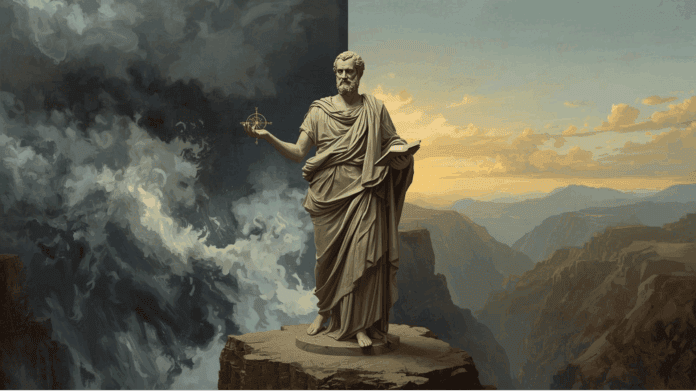
There is a peculiar paradox at the heart of moral action in politics: those who claim to act from the highest principles often cause the greatest harm, while those who acknowledge the constraints of power sometimes achieve the most lasting good. This contradiction puzzled Hans Morgenthau, the German-Jewish scholar who fled Nazi Germany and became one of America’s most influential thinkers on international relations. In his masterwork Politics Among Nations, published in 1948 as the world grappled with the aftermath of unprecedented destruction, Morgenthau articulated a vision of political realism that was, paradoxically, deeply moral—not despite its recognition of limits, but because of it.
Morgenthau’s realism has often been misunderstood as cynical pragmatism, a philosophy that reduces politics to mere power struggles devoid of ethical consideration. This interpretation misses the profound moral architecture underlying his thought. For Morgenthau, political realism was not an abandonment of morality but rather a mature understanding of how moral principles must navigate the treacherous terrain of human nature and political necessity. It was, in essence, a moral philosophy of limits—one that insisted that recognizing constraints on our power to do good was itself the highest form of ethical responsibility.
This counterintuitive wisdom resonates particularly strongly in our current moment, when global challenges from climate change to humanitarian crises demand both moral urgency and strategic wisdom. Morgenthau’s insights suggest that the path to meaningful ethical action lies not in transcending political realities but in working skillfully within them, guided by what he considered the supreme political virtue: prudence.
Moral Courage of Seeing Reality Clearly
To understand Morgenthau’s moral vision, we must first grasp what he meant by “realism.” For him, political realism was not a celebration of power for its own sake but rather an unflinching commitment to seeing political life as it actually is, rather than as we might wish it to be. This stance required what we might call moral courage—the difficult virtue of accepting uncomfortable truths about human nature and political dynamics.
Morgenthau’s realism was forged in the crucible of his personal experience. Born in 1904 in Coburg, Bavaria, he witnessed the collapse of the Weimar Republic and the rise of Nazism, experiences that left him deeply skeptical of utopian political projects. He had seen how noble ideals—nationalism, progress, the perfectibility of man—could be weaponized by those who understood the darker currents of human motivation. His exile to America in 1937 only reinforced his conviction that politics must be understood in terms of power relationships, not merely declared intentions.
This biographical context illuminates why Morgenthau insisted that political actors must begin with a clear-eyed assessment of human nature. In his view, humans are fundamentally driven by what he called the “animus dominandi”—the desire to dominate. This was not a cynical observation but an empirical one, drawn from centuries of historical evidence. Like the psychoanalysts of his era, Morgenthau believed that acknowledging our shadow impulses was the first step toward managing them constructively.
The moral dimension of this stance becomes clear when we consider its alternative. Those who refuse to acknowledge the role of power in politics often end up either naive or hypocritical—naive if they genuinely believe their good intentions will be sufficient, hypocritical if they deploy power while denying its influence. Morgenthau’s realism demanded a kind of intellectual honesty that was itself a moral commitment: the commitment to base policy on facts rather than fantasies.
Consider how this applies to contemporary international relations. When policymakers speak of “spreading democracy” or “humanitarian intervention” without carefully analyzing the power dynamics involved, they risk creating the very instability they claim to oppose. Morgenthau would argue that the moral thing to do is not to abandon these goals but to pursue them with a realistic understanding of the constraints and unintended consequences that any political action entails.
This is where Morgenthau’s thought reveals its surprisingly spiritual dimension. Like the Buddhist concept of accepting reality as it is before seeking to change it, or the Stoic emphasis on distinguishing between what we can and cannot control, Morgenthau’s realism required a form of ego-death—abandoning our comforting illusions about our own righteousness and the malleability of the world. Only by seeing clearly could one act wisely.
Prudence as the Supreme Virtue in Politics
If clear-sighted realism was Morgenthau’s starting point, prudence was his destination. In his understanding, prudence—or practical wisdom—was not mere caution but rather the highest political virtue, the one that made all other virtues possible in the messy realm of politics. This represented a revival of classical political philosophy, particularly Aristotelian ethics, in an age that had largely forgotten such wisdom.
Morgenthau’s conception of prudence was multifaceted. It involved, first, the ability to weigh consequences carefully, understanding that in politics, the road to hell is indeed paved with good intentions. The prudent statesman must ask not merely “Is this policy morally justified?” but also “What are its likely consequences, and are those consequences compatible with my moral aims?” This temporal dimension of ethics—considering how our actions ripple through time—was central to Morgenthau’s thought.
Second, prudence required what we might call moral proportionality: matching means to ends in a way that doesn’t destroy what one seeks to preserve. Morgenthau was particularly critical of policies that, in seeking to achieve perfect justice, risked destroying the conditions that make justice possible at all. This concern led him to oppose both isolationism (which abdicated moral responsibility) and crusading interventionism (which risked destroying international stability in pursuit of ideological goals).
The literary critic Isaiah Berlin, writing in the same era as Morgenthau, captured a similar insight in his famous essay “Two Concepts of Liberty.” Berlin warned against “positive liberty”—the attempt to force people to be free according to some rational plan—arguing that it often led to tyranny. Morgenthau’s political prudence operated from a similar recognition: that the attempt to impose comprehensive solutions often generates more problems than it solves.
But prudence, for Morgenthau, was not simply a matter of intellectual calculation. It required what the ancient Greeks called phronesis—practical wisdom that emerges from experience and judgment rather than abstract reasoning. The prudent politician must develop an intuitive sense for the possible, a feel for when to push and when to yield, when to compromise and when to stand firm. This kind of wisdom cannot be reduced to rules or algorithms; it must be cultivated through practice and reflection.
Morgenthau’s emphasis on prudence also reflected his understanding of politics as fundamentally a realm of competing goods rather than simple conflicts between good and evil. In international relations, nation-states have legitimate interests that often conflict with one another. The prudent statesman seeks not to eliminate these conflicts—an impossible task—but to manage them in ways that minimize violence and preserve the possibility of cooperation. This requires what Morgenthau called the “diplomacy of accommodation”—the patient work of finding solutions that all parties can live with, even if none gets everything they want.
This vision of prudent politics stands in sharp contrast to what Morgenthau saw as the American tendency toward moral absolutism. Americans, he observed, often approached international relations as if they were a courtroom, seeking to determine who was right and who was wrong, then punishing the guilty party. But international politics, Morgenthau argued, was more like a marketplace or a neighborhood—a space where different actors with different interests must find ways to coexist over time.
Tension Between Aspiration and Responsibility
Perhaps the most sophisticated aspect of Morgenthau’s moral philosophy was his recognition that political ethics involves a fundamental tension between our highest aspirations and our concrete responsibilities. This tension, rather than being a flaw in his system, was its very heart—the recognition that mature moral action requires holding multiple truths simultaneously, even when they seem to contradict each other.
Morgenthau was deeply influenced by the Protestant theologian Reinhold Niebuhr, who wrote extensively about the relationship between individual and social ethics. Niebuhr argued that while individuals might be called to self-sacrifice and unconditional love, political leaders have responsibilities to protect their communities that make such pure ethical stances impossible. Morgenthau developed this insight into a full political philosophy, arguing that the statesman faces what we might call the “dirty hands” problem: the necessity of taking morally ambiguous actions in service of larger moral goals.
This creates what Morgenthau called the “tragedy of politics”—the fact that political action almost inevitably involves moral compromise. A leader who refuses to use force may allow terrible injustices to continue; a leader who uses force too readily may become the source of new injustices. There is no position of moral purity available to those who would exercise political responsibility.
The French philosopher Albert Camus, writing in the same post-war period, explored similar themes in his novels and essays. In The Plague, Camus portrayed characters who must act against an epidemic despite not fully understanding it, knowing that their actions might fail or have unintended consequences. Like Morgenthau’s prudent statesman, Camus’s heroes act not from certainty but from what he called “lucid recognition” of their situation. They take responsibility for outcomes they cannot fully control because the alternative—paralysis or withdrawal—is even less acceptable.
This tension between aspiration and responsibility manifests itself concretely in contemporary debates about humanitarian intervention. On one side are those who argue that we have a moral duty to prevent genocide and mass atrocities, regardless of the political complications. On the other side are those who point to the unintended consequences of well-intentioned interventions in places like Libya and Iraq. Morgenthau’s framework doesn’t resolve this tension but rather helps us hold it productively.
From a Morgenthauan perspective, the question is not whether we should care about distant suffering—of course we should—but rather how to structure our care in ways that are likely to be effective over time. This might mean accepting that we cannot solve every problem, choosing our interventions carefully based on our actual capabilities rather than our moral aspirations, and building institutions that can address injustices gradually rather than seeking dramatic transformations.
The wisdom here extends beyond foreign policy to domestic politics as well. Progressive activists often face a version of the same dilemma: whether to compromise with imperfect systems in hopes of incremental progress or to maintain ideological purity at the risk of achieving nothing. Morgenthau’s emphasis on prudence suggests that moral responsibility often requires accepting partial solutions and building toward larger goals over time.
This perspective can be deeply unsatisfying to those who want politics to provide clear moral direction. But Morgenthau argued that this dissatisfaction itself reflected a dangerous form of political immaturity—the desire for politics to be something other than what it is. The mature political actor learns to find meaning and purpose within constraints rather than seeking to transcend them entirely.
Contemporary Applications: Humanitarian Intervention and Climate Diplomacy
Morgenthau’s framework proves particularly illuminating when applied to two of the most pressing moral challenges of our time: humanitarian intervention and climate diplomacy. Both issues reveal how moral urgency must be balanced against political possibility, and how the recognition of limits can actually enhance rather than diminish our capacity for ethical action.
The question of humanitarian intervention has become increasingly urgent in an era of global communication, where distant atrocities are visible in real-time and public pressure for “doing something” can be intense. From a purely moral standpoint, the case for intervention often seems clear: if we have the power to stop genocide or mass atrocities, don’t we have the obligation to act? But Morgenthau’s realism forces us to ask deeper questions: What are the actual consequences of intervention? What are the opportunity costs? What precedents does it set? And perhaps most importantly: Are we prepared to take responsibility for the long-term aftermath of our actions?
The 2011 intervention in Libya illustrates both the appeal and the dangers of humanitarian intervention. Faced with Muammar Gaddafi’s threats to massacre civilians in Benghazi, Western powers felt a moral imperative to act. The intervention succeeded in its immediate goal of preventing a massacre, but it also contributed to Libya’s descent into chaos, created space for extremist groups to flourish, and generated a refugee crisis that destabilized neighboring regions. A Morgenthauan analysis would not conclude that intervention was necessarily wrong, but it would insist on a more sober accounting of both the costs of action and the costs of inaction.
Climate diplomacy presents an even more complex challenge because it requires unprecedented levels of international cooperation to address a problem that unfolds over decades rather than months. Here, Morgenthau’s emphasis on working within existing power structures becomes crucial. The Paris Climate Agreement, for all its limitations, succeeded precisely because it didn’t try to create a world government or eliminate national sovereignty. Instead, it created a framework that allowed countries to pursue climate action while maintaining their political autonomy.
Critics often attack such agreements as insufficiently ambitious, and they’re right in absolute terms—the commitments fall short of what scientists say is necessary to prevent catastrophic warming. But Morgenthau’s framework suggests that political progress often requires accepting intermediate steps rather than holding out for perfect solutions. The question becomes: What is the maximum cooperation we can achieve given current political realities, and how can we structure agreements to build momentum for more ambitious action over time?
This doesn’t mean accepting the status quo indefinitely. Rather, it means understanding that transformative change usually happens through the accumulation of partial victories rather than dramatic breakthroughs. Morgenthau’s prudent approach to climate diplomacy might focus on building coalitions around specific, achievable goals—like technology transfer or carbon border adjustments—rather than seeking comprehensive global agreements that founder on political reality.
The COVID-19 pandemic offered another case study in the tension between moral aspiration and political constraint. From a purely ethical standpoint, the case for global vaccine equity was overwhelming—the virus knew no borders, and protecting vulnerable populations everywhere served everyone’s interests. But the political reality involved complex negotiations between pharmaceutical companies, national governments, and international organizations, each with their own constraints and constituencies.
Morgenthau’s approach would not dismiss the moral urgency of vaccine equity but would focus on identifying the specific political changes that could make progress possible. This might involve working to reform intellectual property rules, building manufacturing capacity in developing countries, or creating incentive structures that align corporate interests with public health goals. The key insight is that moral progress often requires changing the structural conditions that shape actors’ choices rather than simply appealing to their better angels.
Why Limits Enable Rather Than Constrain Moral Action
The most counterintuitive aspect of Morgenthau’s philosophy is his argument that accepting limits actually enhances rather than diminishes our capacity for moral action. This insight challenges our common assumption that moral progress requires the removal of constraints, and it offers a different way of thinking about the relationship between power and ethics.
Morgenthau’s argument begins with an observation about human psychology: unlimited power tends to corrupt not just the powerful but the very notion of moral action itself. When actors believe they can reshape reality according to their will, they often lose touch with the human costs of their actions. The recognition of limits, by contrast, forces a kind of moral discipline—it requires us to choose carefully among competing goods and to take responsibility for the consequences of our choices.
This insight finds support in contemporary research on decision-making and moral psychology. Studies show that people with more power tend to be less empathetic and less attentive to others’ perspectives. Conversely, those who perceive constraints on their actions often engage in more careful moral reasoning. The recognition of limits, it seems, keeps our moral faculties sharp.
Morgenthau also argued that limits enhance moral action by making it more sustainable over time. Political movements that ignore constraints often burn themselves out in unsuccessful attempts to achieve everything at once. By contrast, those that work within constraints can build the coalitions and institutions necessary for lasting change. The civil rights movement in the United States, for instance, succeeded not by demanding immediate and total transformation but by identifying specific, achievable goals that could build momentum for broader change.
Consider the contrast between two approaches to addressing global poverty. One approach might call for the immediate redistribution of wealth from rich to poor countries, based on principles of global justice. This approach has moral clarity on its side, but it ignores the political realities that make such redistribution unlikely. An alternative approach might focus on incremental changes—reforming trade rules, improving governance in developing countries, or expanding access to education and healthcare. This approach accepts existing constraints while working to gradually shift them.
Morgenthau would argue that the second approach, despite its apparent moral modesty, is actually more ethical because it’s more likely to produce real improvements in people’s lives. The first approach may satisfy our desire for moral purity, but if it cannot be implemented, it serves primarily to make us feel good about ourselves rather than to help those we claim to care about.
This perspective also applies to individual moral action. In his personal life, Morgenthau struggled with the question of how to maintain moral integrity while participating in what he saw as a fundamentally flawed political system. His answer was not to withdraw from politics but to engage with it as skillfully as possible, accepting that perfect solutions were unavailable while working to minimize harm and maximize good within existing constraints.
The environmental movement provides another illustration of how limits can enable moral action. Early environmental activism often adopted an all-or-nothing approach, calling for the complete transformation of industrial society. While this approach raised important awareness, it often alienated potential allies and made little practical progress. More recent environmental strategies have focused on incremental changes—carbon pricing, renewable energy subsidies, efficiency standards—that work within existing economic and political systems while gradually shifting their direction.
Morgenthau’s insight here is that moral action in politics is often more like gardening than architecture. The gardener works with existing soil conditions, weather patterns, and plant biology rather than trying to impose an abstract design on unwilling nature. Similarly, the prudent politician works with existing institutions, interests, and cultural patterns rather than trying to create entirely new realities from scratch.
Diplomacy of Restraint: Lessons for Global Governance
Perhaps nowhere is Morgenthau’s wisdom more relevant than in our current struggles with global governance. The interconnected challenges of the 21st century—from pandemics to climate change to economic inequality—seem to demand forms of international cooperation that go far beyond what existing institutions can provide. Yet Morgenthau’s framework suggests that the path forward lies not in abandoning these institutions but in gradually strengthening them through what he called the “diplomacy of restraint.”
The diplomacy of restraint begins with the recognition that lasting international agreements must be acceptable to all major powers, even those whose values we might find objectionable. This doesn’t mean moral relativism—Morgenthau was clear that some values are better than others—but it does mean that moral progress in international relations usually requires finding ways to align different actors’ interests rather than simply imposing one set of values on everyone else.
The Paris Climate Agreement exemplifies this approach. Rather than trying to create a binding international authority with enforcement powers—something that would have been politically impossible—the agreement created a framework for voluntary commitments that countries could strengthen over time. Critics argued that this approach was insufficiently ambitious, and they were right in absolute terms. But the agreement succeeded in creating momentum and establishing norms that have influenced national policies around the world.
Morgenthau’s approach to climate diplomacy would likely emphasize what scholars now call “polycentric governance“—addressing the problem through multiple, overlapping institutions rather than seeking a single comprehensive solution. This might involve bilateral agreements between major emitters, sectoral agreements within particular industries, city-to-city cooperation, and scientific collaboration—a web of relationships that gradually shifts the overall direction of global policy without requiring unanimous agreement on fundamental values.
The recent tensions between the United States and China illustrate both the necessity and the difficulty of Morgenthau’s approach. From a moral standpoint, there are legitimate concerns about human rights in China, just as there are legitimate Chinese concerns about American foreign policy. But Morgenthau would argue that allowing these moral differences to prevent cooperation on existential challenges like climate change represents a failure of prudence—a case where the perfect becomes the enemy of the good.
This doesn’t mean ignoring human rights concerns or abandoning moral principles. Rather, it means structuring international relations in ways that allow for cooperation on some issues while maintaining principled disagreement on others. During the Cold War, the United States and Soviet Union managed to cooperate on arms control while maintaining fundamental ideological opposition. Similar compartmentalization may be necessary for addressing contemporary global challenges.
The European Union offers another model of how Morgenthau’s principles might apply to contemporary governance challenges. The EU succeeded not by eliminating national sovereignty but by creating overlapping institutions that gradually shift the context within which national interests are pursued. This process has been messy, slow, and incomplete, but it has created unprecedented levels of cooperation among countries that spent centuries fighting each other.
Ethics of Imperfection in an Interconnected World
As we navigate an increasingly interconnected world facing existential challenges, Morgenthau’s political realism offers not a counsel of despair but a mature framework for moral action under conditions of uncertainty. His core insight—that acknowledging limits enhances rather than diminishes our capacity for ethical action—provides essential guidance for anyone seeking to make a positive difference in complex political systems.
The COVID-19 pandemic illustrated both the necessity and the difficulty of this approach. The moral imperative to protect vulnerable populations was clear, but the political realities were complex: different countries had different healthcare capacities, different economic constraints, and different cultural attitudes toward government authority. Effective pandemic response required not just medical expertise but political wisdom—the ability to design policies that could actually be implemented given existing constraints.
The most successful pandemic responses often came from countries that combined moral clarity about protecting public health with practical wisdom about implementation. South Korea’s test-and-trace system worked because it was tailored to South Korean institutional capacities and cultural norms. New Zealand’s elimination strategy succeeded because of the country’s geographic isolation and strong governmental institutions. Attempts to simply copy these approaches in different contexts often failed because they ignored local political realities.
Morgenthau’s framework suggests that this pattern—moral clarity combined with contextual wisdom—represents the best hope for addressing other global challenges as well. Climate action, for instance, requires both urgent moral commitment and careful attention to what is politically feasible in different national contexts. The countries that have made the most progress on renewable energy have often done so not by adopting abstract global targets but by identifying specific policies that aligned climate goals with domestic economic and political interests.
The migration crisis presents similar challenges. From a purely moral standpoint, people fleeing violence and poverty deserve protection and assistance. But sustainable migration policies must also consider the political realities in receiving countries, including public attitudes, institutional capacities, and economic constraints. Morgenthau’s approach would focus on building systems that can provide meaningful protection for refugees while maintaining public support for immigration policies over time.
This doesn’t mean accepting injustice or abandoning moral principles. Rather, it means recognizing that lasting moral progress usually requires building coalitions and institutions that can sustain themselves politically. The civil rights movement succeeded not just because its cause was just but because leaders like Martin Luther King Jr. understood how to frame moral demands in ways that could attract broader support and create pressure for institutional change.
Morgenthau’s emphasis on working within constraints also offers guidance for individual moral action in complex institutional settings. Whether we’re working within corporations, non-profit organizations, or government agencies, we often face situations where our moral aspirations conflict with institutional realities. Morgenthau’s framework suggests that the ethical response is not necessarily to withdraw from these institutions but to work within them as skillfully as possible, accepting that we cannot achieve everything while refusing to abandon our commitment to making things better.
The technology industry provides numerous examples of this kind of moral challenge. Engineers and designers working for major tech companies often face pressure to implement features that may have negative social consequences. A Morgenthauan approach might focus on building coalitions within these companies to gradually shift their practices rather than expecting immediate transformation or abandoning the field entirely to those with fewer scruples.
In our age of social media and instant global communication, there’s often pressure to take clear moral stances on complex issues. Morgenthau’s framework suggests that this pressure, while understandable, can sometimes be counterproductive. The most effective moral action often requires accepting ambiguity, building relationships across ideological divides, and working patiently toward incremental progress rather than seeking dramatic transformation.
This is not a counsel of complacency but rather a recognition that sustainable moral progress requires what we might call strategic humility—the recognition that our understanding is limited, our power is constrained, and our actions will have unintended consequences. This humility, paradoxically, can make us more rather than less effective as moral agents by forcing us to think carefully about how to make our limited influence count.
Enduring Relevance of Moral Realism
Hans Morgenthau died in 1980, but his central insights have only become more relevant as we face challenges that require unprecedented levels of international cooperation. His vision of political realism as a moral philosophy of limits offers essential wisdom for navigating the complex ethical terrain of the 21st century.
The deepest insight of Morgenthau’s thought may be his recognition that moral maturity requires accepting paradox rather than resolving it. We must care deeply about justice while accepting that perfect justice is unattainable. We must act decisively while acknowledging our limited understanding. We must work for change while respecting the constraints that make social life possible. These tensions cannot be eliminated through clever reasoning or good intentions; they can only be navigated through the cultivation of practical wisdom.
This wisdom is particularly relevant for younger generations who have grown up with global consciousness but must now grapple with the difficulties of translating moral concern into effective action. Morgenthau’s framework suggests that the path forward involves neither cynical withdrawal nor naive activism but rather what we might call “engaged realism”—full participation in political life combined with clear-eyed assessment of what is possible.
The environmental movement, human rights advocacy, global health initiatives, and other moral causes all benefit from this kind of engaged realism. It asks not whether these causes are important—they clearly are—but rather how to pursue them in ways that build rather than undermine the coalitions and institutions necessary for long-term progress.
Perhaps most importantly, Morgenthau’s political realism offers a framework for hope that doesn’t depend on unrealistic expectations about human nature or political possibility. His hope was grounded not in the belief that humans would transcend their limitations but in the conviction that they could learn to manage those limitations wisely. This more modest hope may also be more durable, capable of sustaining moral action even when dramatic breakthroughs prove elusive.
In our current moment of global crisis and transformation, we need both the moral urgency that comes from clear vision of what ought to be and the practical wisdom that comes from clear understanding of what is. Morgenthau’s great contribution was showing how these two requirements—often seen as contradictory—can actually reinforce each other. By accepting the limits on our power to do good, we paradoxically enhance our capacity to exercise that power wisely.
The ultimate test of any moral philosophy is not whether it makes us feel good about ourselves but whether it helps us act more effectively in service of human flourishing. By this measure, Morgenthau’s political realism—with its emphasis on prudence, its acceptance of tragedy, and its insistence on working within constraints—offers resources that our morally ambitious but politically challenging time desperately needs. It teaches us that the courage to see clearly, the wisdom to act prudently, and the humility to accept imperfection are not obstacles to moral action but rather its essential foundations.
In embracing these insights, we don’t abandon our highest aspirations but rather learn to pursue them through the patient, careful work of politics—the art of the possible in service of the necessary.