
The Arctic is experiencing its most dramatic transformation in recorded history—not just environmentally, but geopolitically. As climate change accelerates Arctic ice melt at rates far exceeding scientific predictions, the Arctic Ocean stands on the precipice of its first ice-free day, potentially before 2030. This physical transformation is catalyzing an unprecedented scramble for resources, shipping routes, and strategic positioning that is fundamentally reshaping international relations and creating what some observers call a “new Cold War”—though this time, the cold is rapidly disappearing.
Accelerating Physical Transformation
The Arctic’s environmental crisis has become a geopolitical opportunity. Recent projections suggest the Arctic could witness its first ice-free day as early as 2027, with near-certainty of ice-free summers by the 2030s—a full decade earlier than the IPCC’s most recent estimates. This acceleration matters because it compresses the timeline for strategic decision-making and intensifies competition among Arctic and non-Arctic states alike.
The region is warming at approximately three times the global average rate, with summer 2023 marking the warmest Arctic conditions since 1900. NASA estimates indicate the Arctic has lost 21,000 square miles of sea ice annually over the past five decades, and this rate is accelerating. What was once a frozen barrier is becoming navigable ocean, opening both the Northeast Passage along Russia’s northern coast and the Northwest Passage through Canada’s Arctic archipelago. These routes could reduce shipping times between Asia and Europe by up to 20 days compared to the Suez Canal route, fundamentally altering global trade patterns and creating new strategic chokepoints.
Resource Imperative
Beneath the melting ice lies one of the planet’s last great resource frontiers. The U.S. Geological Survey estimates the Arctic holds approximately 13% of the world’s undiscovered oil reserves, 30% of its undiscovered natural gas, and vast deposits of critical minerals including rare earth elements essential for modern technology and green energy transitions. These resources are no longer theoretical—they are increasingly accessible and economically viable.
Russia has moved most aggressively to capitalize on Arctic resources, with Arctic development representing a cornerstone of its economic strategy. The Yamal LNG project, in which China holds a 30% stake, exemplifies how resource extraction is driving both economic cooperation and geopolitical realignment. Arctic LNG 2, currently under construction, represents another massive investment in monetizing the region’s hydrocarbon reserves. For Russia, Arctic resources represent not just economic opportunity but strategic necessity, particularly as Western sanctions have limited other revenue streams.
Yet resource competition extends far beyond hydrocarbons. Greenland’s rare earth mineral deposits have attracted intense interest from the United States, China, and the European Union. These minerals are critical for everything from smartphones to missile guidance systems to wind turbines. The intersection of resource scarcity, technological dependence, and great power competition makes the Arctic’s mineral wealth a flashpoint for future conflict.
China Factor: A “Near-Arctic State” Stakes Its Claim
Perhaps no development has been more consequential—or controversial—than China’s Arctic ambitions. In its 2018 Arctic Policy white paper, China designated itself a “near-Arctic state”, a self-identification that Arctic nations immediately contested. Located over 7,000 kilometers from the Arctic Circle, China’s claim to Arctic stakeholder status rests not on geography but on its economic power, climate vulnerability, and global ambitions.
China’s “Polar Silk Road” concept, announced in 2017 as an extension of the Belt and Road Initiative, represents an audacious bid to integrate Arctic shipping routes into its global infrastructure strategy. The vision is straightforward: create alternative trade routes that bypass potential U.S. control of the Strait of Malacca and Suez Canal, diversify energy supply sources, and establish China as an indispensable Arctic player.
In practice, China’s Arctic strategy has pursued multiple vectors simultaneously. Chinese companies have become among the most frequent users of Russia’s Northern Sea Route, primarily transporting liquefied natural gas to Chinese markets. Chinese state-owned enterprises hold significant stakes in Russian Arctic energy projects. China has invested in Arctic infrastructure from Iceland to Finland, established research facilities in Norway’s Svalbard archipelago, and deployed icebreakers to conduct “scientific research” that some analysts view as serving dual civilian-military purposes.
The Ukraine conflict has paradoxically accelerated Sino-Russian Arctic cooperation. As Russia faces Western isolation, China has become its most critical economic partner and technology supplier. Russia’s willingness to grant China greater access to Arctic resources and sea routes represents a dramatic shift from Moscow’s historical reluctance to allow foreign involvement in what it considers sovereign Arctic territory. This deepening partnership concerns Western nations, particularly as Chinese warships have increasingly operated near Alaska’s Aleutian Islands, sometimes in coordination with Russian vessels.
Yet China’s Arctic ambitions face significant constraints. Projects beyond Russia have struggled to gain traction, with Nordic countries and Greenland increasingly wary of Chinese investment. The “Polar Silk Road” itself has largely disappeared from official Chinese discourse since 2023, suggesting that Beijing may be reassessing its Arctic strategy in light of geopolitical tensions and practical limitations.
Military Posturing and Strategic Competition
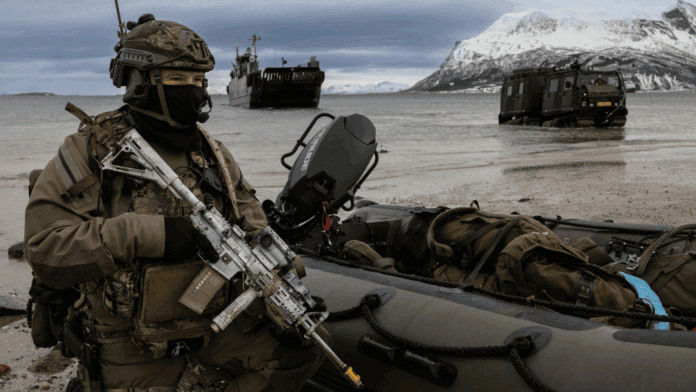
The Arctic’s militarization represents perhaps the most concerning dimension of its geopolitical transformation. Russia has undertaken the most extensive military buildup, reopening Soviet-era bases along its Arctic coast, deploying advanced air defense systems, and establishing new military infrastructure designed to project power across the region. Moscow views the Arctic as both a strategic frontier and a defensive bastion—the Northern Fleet’s submarine forces represent Russia’s most survivable nuclear deterrent, and maintaining freedom of movement from the Arctic to the North Atlantic remains a core Russian military objective.
NATO’s expansion into the Arctic accelerated dramatically following Russia’s invasion of Ukraine. Finland’s accession to NATO in 2023, followed by Sweden’s membership, fundamentally altered the Arctic’s security architecture. NATO now counts seven of the eight Arctic states among its members, leaving only Russia outside the alliance. Large-scale NATO exercises in the region, including Northern Response 2024—the alliance’s largest Arctic exercise in decades involving 20,000 troops—signal that the High North has become a critical theater for alliance planning.
The United States has belatedly recognized the Arctic’s strategic significance. The 2024 Department of Defense Arctic Strategy explicitly identifies the region as critical for U.S. sovereignty, global power projection, and great power competition. It mandates enhanced Arctic capabilities, increased exercises, and deeper engagement with allies and partners. Yet the U.S. faces significant capability gaps, including insufficient icebreaker capacity compared to Russia’s fleet of over 40 vessels, limited cold-weather operational experience, and infrastructure deficits in Alaska.
The intersection of territorial disputes, military buildup, and strategic competition creates dangerous potential for miscalculation. Overlapping territorial claims over extended continental shelves remain unresolved, with Russia, Canada, and Denmark all asserting rights to vast areas of Arctic seabed based on competing interpretations of international law. The status of key waterways remains contested—Canada claims the Northwest Passage as internal waters, while the United States insists it represents an international strait open to all navigation.
Indigenous Peoples: The Arctic’s First Victims
Lost in geopolitical maneuvering are the approximately 400,000 Indigenous peoples whose communities have inhabited the Arctic for millennia. Climate change threatens their traditional ways of life with unprecedented speed—thawing permafrost destabilizes communities, changing ice conditions make traditional hunting dangerous, and shifting wildlife populations undermine subsistence practices that have sustained Arctic cultures for generations.
Indigenous communities face the dual burden of climate impacts and industrial development. Resource extraction projects frequently proceed on Indigenous lands with inadequate consultation or benefit-sharing. The Sámi people of Scandinavia have watched as mining, wind farms, and other “green” development threatens reindeer herding grounds. Russian Indigenous peoples face particularly acute challenges, with the state showing little regard for Indigenous rights in pursuing Arctic exploitation. The Russian Association of Indigenous Peoples of the North even endorsed Russia’s invasion of Ukraine after its leadership was replaced by state-appointed figures, highlighting how Indigenous governance can be co-opted by state interests.
The Arctic Council, established in 1996 with Indigenous peoples’ organizations as Permanent Participants, once represented a model for inclusive governance. Yet Russia’s invasion of Ukraine has fractured this cooperation. The seven non-Russian Arctic states paused Council activities in March 2022, resuming only limited work on projects excluding Russia. In February 2024, Russia suspended its financial contributions until “full-fledged work” resumes, leaving the Council in limbo.
Indigenous leaders emphasize that they remain the Arctic’s most important knowledge holders and most vulnerable populations. Their traditional ecological knowledge—developed over thousands of years—is critical for understanding and adapting to environmental change. Yet too often, they are excluded from high-level decision-making about the Arctic’s future. As one Inuit leader stated: “Nothing about us should be done without us.”
Governance Crisis
The Arctic governance architecture is collapsing under the weight of geopolitical tensions. The Arctic Council, once hailed as a model for international cooperation even during periods of broader tension, has been reduced to a symbolic shell. Without high-level political engagement between Russia and other members, the Council cannot fulfill its mandate for environmental protection and sustainable development. Russia’s refusal to pay dues and threats to withdraw entirely raise existential questions about the institution’s viability.
Three scenarios emerge for the Council’s future. First, it could continue in diminished form with minimal Russian engagement—maintaining the organization’s skeleton in hopes of eventual normalization. Second, the seven Western Arctic states could dissolve the Council and recreate it without Russia, though this would undermine regional governance given that Russia controls 45% of the Arctic coastline. Third, some form of pragmatic modus vivendi could emerge, with working-level cooperation on technical and scientific matters continuing despite frozen political relations.
Norway, which held the Council chairmanship from 2023 to 2025 before transferring it to Denmark (Greenland), has tried to navigate this impossible balancing act. Oslo has the longest experience managing Arctic cooperation with Russia, including resolving a 40-year maritime boundary dispute through the 2010 Treaty on Maritime Delimitation. Norwegian officials emphasize that some level of Arctic cooperation with Russia remains necessary given geographic realities, particularly for environmental monitoring, search and rescue, and scientific data sharing. Yet they also acknowledge that “normal political cooperation with the current Russian regime is not possible.”
Beyond the Arctic Council, other governance frameworks face similar challenges. The United Nations Convention on the Law of the Sea (UNCLOS) provides the legal foundation for maritime claims, but its dispute resolution mechanisms have proven inadequate for resolving overlapping extended continental shelf claims. The International Maritime Organization’s Polar Code establishes shipping standards, but compliance and enforcement remain concerns as traffic increases. Scientific cooperation, once largely insulated from political tensions, has been severely disrupted by the suspension of research partnerships with Russia.
Looking Forward: Scenarios for 2030 and Beyond
The Arctic of 2030 will look dramatically different from today, and several plausible scenarios emerge from current trajectories.
The Deepening Divide Scenario: Continued geopolitical confrontation hardens divisions between Russia-China and Western Arctic states. Military tensions escalate, with increased close encounters and potential for miscalculation. The Arctic Council either dissolves or becomes entirely ceremonial. Parallel but separate governance arrangements emerge—a Western Arctic framework coordinated through NATO alongside Sino-Russian bilateral arrangements. Indigenous peoples’ voices are further marginalized as security concerns dominate decision-making.
The Managed Competition Scenario: Despite political tensions, functional cooperation continues on specific technical issues where shared interests remain compelling—search and rescue, scientific data sharing, environmental protection. The Arctic becomes a patchwork of selective cooperation within an overall framework of strategic competition. China’s Arctic role expands but remains constrained by Western pushback and practical limitations. Economic development proceeds unevenly, with pockets of cooperation existing alongside zones of heightened tension.
The Climate Catastrophe Catalyst Scenario: Rapid and dramatic environmental changes—potentially including major incidents like massive oil spills in ice-free waters or catastrophic permafrost collapse affecting global methane emissions—force renewed cooperation. The shared threat of environmental catastrophe temporarily overrides geopolitical tensions, leading to reinvigorated international coordination. However, this cooperation remains limited to environmental and safety issues rather than extending to security or economic competition.
Each scenario carries profound implications. An ice-free Arctic summer will arrive regardless of human decisions about cooperation or confrontation. The question is whether states will manage this transition through coordinated frameworks that protect the Arctic environment and its Indigenous inhabitants, or whether the region descends into unmanaged competition that risks both environmental catastrophe and military conflict.
Implications for Global Order
Arctic geopolitics matters far beyond the region itself. The Arctic has become a bellwether for the broader international system’s health—a place where climate change, great power competition, resource scarcity, and institutional fragility intersect in concentrated form. How the international community manages Arctic challenges will signal its capacity to address other global problems requiring sustained cooperation despite strategic rivalry.
For the United States and its allies, the Arctic represents both a challenge to be managed and an opportunity to demonstrate the continued relevance of democratic alliances. NATO’s adaptation to Arctic security concerns shows the alliance can still respond to new threats. Yet capability gaps and divided attention (given competing priorities in Europe and the Indo-Pacific) raise questions about whether the West can effectively compete in the Arctic over the long term.
For China, the Arctic represents a test case for its ambitions to reshape global governance and establish itself as a polar power. Success in establishing meaningful presence and influence in the Arctic would validate China’s “near-Arctic state” concept and demonstrate its ability to project power and interests globally. Failure would highlight the limits of Chinese influence when confronting coordinated resistance from established Arctic states.
For Russia, the Arctic represents both economic lifeline and strategic sanctuary. Arctic resource revenues have become even more critical as Western sanctions bite. Yet Russia’s dependence on China for technology and investment in Arctic projects creates its own vulnerabilities and limits Russia’s sovereignty in the region Moscow claims as its own.
For Indigenous peoples and the Arctic environment, the trajectory appears increasingly ominous. Accelerating climate change, intensifying resource extraction, and growing military activity all threaten the Arctic’s fragile ecosystems and the communities that depend on them. Without stronger mechanisms to ensure Indigenous participation in governance and stringent environmental protections, the Arctic risks becoming another zone sacrificed to great power competition and short-term economic gain.
The Arctic’s transformation from frozen frontier to contested geopolitical space is no longer a future scenario—it is the present reality. As ice disappears, the Arctic is revealing itself to be not the periphery of global affairs but a critical arena where the fundamental questions of 21st-century international relations will be contested: Can great powers cooperate on shared challenges despite strategic rivalry? Will international institutions adapt to new realities or collapse under geopolitical strain? Can environmental imperatives override national interests? The answers emerging from the Arctic will resonate far beyond the region, shaping the contours of international order for decades to come.