
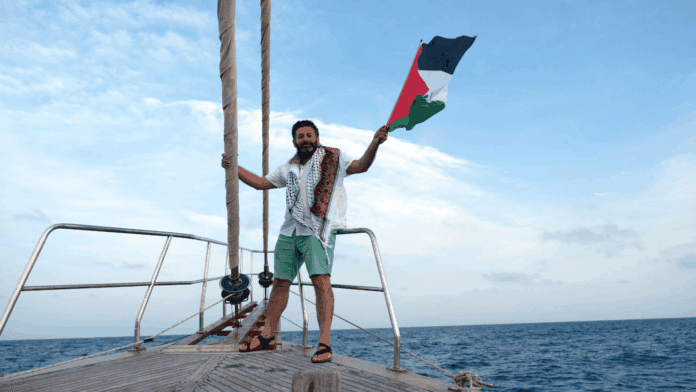
When Israeli naval forces intercepted the Global Sumud Flotilla in early October 2025, detaining over 500 activists from more than 40 countries who were attempting to break the Gaza blockade, the operation represented far more than another chapter in a longstanding maritime confrontation. The flotilla—comprising more than 44 vessels and representing the largest civilian-led maritime convoy in history—embodied an evolving form of humanitarian diplomacy that challenges fundamental assumptions about who holds authority over humanitarian access in conflict zones, and how international law governs the intersection of state sovereignty and civilian intervention.
The interception, which took place in international waters approximately 70-80 nautical miles from Gaza’s coast, has reignited a debate that extends well beyond the immediate Israel-Palestine context. At its core lies a question with profound implications for the future of humanitarian action: when civil society actors undertake direct maritime missions to deliver aid over governmental objections, invoking international humanitarian and maritime law to justify their actions, how should the international community respond? The answer to this question will shape not only the specific fate of flotilla participants but the broader architecture of humanitarian intervention in an era of proliferating conflicts and contested access.
Evolution of Flotilla Diplomacy
Maritime humanitarian missions to Gaza represent a distinct strand of civil society activism that has developed its own tactical repertoire, legal arguments, and symbolic power since the first successful Free Gaza Movement voyages in 2008. These missions differ fundamentally from traditional humanitarian operations in several respects. Unlike established humanitarian organizations that negotiate access through diplomatic channels and operate within frameworks sanctioned by conflict parties, flotilla organizers explicitly position their missions as challenges to state authority—in this case, Israel’s naval blockade, which activists characterize as illegal collective punishment under international law.
The history of flotilla missions to Gaza traces an escalating pattern of civil society determination and state response. The 2010 Mavi Marmara incident, in which Israeli commandos killed nine Turkish activists (later determined by UN investigations to have used excessive force), marked the bloodiest confrontation but failed to deter subsequent attempts. Flotillas in 2011, 2015, 2016, 2018, and throughout 2025 have all been intercepted, yet each mission has refined its approach, expanded its international composition, and sharpened its legal argumentation.
The Global Sumud Flotilla, organized by the Freedom Flotilla Coalition alongside the Global Movement to Gaza, Maghreb Sumud Flotilla, and Sumud Nusantara, represented a strategic evolution. Rather than a single convoy, organizers coordinated departures from multiple Mediterranean ports—Barcelona, Italy, Tunisia, and Greece—creating a dispersed network harder to interdict simultaneously. The flotilla’s name itself, drawn from the Arabic concept of sumud (steadfast perseverance), signaled a long-term commitment to challenging the blockade through repeated attempts rather than singular symbolic gestures.
What distinguishes contemporary flotilla diplomacy from earlier humanitarian activism is its sophisticated synthesis of legal claims, media strategy, and international solidarity networks. Participants livestreamed their journeys, documented interceptions in real time, and mobilized diplomatic pressure from their home governments. The flotilla included parliamentarians from multiple countries, journalists, lawyers specifically trained in maritime law, and high-profile activists like climate campaigner Greta Thunberg, whose participation guaranteed global media attention.
Legal Battleground: Maritime Law Meets Humanitarian Access
The confrontation between the Global Sumud Flotilla and Israeli forces plays out on contested legal terrain where international humanitarian law, the law of armed conflict at sea, and human rights frameworks intersect in complex and sometimes contradictory ways. Both sides invoke international law to justify their positions, yet they interpret the same legal instruments in fundamentally opposing ways.
Flotilla organizers ground their mission’s legality in several key principles. The United Nations Convention on the Law of the Sea (UNCLOS) guarantees freedom of navigation in international waters, a cornerstone principle of maritime law dating back centuries. Under UNCLOS Article 87, all vessels enjoy the freedom of the high seas, which extends beyond any state’s 12-nautical-mile territorial waters. The flotilla organizers assert that their vessels, sailing under recognized flag states and carrying humanitarian cargo, possess an unqualified right to navigate international waters without interference.
Furthermore, activists invoke the San Remo Manual on International Law Applicable to Armed Conflicts at Sea, which establishes strict conditions for lawful naval blockades. The manual prohibits blockades that cause starvation of civilian populations or inflict disproportionate suffering—standards that flotilla participants argue Israel’s Gaza blockade clearly violates. They point to UN Security Council resolutions demanding unimpeded humanitarian access and the removal of barriers to aid delivery as binding legal instruments that supersede any claimed right to maintain a comprehensive naval blockade.
The legal case advanced by flotilla organizers received support from international legal experts and workers’ federations. Stephen Cotton, General Secretary of the International Transport Workers’ Federation representing over 16.5 million transport workers globally, stated unequivocally that “attacking or seizing non-violent, humanitarian vessels in international waters is illegal and unacceptable.” UN experts in 2024 and 2025 repeatedly affirmed that Freedom Flotilla missions have “the right of free passage in international waters” and that “Israel must not interfere with its freedom of navigation, long recognized under international law.”
Israel’s counter-argument rests on different legal premises. Israeli authorities assert that they maintain a lawful naval blockade of Gaza, justified as a security measure to prevent weapons smuggling to Hamas, which Israel and numerous countries designate as a terrorist organization. Under the law of armed conflict, belligerents may establish naval blockades to prevent contraband from reaching enemy territory. A 2011 UN Palmer Report examining the 2010 Mavi Marmara incident concluded that Israel’s blockade itself was legal under international law, though the degree of force used in that particular interception was “excessive and unreasonable.”
Israel argues that the right to enforce a lawful blockade extends to stopping vessels before they reach the blockaded area, even in international waters, to inspect cargo and prevent blockade-running. Israeli officials offered to allow flotilla cargo to be offloaded at Israeli ports, inspected, and then transferred overland to Gaza—a procedure they contend satisfies humanitarian obligations while maintaining security control. The flotilla’s refusal to accept this procedure, Israeli authorities argue, demonstrates that the mission’s primary objective was political provocation rather than genuine humanitarian relief.
The legal debate ultimately turns on contested questions that have divided international law scholars for years: Is Israel’s blockade of Gaza itself lawful? Does the right to enforce a blockade permit interception in international waters? Can civilian humanitarian missions be treated as blockade-runners subject to military interdiction? These questions have no universally accepted answers, leaving flotilla diplomacy to unfold in a legal gray zone where both sides claim the mantle of international law while fundamentally disagreeing on its application.
State Responses: Sovereignty, Security, and Solidarity
The Global Sumud Flotilla’s composition—with participants from more than 40 countries including EU members, Turkey, Malaysia, Brazil, and South Africa—ensured that its interception would generate diverse governmental responses reflecting different relationships with both Israel and the Palestinian cause. These varied reactions illuminate how flotilla diplomacy intersects with traditional state-to-state relations, creating diplomatic complications that extend far beyond the immediate humanitarian mission.
European governments with citizens aboard the flotilla found themselves navigating uncomfortable terrain between humanitarian principles and security partnerships. Spain and Italy deployed naval vessels to escort portions of the flotilla through their territorial waters, ostensibly to ensure the safety of their nationals, but both governments urged activists to turn back rather than confront Israeli forces. Italian Prime Minister Giorgia Meloni explicitly discouraged Italian participation, calling the flotilla “unnecessarily dangerous” and suggesting activists use “safer and already existing means” to deliver humanitarian aid. Greece, from whose ports several vessels departed, issued formal diplomatic protests after the interception but took no concrete action beyond providing consular assistance to detained citizens.
This European ambivalence reflects the complex position of states caught between competing obligations: duty to protect their citizens, commitments to international humanitarian law, and strategic relationships with Israel. The EU’s tepid response contrasts sharply with the legal analysis prepared by Palestinian and international legal organizations, which argued that EU member states have binding obligations under the Treaty on European Union to protect the flotilla as a lawful humanitarian mission and formally notify Israel that interference would constitute a breach of international and EU law.
Other states responded more forcefully. Turkey’s Foreign Ministry characterized the interception as “an act of terrorism,” invoking the memory of the 2010 Mavi Marmara incident in which Turkish citizens were killed. Colombia’s President Gustavo Petro took the extraordinary step of expelling Israel’s diplomatic delegation and terminating his country’s free trade agreement with Israel in protest—one of the most severe diplomatic consequences any state imposed. South Africa’s President Cyril Ramaphosa, whose country has brought genocide charges against Israel at the International Court of Justice, demanded the immediate release of South African activists “abducted in international waters.”
These divergent responses reveal how flotilla diplomacy creates diplomatic spillover effects that extend well beyond the immediate maritime confrontation. For countries like Turkey, Colombia, and South Africa, which have positioned themselves as advocates for Palestinian rights on the international stage, the flotilla interception provided an opportunity to demonstrate solidarity through concrete diplomatic action. For European states more invested in maintaining working relationships with Israel, the flotilla presented an uncomfortable dilemma with no clear resolution that would satisfy domestic humanitarian constituencies while preserving diplomatic capital in Tel Aviv.
Israel’s handling of the detention phase further complicated the diplomatic fallout. Multiple deported activists, including prominent figures like Greta Thunberg and journalists from various countries, alleged systematic mistreatment during their detention, including being forced to kiss Israeli flags, deprivation of food and water, physical abuse, and being held in cells infested with bedbugs. While Israel’s Foreign Ministry dismissed these allegations as “brazen lies,” far-right National Security Minister Itamar Ben-Gvir stated he was “proud” of the harsh treatment, declaring that activists “deserved the conditions of terrorists.”
This divergence between official denials and ministerial statements created additional diplomatic complications. The Committee to Protect Journalists called for the unconditional release of 32 journalists detained aboard the flotilla, highlighting how the interception entangled press freedom issues with humanitarian access debates. Countries with detained journalists faced additional pressure from press freedom organizations and media unions, adding another layer of complexity to governmental responses.
Implications for Humanitarian Intervention
The Global Sumud Flotilla case study offers crucial insights into the evolving dynamics of humanitarian intervention in contemporary conflicts, particularly regarding the role of nonstate actors in challenging state authority over access. As conflicts proliferate and humanitarian crises deepen in contexts where traditional diplomatic channels prove inadequate, civil society organizations increasingly turn to direct action approaches that bypass governmental gatekeepers.
This shift represents a significant departure from the post-Cold War humanitarian architecture, which was largely state-centric. The traditional model assumed that humanitarian organizations would negotiate access with conflict parties through diplomatic frameworks, with major international organizations like the United Nations, International Committee of the Red Cross, and large NGOs serving as intermediaries. This system granted states significant control over humanitarian flows, with access ultimately dependent on governmental consent.
Flotilla diplomacy challenges this model fundamentally. By invoking international maritime law and the principle of freedom of navigation, civil society actors claim a legal right to deliver aid that does not depend on the consent of the blockading state. This framing transforms humanitarian access from a privilege granted by states into a right possessed by civilians acting in solidarity with populations in need. The implications extend well beyond maritime contexts; if civil society successfully establishes precedents for bypassing state authority in delivering humanitarian aid, similar approaches could emerge in other conflict zones where governments restrict access.
However, the flotilla model also reveals significant limitations of civil society-led humanitarian intervention. The Global Sumud Flotilla carried only symbolic quantities of aid—a few ships’ worth of supplies for a population of over two million people facing severe humanitarian crisis. The mission’s impact was primarily political and symbolic rather than materially significant for addressing Gaza’s humanitarian needs. This limitation is inherent to confrontational civil society approaches: they excel at generating media attention, mobilizing international solidarity, and challenging legal boundaries, but they cannot replace the large-scale, sustained humanitarian operations that require governmental cooperation.
The treatment of detained activists also highlights the vulnerability of civil society actors operating in contested legal spaces. Without the protections afforded to diplomatic personnel or the operational security of established humanitarian organizations, flotilla participants faced arbitrary detention, alleged mistreatment, and deportation with limited ability to challenge their treatment through formal channels. The presence of parliamentarians, journalists, and high-profile activists provided some protection through visibility, but hundreds of less prominent participants experienced detention with minimal international attention to their specific circumstances.
For future humanitarian interventions, the flotilla precedent creates both opportunities and risks. On one hand, it demonstrates that determined civil society networks can mobilize significant international attention to humanitarian access issues and create diplomatic complications for states that restrict aid delivery. The flotilla succeeded in forcing the question of Gaza’s blockade onto international agendas and compelling governments to articulate positions on humanitarian access—even if those positions often proved disappointingly tepid.
On the other hand, the model’s confrontational nature carries risks of escalation and potential harm to participants. The 2010 Mavi Marmara incident demonstrated that maritime interceptions can turn deadly. While the 2025 flotilla avoided loss of life, allegations of mistreatment during detention and the psychological impact of confrontation with military forces represent significant costs. For humanitarian organizations considering similar approaches in other contexts, these risks must be weighed carefully against potential benefits.
Future of Access Diplomacy
The Global Sumud Flotilla’s interception and its aftermath reveal broader trends in how humanitarian access will be contested in coming years. As conflicts become more protracted and politicized, and as great power competition increasingly shapes humanitarian response, civil society actors will likely expand their use of direct action approaches that challenge state authority over access.
Flotilla organizers have already announced their intention to continue missions, with plans for even larger subsequent convoys. This persistence reflects a strategic calculation that sustained pressure through repeated attempts, each generating international attention and diplomatic complications, may eventually force changes in how the international community addresses the Gaza blockade specifically, and maritime humanitarian access more broadly.
The legal questions raised by flotilla diplomacy remain unresolved at the international level. Without clear precedents establishing whether civilian humanitarian vessels possess an unqualified right to navigate to conflict zones, or conversely whether states may lawfully intercept such vessels in international waters to enforce blockades, each flotilla mission will continue to generate legal contestation. This ambiguity creates space for civil society innovation but also perpetuates uncertainty about the boundaries of lawful action.
The diplomatic dimension of flotilla missions may prove their most enduring legacy. By forcing governments to choose between competing principles—humanitarian solidarity, international law, diplomatic relationships, and security concerns—flotilla diplomacy makes visible the political calculations underlying humanitarian access decisions. Even governments that ultimately side with the blockading state must articulate their reasoning publicly, creating opportunities for domestic advocacy groups to challenge official positions.
For states concerned about establishing precedents that might constrain their own future options to control access in conflict zones, the flotilla model presents a distinct challenge. If civil society succeeds in normalizing the idea that humanitarian access is a right that can be claimed directly by civilians invoking international law, rather than a privilege granted by states through diplomatic channels, the implications could extend far beyond the Gaza context. Other conflicts where governments restrict humanitarian access—from Syria to Myanmar to Yemen—could see similar civil society initiatives testing legal boundaries and challenging state authority.
The Global Sumud Flotilla thus represents more than an isolated humanitarian mission or publicity stunt. It embodies an emerging form of transnational civil society activism that leverages international law, media attention, and moral authority to contest state monopolies over humanitarian access decisions. Whether this model proves effective in actually improving humanitarian conditions remains uncertain; what is clear is that flotilla diplomacy has established itself as a recurring feature of conflict zones where states restrict maritime access, forcing both legal and political systems to grapple with fundamental questions about sovereignty, humanitarianism, and the authority to decide who may deliver aid to populations in need.
As the international community continues to debate these questions, the flotilla participants—some still detained, others deported but vowing to return—have ensured that the legitimacy of comprehensive blockades and the rights of civilians to challenge them through direct action will remain on the international agenda. In an era when traditional humanitarian diplomacy often proves inadequate to address the scale of needs in conflict zones, this civil society innovation, whatever its practical limitations, signals that new approaches to the politics of humanitarian access are emerging—approaches that will continue to test legal boundaries, complicate diplomatic relationships, and challenge assumptions about who ultimately holds authority over the question of whether aid reaches people trapped in conflict.