
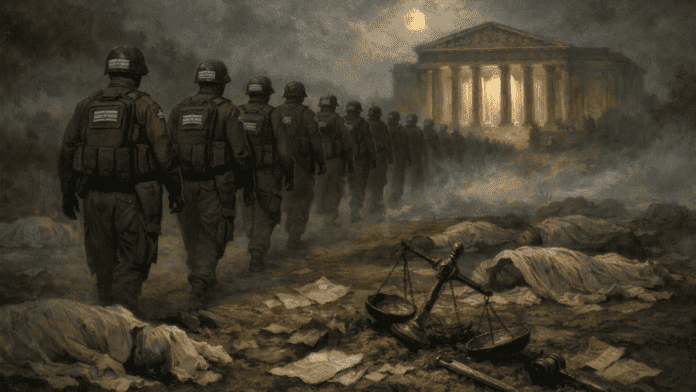
In January 2026, something remarkable happened. An Israeli military official told journalists that the Israeli army accepted that approximately 70,000 Palestinians had been killed in Gaza since October 2023. This was not a concession extracted under legal duress or political pressure. It was stated matter-of-factly, as though the number had become too large to contest. At that point, the war had been running for twenty-seven months.
Since then, the number has grown. And the war has spread.
Understanding what has happened — and what is continuing to happen — across Gaza, Lebanon, and now Iran requires something more than outrage and something more careful than silence. It requires holding the available evidence against the legal and moral standards that the international community has constructed, over decades, precisely for moments like this one.
What the Evidence Shows in Gaza
The scale of Palestinian death in Gaza is no longer a matter of serious dispute, even among those most invested in contesting it. A peer-reviewed, population-representative household survey published in The Lancet Global Health estimated that between 3 and 4 percent of Gaza’s entire pre-war population had been killed violently by early January 2025 alone. Independent statistical modelling by the Max Planck Institute for Demographic Research placed the total at over 78,000 by year-end 2024, with a subsequent update concluding that the true death toll likely now exceeds 100,000. The Gaza Health Ministry’s figures — long contested — have been deemed generally reliable by both US and Israeli intelligence assessments.
The demographic composition of the dead is as significant as the absolute number. An OHCHR study, verifying fatalities from three independent sources, found that 70 percent of Palestinians killed in residential buildings were women and children. Across the conflict as a whole, scholars estimate 80 percent of the dead were civilians. Gaza now holds the grim distinction of having the highest number of child amputees per capita anywhere in the world. Life expectancy in the territory, according to the Max Planck analysis, fell in 2024 to less than half the level that would have been expected without the war.
Beyond the dead, the Lancet researchers estimated 116,000 cumulative injuries as of April 2025, of which between 29,000 and 46,000 require complex reconstructive surgery. At pre-war surgical capacity — itself now destroyed — clearing that backlog would take approximately a decade. More than 224 humanitarian aid workers have been killed, including 179 UNRWA employees and 248 journalists. Hospitals have been raided. Operations have been performed without anaesthetic. The healthcare system has been, in the Lancet researchers’ own framing, “repeatedly decimated by attacks despite protection by international humanitarian law.”
These are not figures from a single contested source. They are the convergent findings of peer-reviewed studies, independent statistical modelling, UN verification, and now Israeli military acknowledgement.
What the Law Says
The 1948 Genocide Convention defines genocide as acts committed with intent to destroy, in whole or in part, a national, ethnic, racial or religious group. The acts listed include killing members of the group and deliberately inflicting conditions of life calculated to bring about physical destruction. Intent — dolus specialis in legal terminology — is the threshold question, and it is the hardest to prove.
It is not, however, impossible to establish through the public record. Israeli cabinet ministers have made statements that are now central to legal proceedings. Defence Minister Yoav Gallant declared in October 2023 that Israel was fighting “human animals” and announced a “complete siege” of Gaza — “no electricity, no food, no water, no fuel.” Finance Minister Bezalel Smotrich said in March 2023 that “there is no such thing as a Palestinian people.” These statements did not occur in a vacuum. They were made by senior officials of the state conducting the military campaign, and they have been cited in International Court of Justice proceedings initiated by South Africa under the Genocide Convention.
In January 2024, the ICJ found that at least some of the rights South Africa asserted under the Genocide Convention were plausible — including the right of Palestinians in Gaza to be protected from genocide — and issued six binding provisional measures accordingly. The court did not determine guilt; that finding awaits the merits stage. But the plausibility threshold, the prerequisite for provisional measures, was met. The court issued provisional measures ordering Israel to take all measures within its power to prevent acts within the scope of the Genocide Convention, to ensure humanitarian aid reached Gaza, and to preserve evidence of alleged violations. Those provisional measures remain in force. The Lancet researchers themselves concluded that their findings constituted “an urgent call for accountability and an immediate cessation of hostilities,” and that “the healthcare infrastructure in Gaza is being repeatedly decimated by attacks despite protection by international humanitarian law.”
The full merits case before the ICJ has not concluded. A legal verdict has not been delivered. What has been established — by the court, by independent researchers, and by the documented record of military conduct — is that the question of whether Israel has crossed the line drawn by the Genocide Convention is not an extreme or fringe position. It is a live legal question before the world’s highest court.
Lebanon: The Expansion of a Pattern
Gaza is not an isolated case. The conduct of Israel’s military in Lebanon, renewed with intensity since March 2, displays features that recur with troubling consistency.
When Hezbollah launched missiles at Israeli military bases on March 2 — citing both the killing of Iranian Supreme Leader Ali Khamenei and what it described as Israel’s ongoing violations of the November 2024 ceasefire — Israel’s response was swift and sweeping. Lebanon’s Health Ministry reported 394 people killed in the first week, including 83 children, 42 women, and nine rescue workers.
The specific incidents of that week are worth examining in detail, because detail is what distinguishes pattern from coincidence. An Israeli strike hit a hotel in Raouche — a popular Beirut tourist and residential district — killing four and wounding ten. The hotel was housing civilians displaced by fighting elsewhere in Lebanon. It was the second Israeli attack on a Beirut-area hotel in that same week; the first struck the predominantly Christian neighbourhood of Hazmieh. In the eastern Bekaa Valley, Israeli raids on the town of Nabi Chit killed 41 people and wounded 40. A strike on the nearby town of Shmistar killed six people including four children. Near Kfar Tebnit, two children and their parents were killed in a single family strike.
The Nabi Chit operation is particularly instructive. Four Israeli helicopters entered Lebanese airspace, with commandos reportedly wearing uniforms similar to the Lebanese army and using vehicles disguised as Lebanese military equipment. When confronted with the death toll, the IDF stated it was “not aware of any casualties.” Israel said the mission was a search for the remains of an airman missing since 1986. Tami Arad, the missing airman’s widow, publicly objected to the operation, stating that “the sanctity of life (of soldiers) takes priority over the commitment to bring back the remains of a soldier.”
Throughout this period, Israel’s military declared 26 rounds of strikes on Dahiyeh — Beirut’s southern suburbs — issued forced evacuation orders covering dozens of villages, and directed ground troops deeper into Lebanese territory. At least 30,000 people have been displaced. The Lebanese government — which has formally outlawed Hezbollah’s military activities, ordered the detention of IRGC personnel, and pulled its own army from border positions — has received no diplomatic protection from this campaign as a result. Compliance, in other words, offered no shelter.
Legal and Institutional Reckoning
The international legal and institutional response to these events has been significant, if insufficient. The ICJ’s provisional measures in the genocide case remain in force. Writing for the European Council on Foreign Relations, senior analyst Ellie Geranmayeh described the US-Israeli military campaign as “an illegal war of choice” — and argued Europeans had an obligation to say so publicly. Legal scholars at Just Security have raised fundamental questions about whether the strikes on Iran — and by extension the expanding campaign across the region — constitute violations of the UN Charter. France’s President Macron has called on Israel to refrain from a ground offensive in Lebanon. The UK’s House of Commons Library has noted the legal questions raised by British base usage in the Iran strikes.
None of this has produced a change in Israeli military conduct, nor in American political support for it. The United States has not applied meaningful diplomatic pressure at any stage across Gaza, Lebanon, or the Iran campaign. This is not a peripheral observation — it is central to the analysis. States generally moderate military conduct when they face real costs for excess. When an ally signals unconditional support regardless of conduct, the incentive structure for restraint disappears.
Researchers from Duke University, Guy’s and St. Thomas’ NHS Foundation Trust and al-Shifa Hospital, publishing in eClinicalMedicine, estimated that between 29,000 and 46,000 Gaza injuries require reconstructive surgery — a figure that could reach 68,000 by May 2026 if hostilities continue. “Without a significant increase in reconstructive capacity,” the authors wrote, “tens of thousands of patients will remain with surgically addressable disability.” That conclusion comes from peer-reviewed modelling built on attack data, geospatial mapping and population density estimates. It remains unheeded.
Standard Being Applied
There is a version of the argument that says Israel has the right to defend itself — which is true — and that the complexity of urban warfare produces civilian casualties — which is also true — and that Hezbollah and Hamas bear responsibility for embedding themselves among civilian populations — which is a legitimate and serious point that any honest analysis must acknowledge.
But that argument runs into the numbers. International humanitarian law does not prohibit civilian casualties in war. It prohibits disproportionate attacks — those where civilian harm is excessive relative to the anticipated military advantage. It prohibits targeting civilians directly. It prohibits the destruction of objects indispensable to civilian survival. The question that the evidence forces is whether these prohibitions have been respected when 80 percent of Gaza’s dead are civilians, when hotels housing displaced families are struck twice in a week, when a family of four is killed in a village strike, when 83 children are among 394 Lebanese killed in seven days.
The International Committee of the Red Cross, which does not issue political statements lightly, has repeatedly flagged serious IHL concerns throughout the Gaza campaign. The UN’s own verification mechanisms have documented systematic patterns. The convergence of independent scientific evidence, legal proceedings, and the documented record of specific incidents — each verifiable, each sourced — constitutes a body of evidence that demands, at minimum, serious institutional accountability.
That accountability has not come. What has come instead is an expanding war.
DiploPolis covers international affairs, diplomacy, and geopolitical analysis with an independent editorial voice. Follow The DiploPolis Dispatch on Substack for weekly insights.