
When Indonesia formally joined BRICS in July 2025, it marked more than an expansion of an economic bloc—it announced the arrival of a genuinely multipolar world. Just days after the Rio summit concluded, five Central Asian presidents traveled to Washington for an unprecedented November meeting with President Donald Trump, courted by both Beijing and Washington for their critical mineral reserves. These simultaneous diplomatic maneuvers capture the essence of multipolarity in 2025: no single power dictates outcomes, middle powers navigate competing offers, and the world’s diplomatic architecture is being fundamentally rewritten.
The Munich Security Report 2025 identifies “multipolarization” as the defining trend of contemporary international relations. This represents both a redistribution of power toward a larger number of actors and increasing polarization between and within states. The result is a diplomatic landscape where negotiated settlements replace unilateral impositions, where middle powers exercise strategic autonomy rather than choosing exclusive alignments, and where parallel institutions challenge—rather than simply reform—Western-dominated global governance structures.
For diplomacy practitioners, the implications are profound: the rules of engagement are changing, the diplomatic toolkit is expanding, and the skills required to navigate this new order differ dramatically from those that sufficed during the unipolar moment.
Global South: From Reactive to Architectonic
The most consequential shift in the international order is the transformation of the Global South from passive recipient to active architect of global governance. This is not merely about rising economies gaining voice within existing institutions—it represents the construction of parallel frameworks that operate according to different principles and serve different constituencies.
The 17th BRICS Summit in Rio de Janeiro crystallized this transition. Indonesia’s admission as the 11th full member, alongside the designation of 10 new partner countries, expanded BRICS’ reach across Southeast Asia, Latin America, Africa, and Central Asia. The bloc now accounts for approximately 40-45% of global GDP when measured by purchasing power parity, surpassing the G7’s roughly 28%. More importantly, BRICS issued the Rio de Janeiro Declaration outlining 126 specific commitments across climate finance, artificial intelligence governance, and health partnerships, with each functioning as an alternative to Western-dominated institutional frameworks.
This institutional proliferation matters because it provides options. When the BRICS New Development Bank finances infrastructure projects or when the Asian Infrastructure Investment Bank provides development capital, recipient countries gain leverage in negotiations with traditional lenders like the World Bank. The mere existence of alternatives shifts diplomatic dynamics, even when countries continue engaging with legacy institutions.
Brazil’s emphasis during its 2025 BRICS presidency on “strengthening Global South cooperation for more inclusive and sustainable governance” signals a coherent strategy. These nations aren’t simply demanding reform of institutions designed in 1945; they’re building new ones designed for 2025’s geopolitical realities. The African Continental Free Trade Area, the Regional Comprehensive Economic Partnership in Asia, and expanding South-South trade networks reflect this architectural ambition.
Critically, economic interdependence among Global South nations is accelerating faster than their trade with developed economies. This creates positive feedback loops: as intra-BRICS trade grows, so does the logic for common payment systems, coordinated industrial policies, and shared infrastructure investments. The transition from reactive to architectonic represents the most significant structural challenge to Western-led international order since its post-1945 establishment.
Strategic Autonomy: The New Diplomatic Doctrine
If institutional proliferation provides the architecture for multipolarity, strategic autonomy provides its operating system. Strategic autonomy—the practice of maintaining partnerships with multiple powers rather than choosing exclusive sides—has become the defining diplomatic strategy of middle powers navigating great power rivalry.
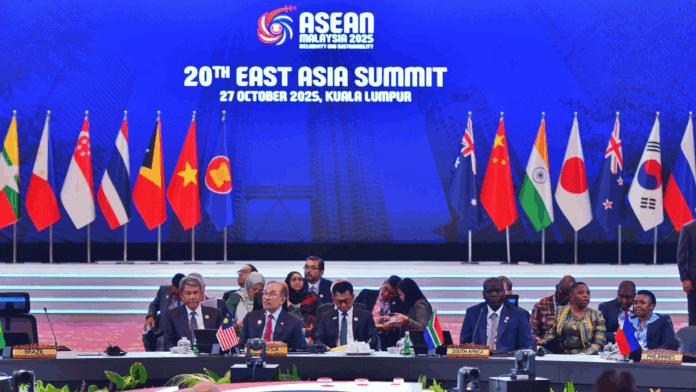
Nowhere is this more developed than in Southeast Asia. Through ASEAN-centric multilateralism, countries like Indonesia, Malaysia, and Thailand have constructed what scholars call an “omni-enmeshment” architecture: a web of institutions and forums—from the ASEAN Regional Forum to the East Asia Summit—that bind all major powers as dialogue partners. The logic is preventive: by enmeshing both Washington and Beijing in overlapping networks of cooperation, ASEAN makes it costly for either power to pursue zero-sum competition in the region.
The Central Asian states’ November 2025 Washington summit exemplifies this strategy’s maturation. Kazakhstan, Uzbekistan, Kyrgyzstan, Tajikistan, and Turkmenistan—traditionally within Russia’s sphere and increasingly courted by China—engaged Trump administration officials on critical minerals cooperation while maintaining their partnerships with Beijing and Moscow. As Kazakhstan’s President Tokayev emphasized, his country “maintains good relations with each of the major powers and believes countries should not have to choose sides.”
India provides another instructive case. New Delhi has deepened security cooperation with Washington through the Quad while simultaneously expanding economic engagement with Russia and maintaining dialogue channels with China despite border tensions. Saudi Arabia balances U.S. security guarantees with Chinese economic partnerships and BRICS membership. This isn’t fence-sitting—it’s sophisticated statecraft that maximizes options and minimizes vulnerability to coercion.
The ASEAN model’s most striking success is crisis prevention. Regional forums provided channels for managing India-Pakistan tensions, prevented escalation of territorial disputes, and offered venues for dialogue even when bilateral relations between major powers deteriorated. This preventive diplomacy represents multipolarity’s understated dividend: more mediators, more channels, more circuit breakers before conflicts spiral.
However, strategic autonomy has inherent limitations. When great powers demand exclusive alignment—as increasingly occurs around technology standards, supply chains, and security partnerships—middle powers face genuinely difficult choices. The formation of competing blocs in critical sectors like semiconductors, rare earth processing, and advanced manufacturing compresses the space for omni-enmeshment. Strategic autonomy works best when great powers value access more than exclusivity; as competition intensifies, that calculus may shift.
Institutional Transformation: Parallel Systems, Not Just Reform
The architecture of global governance is fragmenting, not collapsing. Understanding this distinction is crucial for diplomacy practitioners navigating the 2025 landscape.
Legacy institutions—the UN Security Council, IMF, World Bank, WTO—remain operational but increasingly struggle to reflect contemporary power distributions. The Security Council’s permanent membership and veto structure, designed for 1945’s victors, cannot accommodate 2025’s economic giants. India, with the world’s largest population and third-largest economy (by PPP), lacks permanent membership. African nations, representing 18% of global population, have no permanent representation despite the African Union’s G20 admission in 2023.
Reform efforts consistently founder on a fundamental problem: existing veto holders must approve changes that dilute their power. This makes comprehensive Security Council reform virtually impossible without a crisis forcing consensus—a crisis that, by definition, would come too late to prevent whatever catastrophe prompted it.
Global South actors have drawn logical conclusions: build parallel institutions rather than await permission to reform existing ones. The BRICS expansion in 2025 exemplifies this strategy. Rather than campaigning for IMF voting reforms (which require 85% approval, giving the U.S. effective veto), BRICS created the New Development Bank with different voting structures and lending criteria. Rather than waiting for World Bank governance changes, the Asian Infrastructure Investment Bank provides alternative development financing.
This creates a bifurcated system: legacy institutions with universal membership but contested legitimacy, and newer institutions with focused memberships but growing capacity. The result is not the death of multilateralism but its fragmentation into issue-specific coalitions rather than universal frameworks.
The implications for diplomatic practice are significant. Coordination across multiple institutions becomes more complex. Forum-shopping—selecting venues most favorable to one’s interests—becomes standard practice. The multiplication of institutions creates transaction costs but also opportunities: states can play institutions against each other to achieve better outcomes, and the system becomes more resilient through redundancy.
The Munich Security Report 2025 warns that this fragmentation makes collective action on global challenges more difficult. Climate diplomacy, pandemic response, and financial stability all require coordination across the global economy. When institutions fracture along geopolitical lines, such coordination becomes hostage to great power politics. The optimistic scenario sees competitive pluralism where multiple institutions experiment with different approaches; the pessimistic scenario sees paralysis where no institution can achieve sufficient buy-in.
Diplomatic Mechanisms in Flux
Multipolarity fundamentally alters how diplomacy operates. The shift from unilateral imposition to negotiated outcomes changes diplomatic calculations, required skills, and likely timelines.
Consider the evolution of mediation in contemporary conflicts. Gaza negotiations in 2024-2025 involved Qatar, Turkey, Egypt, and Saudi Arabia, each with different relationships to the parties and different leverage points. No single mediator possessed sufficient influence to impose terms; coordination among mediators became essential. This pattern recurs across conflict zones, with multiple parties claiming mediation roles, each bringing partial influence, requiring unprecedented coordination among the mediators themselves.
Preventive diplomacy has gained new urgency in this environment. When power is concentrated, the hegemon can deter or intervene to contain escalation. When power is diffuse, prevention becomes essential because no single actor possesses the capacity to manage spiraling conflicts. ASEAN’s role in managing regional tensions, Kazakhstan’s Astana International Forum creating dialogue spaces, and the proliferation of track-two diplomacy channels globally all reflect this imperative. The system’s stability increasingly depends on preventing crises rather than managing them after eruption.
Economic statecraft has largely replaced military coercion as the primary tool of influence. The Central Asian mineral diplomacy exemplifies this shift in multipolarity’s diplomatic currency. Rather than coercing alignment, great powers compete to offer attractive economic partnerships. The U.S. signed $12.4 billion in trade deals with Central Asian states in Trump’s first six months of 2025. China simultaneously offers Belt and Road connectivity. Russia provides energy partnerships. Central Asian states extract maximum value by playing suitors against each other, a dynamic that would be impossible in a unipolar system where the hegemon could credibly threaten punishment for hedging.
Regional forums have increasingly supplanted global structures as venues for substantive problem-solving. The Munich Security Report identifies a widespread preference for bilateral deals rather than inclusive multilateral cooperation. This reflects practical realities: achieving consensus among 193 UN members is exponentially harder than coordinating among ASEAN’s 10 or BRICS’ 11. Regional frameworks become the primary venues for actual problem-solving, while global institutions increasingly serve ceremonial functions or become paralyzed by great power disagreements.
Transactional diplomacy has risen correspondingly as principle-based approaches founder. Principle-based diplomacy assumes shared values and rule-based frameworks. Transactional diplomacy treats each interaction as a discrete negotiation based on interests. Trump’s approach to international relations epitomizes this shift, but it extends beyond any single leader. When powers disagree on fundamental values regarding human rights, sovereignty, and legitimate governance, transactions become the only available foundation for cooperation. This doesn’t make cooperation impossible, but it makes it narrower and more contingent.
This diplomatic evolution creates both opportunities and risks. More mediators mean more opportunities for breakthrough but also more complexity in coordination. More forums mean more venues for progress but also more chances for contradictory outcomes. Economic competition for partnerships means better deals for middle powers but also risks of debt traps and asymmetric dependencies. The art of contemporary diplomacy lies in navigating these trade-offs without the simplified decision frameworks that unipolarity or bipolarity once provided.
Intellectual Crisis: Order Without Consensus
Perhaps multipolarity’s most profound challenge is intellectual rather than material: the erosion of consensus on what constitutes legitimate international behavior.
The post-1945 liberal international order rested on proclaimed universal principles: sovereign equality, self-determination, human rights, rule of law, and peaceful resolution of disputes. Implementation was always contested and often hypocritical, but the principles provided reference points for diplomatic engagement and accountability mechanisms.
Multipolarity’s rise coincides with—and partly drives—this normative consensus’s breakdown. China advances “socialism with Chinese characteristics” and rejects universal human rights in favor of culturally contextual governance. Russia champions “civilizational diversity” and traditional values against Western liberalism. Many Global South states, having experienced colonial domination and contemporary interventions justified by liberal principles, exhibit profound skepticism toward Western normative claims.
This creates what some observers call “multipolarism of fools”—a situation where both right-wing authoritarians and left-wing anti-imperialists oppose liberalism but for incompatible reasons, creating strange bedfellow coalitions that lack positive visions for alternatives. The result is more effective at delegitimizing existing order than constructing replacement frameworks.
For diplomatic practice, this normative fragmentation produces several consequences. Norm entrepreneurship becomes contentious terrain. When Western powers promote democracy or human rights, Global South states increasingly respond by highlighting historical hypocrisy or asserting alternative values like non-interference and developmental sovereignty. This doesn’t necessarily reflect rejection of human rights in principle but rather resistance to selective Western enforcement.
Transactional logic fills the normative vacuum left by eroding shared values. Without consensus on fundamental principles, diplomacy defaults to interest-based bargaining. This can produce functional cooperation on specific issues even among states with incompatible worldviews, but it struggles with systemic challenges requiring principled commitments that transcend immediate interests.
Rule-making itself becomes competitive rather than cooperative. Rather than a single rule-based order, multiple powers advance competing frameworks embedding different assumptions about legitimate behavior. China promotes Belt and Road’s connectivity vision. The United States advances its Indo-Pacific strategy. Europe pursues strategic autonomy. Each framework carries implicit and explicit rules about appropriate governance, economic relations, and security arrangements.
The Munich Security Report warns that “multipolarity may well move us away from an order that does have standards, even if they are sometimes implemented inconsistently, and towards an order without any standards at all.” This risk is real but not inevitable. An alternative outcome sees multiple regional orders with different but overlapping standards, requiring sophisticated translation and coordination but avoiding the extremes of either hegemonic imposition or anarchic fragmentation. The next five years will reveal which trajectory prevails.
Conflict Dynamics: The Instability Risk
Historical observation provides sobering context: multipolar systems tend toward instability. The pre-1914 Concert of Europe and the interwar period both collapsed into catastrophic conflict. While contemporary nuclear deterrence and economic interdependence may provide stabilizers absent in earlier eras, multipolarity’s structural characteristics increase miscalculation risks.
The possibility of multiple simultaneous conflicts becomes more acute in multipolar systems. Ukraine, Gaza, and potential Taiwan scenarios could escalate concurrently rather than sequentially. No single power possesses the resources or attention span to manage all simultaneously, increasing the likelihood that at least one spirals beyond control while international attention focuses elsewhere.
Shifting alliances create dangerous uncertainty about deterrence. When alignments remain stable, states can predict others’ behavior and calibrate responses accordingly. When alliances shift—as strategic autonomy encourages—deterrence becomes uncertain. If actors cannot reliably predict who will support whom in contingencies, they may miscalculate the costs of action. This uncertainty pervades contemporary calculations: Will India support the United States in a Taiwan conflict? Would Saudi Arabia remain neutral in an Iran-Israel war? How would ASEAN respond to South China Sea confrontation? These ambiguities can encourage aggressive gambits by actors convinced others will remain neutral.
Arms racing accelerates as multiple powers compete for influence without clear hierarchies. The Munich Security Report documents rising global military expenditures driven by multipolar competition. As powers compete for influence, military buildups provide both capability demonstration and hedging against uncertainty. This creates action-reaction spirals where each power’s defensive measures appear threatening to others, generating security dilemmas that drive further buildup.
Multipolarity is structural, not cyclical. The diffusion of power toward multiple centers reflects differential growth rates and institutional innovation, representing fundamental rather than temporary change in the international system.
Preventive war temptations increase during power transitions. When power shifts occur gradually, declining powers face temptations to use force while still advantageous rather than accepting inevitable decline. China’s rise relative to the United States, India’s rise relative to China, and various regional power competitions create multiple potential Thucydides Traps where dominant powers might strike preemptively against rising challengers.
These risks explain why preventive diplomacy gains such importance in multipolar systems. The ASEAN model of omni-enmeshment explicitly aims to prevent precisely these escalation dynamics by maintaining dense networks of cooperation that make conflict more costly. Similarly, middle powers’ strategic autonomy serves partly as circuit breakers—by refusing to choose sides definitively, they prevent bipolar bloc formation that would increase conflict likelihood.
However, these preventive mechanisms work only if great powers value them. If Washington or Beijing decides that securing exclusive alignments outweighs benefits of preserving middle powers’ autonomy, the system’s stabilizers erode rapidly. The 2025-2030 window will reveal whether the preventive architecture proves robust or whether great power competition overwhelms it.
2025-2030: The Critical Window
The next five years will determine whether multipolarity evolves toward cooperative pluralism or competitive fragmentation. Several key metrics warrant close attention.
UN Security Council reform efforts will signal the system’s capacity for institutional adaptation. If the 2025 Summit of the Future produces meaningful progress toward expanding permanent membership or reforming veto powers, it would demonstrate that legacy institutions can evolve to reflect contemporary realities. Continued deadlock would cement parallel institution building as the primary Global South strategy, accelerating the fragmentation of global governance.
Trade architecture developments will reveal whether economic multipolarity produces efficiency gains or coordination losses. The proliferation of regional trade agreements while global frameworks stagnate, the potential traction of alternative payment systems like BRICS Pay platform, and the balance between integration and fragmentation in commercial relations will all shape economic interdependence patterns. These patterns, in turn, determine whether economic ties can constrain security competition or whether geopolitics will trump commerce.
Strategic autonomy’s sustainability faces genuine tests as great power competition intensifies. Can middle powers maintain multi-alignment when pressured to choose sides, or will they face forced alignments? India’s navigation between U.S., Russia, and China partnerships, ASEAN’s preservation of centrality amid competing great power demands, and Central Asian balancing between Washington, Beijing, and Moscow all test whether autonomy remains viable or proves ephemeral when great powers demand exclusivity.
Technology governance coordination presents perhaps the most challenging test. AI regulation, data governance, cyber norms, and critical technology supply chains all require coordination across incompatible political systems. Success would demonstrate functional cooperation despite value differences and provide templates for managing other domains. Failure would portend dangerous fragmentation in domains where technological interdependence makes isolation impossible and conflict potentially catastrophic.
Strategic autonomy replaces alignment as the dominant diplomatic strategy. Middle powers increasingly refuse binary choices, instead cultivating partnerships across competing poles through “omni-enmeshment” strategies that make exclusive alignment costly for all parties.
Climate diplomacy effectiveness constitutes the ultimate test of multipolar cooperation capacity. An existential shared threat that requires coordinated action across the fragmented institutional landscape would validate multipolarity’s cooperative potential. If states cannot coordinate on climate despite overwhelming incentives, it would validate pessimists’ warnings about collective action problems in diffuse power systems. Climate negotiations over the 2025-2030 period will thus serve as bellwether for whether multipolarity can produce functional cooperation on civilizational challenges.
Middle powers hold crucial influence over these trajectories. Their willingness to serve as bridges between competing powers, their insistence on inclusive rather than exclusive frameworks, and their capacity to moderate great power rivalries through forum-building and mediation may determine whether multipolarity stabilizes or destabilizes. The BRICS expansion and proliferation of regional mechanisms suggest these actors recognize their importance and are building capacity to exercise it. Whether this capacity proves sufficient to the challenge remains the central question of contemporary international relations.
Conclusion: Diplomatic Skills for a Multipolar Era
Multipolarity represents structural transformation, not temporary disruption. The concentration of power that characterized 1945-1990 (bipolar) and 1990-2010 (unipolar) eras was historically anomalous. The current diffusion toward multiple power centers reflects longer historical patterns, now accelerated by differential growth rates, technological diffusion, and institutional innovation.
Parallel institutions, not just reform efforts, define the new governance landscape. Global South actors build alternative frameworks through BRICS institutions and regional arrangements rather than waiting to reform Western-dominated legacy systems, creating competitive pluralism in global governance that changes negotiating dynamics across all institutions.
For diplomacy practitioners, this demands new mindsets and capabilities. The first imperative is embracing complexity over simplicity. Cold War binary logic or unipolarity’s hierarchical order provided clear decision frameworks. Multipolarity requires navigating multiple relationships simultaneously, managing contradictions, and accepting ambiguity as permanent features of the system rather than temporary confusion.
Mastering transactional engagement while maintaining principled relationships presents the second challenge. When values diverge but cooperation remains necessary, diplomats must negotiate specific arrangements without sacrificing long-term relational capital. This balance—conducting transactions without descending into pure cynicism, maintaining principles without rigid inflexibility—defines effective multipolar diplomacy.
Building redundant networks becomes essential for resilience. Single-point dependencies create vulnerabilities in multipolar systems where any relationship can deteriorate rapidly. Smart states cultivate partnerships across multiple poles, develop alternative options for critical needs, and participate in overlapping institutions that provide fallback options when primary channels fail.
Investing in preventive capacities gains urgency as crisis management becomes more difficult. Waiting for crises to escalate before engaging ensures they spiral beyond any single actor’s control. Early warning systems, conflict prevention mechanisms, and maintained dialogue channels—even with adversaries—become essential infrastructure rather than optional luxuries.
Thinking regionally while acting globally provides the final strategic orientation. While global institutions struggle with paralysis, regional frameworks remain functional venues for problem-solving. Effective states anchor themselves in regional architectures while maintaining global connections, using regional solidarity as leverage in broader negotiations while ensuring regional concerns get heard in global forums.
The world of 2030 will feature more poles, more institutions, and more competing frameworks than today. Whether this produces creative pluralism or dangerous fragmentation depends on choices made in the next five years. The alternative to multipolar order is not renewed unipolarity—that ship has sailed with China’s rise and the Global South’s institutional innovations. The alternative is multipolar disorder, where power diffusion produces chaos through unconstrained competition rather than stability through mutual restraint.
The task for contemporary diplomacy is ensuring that multiple power centers produce system stability. This requires great powers accepting constraints on their ambitions, middle powers exercising their moderating influence effectively, and all actors recognizing that in genuinely multipolar systems, no one gets everything they want but everyone can prevent outcomes they find intolerable.
Indonesia’s BRICS accession, Central Asian mineral diplomacy, ASEAN’s institutional innovations, and proliferating South-South cooperation mechanisms all point toward a world where no single power writes the rules but where rules nevertheless exist—negotiated, contested, and constantly renegotiated. This is the diplomatic reality of 2025: messier than unipolarity, more complex than bipolarity, and demanding skills we are only beginning to develop. The question is whether we develop them fast enough.