
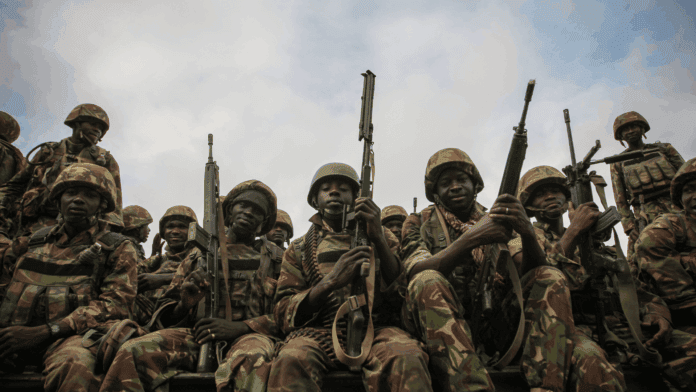
The fall of al-Fashir on October 26, 2025, marked far more than a tactical victory for Sudan’s Rapid Support Forces. After 18 months of brutal siege that starved a city and displaced hundreds of thousands, the RSF’s seizure of North Darfur’s capital completed its domination of the entire Darfur region. What followed was predictable horror—mass executions along earthen berms, hospital massacres documented by satellite imagery showing blood-stained streets, and ethnic cleansing that human rights investigators compare to Rwanda’s darkest days. Yet the strategic implications extend beyond atrocity. Al-Fashir’s capture represents an inflection point where Sudan’s civil war transitions from a contest for national control into something more permanent: de facto partition along an east-west axis that mirrors Libya’s decade-long fragmentation.
The territorial reality is stark. The RSF now governs all of Darfur plus significant portions of Kordofan, connecting to supply corridors through Chad and Libya. The Sudanese Armed Forces, meanwhile, retain the Nile valley, the Red Sea coast, and Port Sudan—the rump state’s provisional capital. Between them lies not a fluid frontline but increasingly hardened boundaries reinforced by parallel governments, separate economic systems, and irreconcilable visions for Sudan’s future. The question is no longer whether partition will occur, but what form it takes and what consequences it unleashes across a region already destabilized by conflicts in Yemen, Libya, and the Sahel.
Military Stalemate That Enables Division
Sudan’s war began in April 2023 when the SAF and RSF—former partners in military rule—turned guns on each other in a power struggle over planned democratic transition. The RSF, an outgrowth of the Janjaweed militias responsible for Darfur’s genocide two decades ago, initially swept across western Sudan. The SAF responded with an offensive that recaptured Khartoum in March 2025, marking a critical territorial shift. Yet neither side possesses the capacity for decisive victory.
The SAF controls population centers along the Nile, holds Port Sudan’s strategic access to the Red Sea, and maintains formal recognition in international forums. Turkey has supplied Bayraktar drones that proved instrumental in urban operations, while Iran provides weapons systems and apparent logistical support through Port Sudan. The military’s alliance with Islamist factions, including remnants of al-Bashir’s National Congress Party, gives it ideological cohesion but limits its appeal in secular-leaning regions.
The RSF compensates for weaker conventional forces with mobility, tribal alliances, and external patronage. Its control of Darfur secures gold-mining operations worth an estimated $860 million annually, funding weapons purchases and militia recruitment. The UAE’s backing—though officially denied—appears confirmed through flight-tracking data showing cargo movements to Chad, Bulgarian-made mortars traced to RSF units, and gold flows to Dubai refineries. General Mohamed Hamdan Dagalo (Hemedti) also maintains ties to Khalifa Haftar in eastern Libya, opening another supply corridor.
This military equilibrium creates conditions for partition. Neither force can conquer the other’s core territories; neither faces domestic pressure strong enough to force compromise. The RSF’s parallel government, announced in August 2025 with Hemedti as presidential council head and SPLM-N leader Abdelaziz al-Hilu as deputy, formalizes what existed informally. The SAF’s amendment of Sudan’s transitional constitution to remove all RSF references signals reciprocal rejection. As Crisis Group analyst Alan Boswell notes, “The RSF aims to be legitimate as a national actor. Yet [this government] makes de facto partition all the more likely, even if that is not the strategic intent.”
Libyan Template: Rival Governments and Frozen Conflict
Sudan’s trajectory increasingly resembles Libya’s post-2011 collapse. After Gaddafi’s fall, Libya fragmented between a UN-recognized government in Tripoli and Haftar’s Libyan National Army in Benghazi—a division sustained by external patrons, oil revenues, and military stalemate. A decade later, Libya remains partitioned despite periodic unification efforts.
Sudan’s partition differs in scale and complexity but follows similar logic. Like Libya’s oil, Sudan’s gold finances parallel war economies independent of central authority. The UAE imported 29 tonnes of gold directly from Sudan in 2024, with major volumes routed through Egypt (27 tonnes), Chad (18), and Libya (9), according to UN trade data. An estimated 90 percent of Sudanese gold bypasses official channels—a smuggling network that both SAF and RSF exploit through different routes. Gold from SAF-controlled areas flows to Egypt and Ethiopia; RSF gold moves through Chad, Libya, South Sudan, and the Central African Republic before reaching Dubai.
Like Libya’s competing central banks, Sudan now hosts rival administrative structures. The SAF’s “Hope Government” in Port Sudan issues currency, manages what remains of state infrastructure, and collects customs revenues at Red Sea ports. The RSF’s “Government of Peace and Unity” based in Nyala distributes governance posts to allied militias and attempts to provide basic services in Darfur—though evidence suggests rudimentary capacity at best. Neither government enjoys broad legitimacy or provides effective governance, but both possess sufficient resources to sustain themselves indefinitely.
The international response mirrors Libya’s trajectory toward frozen conflict. The African Union warned that parallel governments risk “severing the country” and urged states not to recognize either administration. Yet practical engagement already occurs. The SAF maintains Sudan’s UN seat and diplomatic presence; the RSF conducts negotiations through Kenya despite Khartoum’s protests. External actors prioritize access and influence over reunification—the UAE backs the RSF for gold and Red Sea position; Egypt supports the SAF to preserve Nile valley stability; Saudi Arabia hedges between both.
The U.S.-led “Quad” mediation effort involving Egypt, Saudi Arabia, and the UAE proposed a three-month humanitarian truce leading to permanent ceasefire and nine-month transition to civilian rule. The initiative collapsed when the RSF launched its final assault on al-Fashir days after an October 2025 Quad meeting in Washington. Peace talks have become forums for tactical advantage rather than genuine negotiation—a pattern Libya knows well.
Regional Security Implications: From Red Sea to Sahel
Sudan’s partition carries consequences that ripple outward through three overlapping spheres: the Red Sea corridor, the Sahel belt, and East Africa’s unstable core.
Red Sea Maritime Security
Port Sudan’s strategic location on the Red Sea—controlling access to a waterway carrying 12-15 percent of global trade—makes partition particularly consequential. Russia’s rumored naval logistics facility at Port Sudan would give Moscow a foothold near Bab el-Mandeb strait, enabling forward deployment for vessels operating between the Mediterranean and Indian Ocean. China already maintains a base in Djibouti; Russia in Port Sudan completes a strategic encirclement that concerns Western naval planners.
The SAF’s apparent collaboration with Yemen’s Houthis introduces additional instability. Reports indicate Houthi drone strikes on vessels near Yanbu were launched from Sudanese territory, possibly using Port Sudan’s facilities as staging areas. Iran facilitates this alliance, supplying the SAF with Mohajer-6 and Ababil drones while enabling Houthi access to SAF-controlled infrastructure. Sudan’s Red Sea coast, once envisioned as a commercial corridor connecting Africa to Gulf markets, now threatens to become a weapons hub extending Yemen’s maritime disruption northward.
For regional states, the implications are severe. Egypt views an RSF-dominated west as a strategic threat to the Nile valley and potential staging ground for extremist infiltration. Saudi Arabia fears Emirati port facilities in RSF territory could challenge its maritime dominance. The UAE itself invested $6 billion in the proposed Abu Amama port complex—now vulnerable if territories change hands. Every actor has reason to prevent further escalation, yet none possesses leverage to enforce resolution.
Sahel Contagion and Trans-Saharan Networks
The RSF’s Darfur stronghold connects directly to the Sahel’s arc of instability stretching from Lake Chad to the Atlantic. Darfur borders Chad, Libya, Central African Republic—all experiencing their own conflicts and governance crises. The RSF’s supply routes through Chad and Libya create trans-border networks that facilitate not just arms and gold but also extremist movement, human trafficking, and narcotics smuggling.
Chad faces particular pressure. Hundreds of thousands of Sudanese refugees strain Chad’s limited resources, while UAE-funded facilities at Amdjarass near the border allegedly serve as RSF logistics hubs and gold export nodes. Chad’s President Mahamat Déby must balance maintaining stability with managing relations between Sudan’s warring parties. Libya’s Haftar, aligned with both the RSF and UAE, provides additional complications—his control of southern Libya’s border region enables weapons flows and offers the RSF sanctuary if needed.
Further west, militant groups operating in the Sahel could exploit Sudan’s instability to extend operational reach. Al-Qaeda affiliates and Islamic State franchises already contest territory from Mali to Burkina Faso. A fragmented Sudan with porous borders and weak governance offers new transit routes, recruitment grounds, and revenue sources through illicit networks. The SAF’s reliance on Islamist militias risks empowering exactly the extremist factions regional security frameworks aim to contain.
East African Destabilization
South Sudan’s economic crisis illustrates partition’s cascading effects. Approximately 75 percent of South Sudan’s oil exports flow through Sudanese pipelines to Port Sudan—a lifeline Sudan’s war severed. Juba’s government, already fragile from its own civil conflict, faces fiscal collapse without oil revenues. South Sudan has tried maintaining relations with both SAF and RSF to negotiate pipeline reopening, but lacks leverage to broker agreement. The humanitarian spillover compounds Juba’s crisis—Sudanese refugees cross into a country that can barely support its own population.
Ethiopia confronts similar dilemmas. Its internal Tigray conflict and tensions with Egypt over Nile waters make Sudanese stability vital. An RSF-dominated west allied with the UAE potentially shifts regional power dynamics; an SAF-dominated east backed by Egypt and Islamist factions threatens different complications. Ethiopia’s own fragility leaves little capacity to manage Sudanese spillover.
The pattern is clear: Sudan’s partition does not create isolated zones of control but rather interconnected instability that resonates across borders. Every neighbor faces refugee flows, economic disruption, security threats, and pressure to choose sides in a conflict where all options carry costs.
Governance, Finance, and Border Control: Scenarios for a Divided Sudan
Three scenarios describe possible outcomes over the next 2-5 years, each with distinct governance structures, financial systems, and border arrangements:
Formalized Partition
This scenario sees international recognition of separate states—an RSF-dominated western entity encompassing Darfur and parts of Kordofan, and an SAF-controlled eastern state along the Nile and Red Sea. Formal partition would require negotiating borders, dividing assets and debts, establishing citizenship rules, and settling questions about oil infrastructure, Nile water rights, and international treaty obligations.
Governance would likely remain weak in both entities. The RSF’s capacity for state-building appears minimal; its administration relies on militia structures rather than bureaucratic institutions. The SAF’s rump state would retain more governmental infrastructure but remain compromised by Islamist influence and military dominance. Neither state would achieve democratic governance in the medium term.
Financially, both entities would depend on resource extraction—gold for the RSF, whatever oil production remains for the SAF plus Red Sea port revenues. International financial institutions would face difficult decisions about debt allocation and lending eligibility. The IMF and World Bank have suspended assistance to Sudan since the 2021 coup; partition would complicate resumption of support.
Border control would prove challenging. The RSF-SAF boundary would likely remain militarized and contested, particularly around resource-rich areas and transport corridors. International borders with Chad, Libya, South Sudan, and others would remain porous, enabling continued smuggling and militant movement.
Frozen Conflict and De Facto Partition
This more likely scenario maintains formal fiction of a united Sudan while accepting practical division. No international recognition of separate states occurs, but both RSF and SAF administer distinct territories with minimal interaction. Periodic clashes occur along contested boundaries without decisive territorial shifts.
Governance remains bifurcated and weak. Both sides issue identity documents, collect taxes in controlled areas, and provide minimal services. No single administration governs effectively; corruption and militia rule predominate. Civilians suffer under dual extraction systems—taxed by whichever force controls their location while receiving little benefit.
Financial systems operate independently but inefficiently. Parallel currencies might emerge, though both would likely suffer inflation. International sanctions complicate formal banking; informal networks dominate transactions. Gold smuggling continues as the RSF’s primary revenue source; Port Sudan customs and remnant oil production sustain the SAF. Neither side accesses significant international development financing.
Border controls remain dysfunctional. The internal boundary between RSF and SAF zones features checkpoints, smuggling routes, and intermittent violence. International borders suffer from state weakness—neither RSF nor SAF can effectively police their territories. Humanitarian access depends on negotiating with multiple armed actors.
Renewed War and Further Fragmentation
The least likely but most destabilizing scenario sees intensified fighting that fragments Sudan beyond the east-west split. Additional armed groups—the SPLM-N in South Kordofan and Blue Nile, various Darfuri factions, eastern tribes, northern movements—carve out autonomous zones. External interventions escalate; regional conflicts merge as Chad, Egypt, Ethiopia, and others back different proxies.
Governance collapses into warlordism. No central authority exists even nominally; territorial control shifts based on militia strength and external patronage. Somalia-style fragmentation emerges—patchwork of armed fiefdoms with no coherent state structure.
Financial systems devolve to local resource extraction and protection rackets. No formal economy operates; black markets and smuggling networks dominate. International aid organizations withdraw due to insecurity, leaving populations dependent on whatever local strongmen provide.
Borders become meaningless as state collapse eliminates capacity for control. Refugee flows accelerate; militant groups operate across national boundaries freely; transnational smuggling networks expand. Regional security deteriorates as instability spreads.
Role of Gold, Customs, and Smuggling Routes
Understanding Sudan’s partition requires examining the illicit economies that sustain it. Gold operates as the primary currency of war, with production estimated between 65-90 tonnes annually depending on source. The official figure—64 tonnes in 2024 according to state-owned Sudan Mineral Resources Company—undercounts reality by excluding RSF-controlled mines and informal production.
The RSF’s Al-Junaid Multi Activities Company, controlled by Hemedti’s family and sanctioned by the U.S. and EU, operates major mines at Songo in South Darfur and Jebel Amer in North Darfur. Former engineers estimate Al-Junaid’s wartime earnings at minimum $1 billion annually. This gold flows through Chad—where UAE-funded facilities at Amdjarass serve as collection points—then onward to Dubai. Chatham House research documents how much of North Darfur’s gold is smuggled to Chad for UAE transportation.
SAF-controlled gold moves through different channels. Northern mines near the Egyptian border supply gold that crosses into Egypt, where it enters global markets through less scrutinized channels. The SAF also maintains formal export relationships—90 percent of legal gold exports go to the UAE, according to government advisors, though Qatar and Turkey represent emerging alternatives.
Both sides exploit customs revenues where possible. Port Sudan’s position as Sudan’s only functional seaport gives the SAF monopoly over import duties, fees for South Sudanese oil transit, and charges for humanitarian cargo. The RSF, controlling interior routes, taxes overland trade from Chad, Libya, and Central African Republic. Neither system functions efficiently; corruption siphons revenues while arbitrary taxation burdens civilians.
The smuggling networks extend beyond gold. Mercury and cyanide—essential for gold processing—flow from Libya, Egypt, and Chad into mining areas. Weapons move along the same routes in reverse. UN experts documented “complex financial networks established by RSF before and during the war” that “enabled it to acquire weapons, pay salaries, fund media campaigns, lobby, and buy support of other political and armed groups.”
These economic networks make partition self-sustaining. The RSF doesn’t need control of Port Sudan if it can export gold through Chad and Libya. The SAF doesn’t require Darfur’s gold if it controls Red Sea revenues and northern mining. Each side possesses sufficient resources to perpetuate conflict indefinitely, removing economic pressure for negotiated settlement.
Failed Mediation and Accelerating Fragmentation
International peace efforts have collapsed under the weight of external actors’ competing interests. The European Union Institute for Security Studies observed that al-Fashir’s fall came days after the latest Quad meeting, illustrating how “Sudan’s war outpaces truce plan.” The RSF has repeatedly exploited diplomatic initiatives—the November 2023 capture of four Darfur states occurred shortly after Jeddah talks stalled.
The London Sudan Conference in April 2025 exemplified diplomatic paralysis. Participating nations failed to produce a joint communique as Egypt and Saudi Arabia sought language recognizing state institutions (implicitly legitimizing the SAF), while the UAE pushed for civilian governance emphasis. These divisions reflect fundamental disagreements about desired outcomes.
Egypt prioritizes preventing RSF dominance along its southern border and preserving Nile valley stability. Saudi Arabia seeks to limit both Emirati expansion and Iranian influence while maintaining general Red Sea security. The UAE appears willing to accept permanent partition if it secures gold access and strategic position. The U.S. under Trump prioritizes ties with the UAE and Saudi Arabia over Sudan itself, viewing the crisis as secondary to Gaza, Iran, and Gulf cooperation.
Russia and Iran complicate matters further. Russia’s pursuit of naval facilities at Port Sudan trades weapons and support for strategic access—a transaction the SAF accepts from desperation. Iran’s drone supplies and apparent facilitation of Houthi operations give Tehran leverage over SAF decision-making. Neither Russia nor Iran supports mediation that might empower Western-backed civilian governance.
China maintains lower profile but significant interests. Chinese investment in Sudanese infrastructure and its Djibouti military base make Red Sea stability important. Beijing’s standard approach—economic engagement without political strings—becomes impractical when no functional government exists to engage. Like other external actors, China hedges by maintaining channels to both SAF and RSF.
The proliferation of armed groups beyond the main belligerents further complicates mediation. Darfuri movements, eastern tribes, SPLM-N factions, Islamist militias allied with SAF, tribal forces backing RSF—each maintains independent interests and grievances. Any viable peace process would require incorporating these groups, yet including them risks rewarding violent actors and incentivizing further militarization.
Costs of Partition and Paths Not Taken
Sudan’s slide toward partition represents a catastrophic failure of both internal actors and international community. The human costs are almost incomprehensible: over 40,000 deaths by conservative UN estimates (likely far higher); 15 million displaced; 24.6 million facing acute food insecurity including famine; healthcare systems 70 percent non-functional; an entire generation traumatized and denied education.
The strategic costs compound over time. A divided Sudan means permanent instability at the crossroads of Red Sea, Sahel, and East Africa. Extremist groups gain operational space; smuggling networks flourish; refugee crises persist; neighboring states face security threats they cannot manage. The international norms against recognizing territorial changes achieved through violence erode—if Sudan’s partition becomes accepted reality, what precedent does it set for other conflicts?
Alternative paths exist but require political will currently absent. A genuine international effort might press external backers to cut military support simultaneously, starving both sides of means to continue fighting. The UN could deploy a robust peacekeeping force—though Sudan’s size and the belligerents’ hostility make this impractical without their consent. A Libya-style arms embargo might reduce weapons flows if enforced seriously, though Chad and Libya’s porous borders complicate enforcement.
Most fundamentally, any sustainable resolution requires returning to Sudan’s abandoned democratic transition. The 2019 revolution that ousted al-Bashir demonstrated mass civilian demand for representative governance. That aspiration didn’t die—it was murdered by generals who chose power over principle. Reviving it means supporting civilian political forces, conditioning international engagement on progress toward elections and accountability, and refusing to legitimize military rule through recognition or assistance.
Yet the trajectory points overwhelmingly toward partition. Al-Fashir’s fall solidified territorial division; parallel governments formalized political split; external actors accepted fragmentation as fait accompli. What remains is acknowledging reality: Sudan is becoming two or more separate entities, each governed by armed factions enriched through resource extraction and violence. The international community’s choice is whether to shape this partition toward minimally stable outcomes or allow it to metastasize into broader regional catastrophe.
The Libya comparison ultimately proves instructive. A decade after Gaddafi’s fall, Libya remains divided, dysfunctional, and dangerous—a failed state whose problems spillover across North Africa and the Mediterranean. Sudan’s partition promises similar trajectory but at larger scale. Darfur alone exceeds Libya’s population; Sudan’s borders touch seven countries; its position astride Red Sea and Sahel gives its instability strategic weight Libya never possessed.
Sudan after al-Fashir is Sudan approaching the point of no return. The logic of partition has taken hold—not because Sudanese people desire it, but because those with guns and external backing see division as the path to maintaining their power. The catastrophe unfolding in real-time across Sudan’s western reaches, documented in satellite imagery and survivor testimony, should shock the world’s conscience into action. Instead, it confirms what realist analysis suggested: when violence pays and external actors enable conflict, partition becomes less a possibility than an inevitability.
The question haunting Sudan’s future is not whether partition will occur, but what horrors will accompany it, and whether the international community can summon sufficient resolve to prevent worst-case scenarios from materializing. Based on patterns observed in Libya, Yemen, Somalia, and Syria, the answer appears depressingly clear.